The last post focused on the function that Africa served in Madison Hemings's account of his great-grandmother. This is, of course, all in addition to the data that he intends to convey. As mentioned in an earlier post, family stories both offer information as it is remembered, but also remember certain parts in certain ways in order to convey what the tellers have thought important. There is a good book on the subject called Black Sheep and Kissing Cousins that has helped me a lot in the past not only in understanding family stories of my subjects but my own family stories, as well. (After all, in the end, aren't they all of the same big piece of human behavior -- but that's another story for another time and another blog.)
Africa was actually a part of the function that Elizabeth's mother served in the overall story of the Hemings family, given that so little information about her as a person survived since the events Madison described. She connected the family to the continent and to a racial mixing central to American history (also a subject to return to later). Another function that she serves in Madison's telling explains Elizabeth Hemings's placement in the plantation house rather than in the fields, and by extension the place of her children and grandchildren in the more privileged positions in the plantation hierarchy.
Why would being in the Big House matter? In the Hemings's case, being part of the plantation household rather than in the fields put Elizabeth in the way of John Wayles, her daughter Sally in the way of Thomas Jefferson, their children in skilled positions, and Sally's children on the path to freedom, a good living, and with the option of passing. The shift was no small matter, especially in retrospect.
Still, why would this be a question? After all, some people worked in the house and some in the fields, and women would more likely end up in a kitchen or cleaning to free up the O!-so-delicate white mistress from the kind of labor that field work then housework required. Make no mistake, pre-industrial housework was labor. (Spend a summer doing kitchen demonstrations as a museum interpreter and you will find out soon enough that women who did the cooking and cleaning in the days of cast iron and scrub brushes probably had muscular arms.) This wouldn't be such an oddity of a story by 1873 that it would bear mentioning, would it?
Except perhaps that wasn't the question Madison was asked. Although he seems to start as if he were asked about the Hemings name, he continues as if in a set narrative as "it comes down to me." The parts dealing with Elizabeth and her mother moving into the planation household could be an answer to a question asked much much earlier, maybe posed by a Hemings child, "mama, why are we up here and those people down there?" Or a white one that went something like, "why do you have such a dark face working in your house, Mrs. Eppes?" Or, "Why do you have one of them in you home, Mrs. Eppes? Aren't you afraid? They are practically savage!" Something obnoxious like that. Something that would explain the reasons a woman relatively fresh from the Middle Passage would be working in the plantation household when, although fewer in number, a creole woman might be preferred for her lighter skin, her command of English, her cultural familiarity, and a whole host of other prejudices.
The face of the answer would explain the situation for white people. "Oh, you had to protect your investment from unscrupulous quarters," they might nod. "We understand." For the Hemingses, the explanation told of freedom thwarted. Wayles in Madison's account, but most likely Eppes in fact, moved Elizabeth and her mother into the plantation house because Captain Hemings intended to steal Elizabeth out of slavery.
What a sea captain might have to do with a mixed race child, even his own, is a whole other question. Who was going to take care of her on the voyage over? Who was going to take care of her in England, or wherever it was that he planned to take her? If there was a wife who would be mother, how was she going to feel about an illegitimate brown child of her husband? Or was he going to make up another story? Did he care nothing for Elizabeth's mother's feelings in this? Or did she support the idea of her baby getting out of slavery? Did he promise that the baby would live a better life? In other words, what the hell was he thinking or doing? There's a lot that will never be answered even if his name surfaces in some ship log or bill of lading buried somewhere in Kew.
But I digress....
For the Hemingses, in this story they have a white forefather who not only acknowledged his paternity of a brown daughter, but recognized her humanity enough to want her to be free. The man who claimed her as property, a thing, wanted to keep her as a science experiment. What -- not who -- would she become? His best expectations about her father or his worst expectations about her mother? He brought them both closer, into his residence for surveillance, really. First to keep the captain from spiriting at least one of them to freedom. Then, after the disappearance of the captain, to observe the development of Elizabeth. Later, he took her as his "concubine."
Here, also, we encounter two ambivalences about white fathers from Madison. Captain Hemings with his disappearance or abandonment; and Wayles, who became Madison's grandfather, but one for whom he expresses little admiration or connection. Wayles would not allow the baby to become free, raised her, then fathered her children whom he held as slaves. Although Wayles, in fact, did not come into possession of Elizabeth until she was eleven, and he did not take her as his concubine until she was in her late twenties, our twenty-first century sensibilities squirm at this early intimacy and sense of grooming. I can almost hear at least one reader thinking "what a freak!" and certainly such a thing would not be outside the perversities of slavery. Madison most likely thought of it all as part of the grand exploitation of his family.
What of Elizabeth in this story? She would have been the one who told her daughter Sally who told her son Madison who told the reporter who published this genealogy for us. Did she grow up learning that she could have been free? What did she think of that? Did she contemplate a different life that could have been? Did she think such wishes or daydreams foolish? Did she decide to put another scheme in place, teaching her children something about race and freedom? Did she play a long game of getting out? Or did she decide to make what she had work the best it could? We will return to her.
Once again a wish for Hilary Mantel's gifts.
Wednesday, July 8, 2020


Tuesday, July 7, 2020
Elizabeth's Mother, part 1: An African Ancestry
---------------------------------
Now on to our main topic: Elizabeth Hemings's mother was, according to Madison Hemings, "a full-blooded African, and possibly a native of that country." In Madison's telling, she gave birth to her daughter and moved into the plantation household under her master's orders when Captain Hemings planned to kidnap the baby. That's really all Madison relayed about her. No name, no background, no story of what became of her, not even an indication that the Captain planned to purchase or to kidnap her along with her daughter. Indeed, quite the contrary since Madison mentioned "parting mother and child" in describing the proposed sale of Elizabeth and only the kidnapping of "the child," a plan thwarted by the "leaky fellow servants of the mother." Madison keeps mother and daughter separate through this section of his history.
Considering all of this, what function does she serve in his account? For this post, I will focus on this:
Elizabeth's mother establishes an African ancestry, which appears important to Madison. He was the only one of the children of Thomas Jefferson and Sally Hemings to claim that ancestry and trace the family's arrival from two continents. By the twentieth century, even his brother Eston's descendants conspired to hide its African origins even as they claimed their Jefferson lineage. Here is an interview with one of those descendants, Julia Jefferson Westerinen, explaining how her black ancestry was hidden from her as she was growing up. (Part of the "Getting Word" oral history project at Monticello.):
I also think that remembering Elizabeth's mother as "of that country" Africa* serves another purpose here. "Country" suggests a nationality or nationalism that informed western political movements at the time Madison relayed his family history in 1873. Think of the unification of Germany and Italy, or of the later patriotism of the U.S.'s Spanish-American War, or of the long-term causes of World War I. Whether he was conscious of this or whether this is my latter day historian's interpretation alone, Madison participates in a type of Afrocentric thinking here that emerged from the creation of an African-American consciousness.
Remember that the institution of slavery created race in the United States, sorting people into "white" and "black" and negotiating those who were neither into conditional membership in one or the other. This had little relationship to the history Africa suffered at that particular moment in time, which is a whole other chapter in our Western Civilization textbook, but that part doesn't figure into the Hemings story here. The part that does figure into the story is that Madison sees himself as both a product of that fusion of people from African who did not share a common identity while also projecting it both back into his great-grandmother's origins and across the ocean. His great-grandmother came from a country of dark-skinned people just as his grandfather, "John Wayles, a Welchman,"came from Wales or Captain Hemings came from England, places of light-skinned people.
Given the ambivalences that he expresses throughout his narrative, I wonder about his sense of place, nationalism, or patriotism in the United States. I wonder also what he is saying about race here. Is he saying that it is all the same, that Wales, England, Africa, they are all countries or nations equally? He, the descendant of both, should be equal? He, a descendant of Africa, does not appear to be so? He connects Jefferson to Africa implicitly as he tells this story, and he seems to have mixed feelings about Jefferson (a topic for another time).
Whatever textual reading you make of this, Africa ultimately exists long ago and far away in Madison's story. So much so that, but for his story it could have disappeared from his family altogether.
In Lose Your Mother, Saidiya Hartman describes an undershrub favored by slave traders as a drug for their captives:
Manta uwa made you forget your kin, lose sight of your country, and cease to think of freedom. It expunged all memories of a natal land, and it robbed the slave of spiritual protection. Ignorant of her lineage, to whom could the slave appeal? No longer able to recall the shrines or sacred groves or water deities or ancestor spirits or fetishes that could exact revenge on her behalf, she was defenseless. No longer anyone's child, the slave had no choice but to bear the visible marks of servitude and accept a new identity in the household of the owner. (p. 157)The name of that shrub, manta uwa, "means 'forget mother' in Hausa." Hartman tries to find her mother, or rather, many mothers, in the course of her book, moving backward along a route similar to one that Elizabeth's mother likely took toward Virginia. So little of Elizabeth's mother's story, of her self, survived that journey, down to today. Whatever was shed of her story between the people who remembered the living woman and Madison's knowledge, Madison seems to make sure to retain what remained. She left a trace.
----------
* No, students in my world civilizations classes, Africa is NOT a country and do not use Madison as an excuse for saying so or I will send you to Prof. Odhiambo and she will set you straight in ways that you will not soon forget. Although, you may learn quite a bit in the process.
Monday, July 6, 2020
Another Douglass Post: Bambarra
I just can't quit you, Douglass!
Alas, one may move on to other projects, but when you spend a considerable amount of time with a person, in their lives and up in their business, they stay with you. Also, when you roam around the same time periods, wanting to know something about that world, questions about their lives crop up when you ask questions about the lives in the new project.
Seriously, being a historian is all about asking questions that are usually answered with more questions.
One big question has to do with Anna Douglass's parents.
 Just an aside, I've noticed a tendency on the internet these days to not only call her Anna Murray Douglass, but to hyphenate her last name to Anna Murray-Douglass. If you do that, realize that she never went by either as far as the documents suggest. She was "Mrs. Douglass." Just like Mary Todd Lincoln never went by that name, as Catherine Clinton pointed out. Hyphenation is a product of the late-twentieth century feminist movement. "Anna Murray Douglass" was Rosetta Douglass Sprague's designation at a time when some women did include their maiden names in their full name, as Rosetta did, to honor their own lineage. Everywhere else, she was "Mrs. Douglass" or "Anna Douglass." There once was a time that wives took that as almost a professional title that they had earned because being "Mrs. Husband's Name" was a job.
One thing that I've noticed in this heritage-history debate and in trying to understand the lives of otherwise silent women in the past, is that the craft of history involves the effort to understand individuals in their time, place, and circumstances while the work of heritage preservation has more to do with the present and the employment of the past to serve a purpose in the present. History turns heroes into humans, heritage turns humans into heroes.
But I digress...
Anna Douglass's father was Bambarra Murray of Caroline County, Maryland, and that was about all that Rosetta Douglass Sprague knew about him. When researching her family back about a decade ago now, his named sounded African and I soon learned that Bambarra was actually a group of people. Of course, given the lack of curiosity of slave traders beyond any information that would help them make a better profit and prevent uprisings, designations of people, including classification of them as "tribes," let to a gigantic mess of assigned ethnicities and affiliations. Perhaps at some point, Bambarra, his father, or his grandfather, had either been called a Bambarra so often as to have that become his name, or maybe in the retelling "he was a Bambarra named Murray" became "he was Bambarra Murray," or maybe he was named Bambarra as a tribute to his or an ancestor's origins. Indeed, now that I'm thinking about it, my assumption was always that this ancestor was a male.

In any case, in investigating him, I confess to rather giving up the ghost early. I had classified him as a contemporary of Harriet Bailey, maybe slightly older, putting his birth in the 1780s or 1790s. The transatlantic slave trade had pretty much ended in Maryland by that time. Not only did Congress suspend it during the War for Independence, but the Chesapeake states actually supported its permanent end because their enslaved population had grown of its own accord. You can see that in the large, extended Bailey family (subject of Ezra Greenspan's current research for what will probably be a brilliant book) at this point in its history. If Bambarra were born in the time I estimated, then he could not possibly have been African unless he came through the Caribbean, and even then the trade was a bit iffy because of the blockades and fighting that resulted from the American war, the French Revolution, the British fighting with the French, the Haitian Revolution and everyone else piling on. Long story short, I came to the conclusion that Bambarra, however far removed from Africa, more likely hailed from right there in Maryland.
I moved on with my research.
Then Elizabeth Hemings's mother and the way her great-grandson told their story began to fascinate me in the sort of way that makes me wish I had Hilary Mantel's skills. In researching her, I once again came across the word Bambarra, and once again thought about Bambarra Murray the person.
The Bambarra people lived on the upper Senegal River, spoke Malinke, and traded with the French, which meant that they were also traded by the French. According to Ira Berlin in Many Thousands Gone, they had a reputation for warring against Muslims and the Mandika. If you remember Roots, Kunta Kinte identified himself as Mandika from the village of Juffure. The miniseries gives the impression of a tiny, isolated town, but Don Wright's work on the Gambia will tell you that it actually was a major trading post on the mainland from the English fort. There they traded in captives who became slaves bound for the Americas.
In other words, whoever the real Kunta Kinte was, his family would have traded in Anna Murray's ancestors, who would just as easily have traded in Kunta Kinte's family. After all, Berlin wrote that the Bambarras' martial prowess had such renown that their name became synonymous with black soldiers on both sides of the trade, both captor and captive. Neither the Kunta Kinte side nor Bambarra Murray side would have considered one another as "African" in the sense of a common, homogenous identity, either. As Saidya Hartman put it in Lose Your Mother, "They sold strangers: those outside the web of kin and clan relationships....In order to betray your race, you had first to imagine yourself as one." That imagining began in the hold of a slave ship.
As I started to retrace Annette Gordon-Reed's steps -- not because I doubt her but because you must in order to see what other historians have seen and to see if you see something yourself -- I looked into the Transatlantic Slave Trade Database. (That's when I started putting pieces together on my "Upper James River" and "Bermuda Hundred" puzzle.) Now, I'm sure I played with this in my research before, but obviously didn't really know what to do with it, or tried to do the wrong thing with it. I'm learning that different centuries also require different strategies for research and different ways of thinking in ways that I can't articulate at the moment. In any case, I approach it as if the eighteenth century were the nineteenth century, just earlier, rather than something different entirely. Now, I approached it as the eighteenth century, which made a difference. Again, I don't quite know why. Also, I think they changed some of their interface and search capabilities in the meantime, but I could be wrong.
Anyway.....
Putting in a search that narrowed the landing place to Maryland both for the Transatlantic and the Intracoastal trade, I found voyages that landed at Oxford as late as 1773.

We have a 1773 voyage from Saint-Louis to an unspecified Maryland port, voyages in 1772 and 1771 from Saint-Louis to Oxford, a 1770 voyage from Gambia to an unspecified port in Maryland and another from Saint-Louis to Oxford.
Oxford? That's awfully familiar. As in Talbot County familiar. The red thingy marks Oxford on the map below. St. Michael's, where Douglass lived for a short time as a teenager, lies to the northwest, Easton, where he was held in jail and where there where the slave trader Austin Woolfolk bought and sold people bound for the Mississippi cotton fields lied to the northeast. Tuckahoe Creek where Douglass spent his first four or five years is marked further northwest, and Denton on the other creek further to the east. (Down at the bottom, just above the Google insignia, you'll find Cambridge, Harriet Tubman territory.) Given Oxford's proximity to Denton, the place named by Sprague as her mother's birthplace in her , and the access by water, that seems a more likely entry point for African captives, especially so late in the business, than Annapolis, which lies much further north on the Chesapeake.

Also, these voyages gathered their captives in Saint-Louis and the Gambia. Both places traded in Bambarra people. Saint-Louis is marked with the red thingy on the coast of Senegal on the map below, and the Gambia is further along the coast to the south, a tiny finger of a country reaching inland. The Bambarra peoples lived kind of in the middle there, on and past the border of Senegal, to the best of my knowledge (which I will admit has significant limits on this topic.)

Then, I thought, "I'm a bonehead!" I had placed Bambarra in Harriet Bailey's generation, her contemporary. Yet, not only was Anna older than Douglass, she was the eighth child of her parents. Bambarra might more likely have been the contemporary of Betsey Bailey, Douglass's grandmother, who was born in 1774 (a year after Sally Hemings, by the way). Men can have children for much longer than women, too. So, he could have arrived as a child, as Denmark Vesey had, on one of these voyages? Or could his father or mother have arrived?
One thing seems sadly certain, what every Bambarra knew of Africa, either directly or through a parent or grandparent, almost none of it seems to have made its way to his most famous son-in-law whose curiosity about Africa, especially later in life, would have made him want to know.
The same thing seems to have happened with Elizabeth Hemings' mother. What she knew of Africa, even her own name and the name given to her in Virginia, disappeared.
I wonder if, for some of the people who survived, the remembering hurt too much. To retell would be to relive, and living the first time was far too much.
This also makes me think of the point of Saidya Hartman's book. We white Americans like to relish in our ancestry in Europe, even if Europeans laugh at us for thinking that Ireland is all shanties and Gaelteach, or Scotland is all kilts and "Skye Boat Song," or Germany is dirndls and Oktoberfest, or Italy is pasta and wine. Even if we find out that the reality isn't the imagined land, we can still rest in the sense of coming back to a place that our ancestors build and we call home. Black people cannot. Hartman contemplates that loss of that imagined land, but also the sense that, although your people built the United States, you are still made unwelcome. Somewhere in there is a reason that Bambarra's, whichever one came from Africa, and Elizabeth Heming's mother's stories slipped away.
This also seems to be part of the equation for Sally Hemings in thinking of her children's future. Home, or homelessness? She had to be mercenary about it, in some sense, don't you think? For Douglass, the theme song in my head was "Motherless Child."
For Elizabeth's mother and for Bambarra, it is the Ladysmith Black Mambazo parts of "Homeless."
Alas, one may move on to other projects, but when you spend a considerable amount of time with a person, in their lives and up in their business, they stay with you. Also, when you roam around the same time periods, wanting to know something about that world, questions about their lives crop up when you ask questions about the lives in the new project.
Seriously, being a historian is all about asking questions that are usually answered with more questions.
One big question has to do with Anna Douglass's parents.

One thing that I've noticed in this heritage-history debate and in trying to understand the lives of otherwise silent women in the past, is that the craft of history involves the effort to understand individuals in their time, place, and circumstances while the work of heritage preservation has more to do with the present and the employment of the past to serve a purpose in the present. History turns heroes into humans, heritage turns humans into heroes.
But I digress...
Anna Douglass's father was Bambarra Murray of Caroline County, Maryland, and that was about all that Rosetta Douglass Sprague knew about him. When researching her family back about a decade ago now, his named sounded African and I soon learned that Bambarra was actually a group of people. Of course, given the lack of curiosity of slave traders beyond any information that would help them make a better profit and prevent uprisings, designations of people, including classification of them as "tribes," let to a gigantic mess of assigned ethnicities and affiliations. Perhaps at some point, Bambarra, his father, or his grandfather, had either been called a Bambarra so often as to have that become his name, or maybe in the retelling "he was a Bambarra named Murray" became "he was Bambarra Murray," or maybe he was named Bambarra as a tribute to his or an ancestor's origins. Indeed, now that I'm thinking about it, my assumption was always that this ancestor was a male.

In any case, in investigating him, I confess to rather giving up the ghost early. I had classified him as a contemporary of Harriet Bailey, maybe slightly older, putting his birth in the 1780s or 1790s. The transatlantic slave trade had pretty much ended in Maryland by that time. Not only did Congress suspend it during the War for Independence, but the Chesapeake states actually supported its permanent end because their enslaved population had grown of its own accord. You can see that in the large, extended Bailey family (subject of Ezra Greenspan's current research for what will probably be a brilliant book) at this point in its history. If Bambarra were born in the time I estimated, then he could not possibly have been African unless he came through the Caribbean, and even then the trade was a bit iffy because of the blockades and fighting that resulted from the American war, the French Revolution, the British fighting with the French, the Haitian Revolution and everyone else piling on. Long story short, I came to the conclusion that Bambarra, however far removed from Africa, more likely hailed from right there in Maryland.
I moved on with my research.
Then Elizabeth Hemings's mother and the way her great-grandson told their story began to fascinate me in the sort of way that makes me wish I had Hilary Mantel's skills. In researching her, I once again came across the word Bambarra, and once again thought about Bambarra Murray the person.
The Bambarra people lived on the upper Senegal River, spoke Malinke, and traded with the French, which meant that they were also traded by the French. According to Ira Berlin in Many Thousands Gone, they had a reputation for warring against Muslims and the Mandika. If you remember Roots, Kunta Kinte identified himself as Mandika from the village of Juffure. The miniseries gives the impression of a tiny, isolated town, but Don Wright's work on the Gambia will tell you that it actually was a major trading post on the mainland from the English fort. There they traded in captives who became slaves bound for the Americas.
In other words, whoever the real Kunta Kinte was, his family would have traded in Anna Murray's ancestors, who would just as easily have traded in Kunta Kinte's family. After all, Berlin wrote that the Bambarras' martial prowess had such renown that their name became synonymous with black soldiers on both sides of the trade, both captor and captive. Neither the Kunta Kinte side nor Bambarra Murray side would have considered one another as "African" in the sense of a common, homogenous identity, either. As Saidya Hartman put it in Lose Your Mother, "They sold strangers: those outside the web of kin and clan relationships....In order to betray your race, you had first to imagine yourself as one." That imagining began in the hold of a slave ship.
As I started to retrace Annette Gordon-Reed's steps -- not because I doubt her but because you must in order to see what other historians have seen and to see if you see something yourself -- I looked into the Transatlantic Slave Trade Database. (That's when I started putting pieces together on my "Upper James River" and "Bermuda Hundred" puzzle.) Now, I'm sure I played with this in my research before, but obviously didn't really know what to do with it, or tried to do the wrong thing with it. I'm learning that different centuries also require different strategies for research and different ways of thinking in ways that I can't articulate at the moment. In any case, I approach it as if the eighteenth century were the nineteenth century, just earlier, rather than something different entirely. Now, I approached it as the eighteenth century, which made a difference. Again, I don't quite know why. Also, I think they changed some of their interface and search capabilities in the meantime, but I could be wrong.
Anyway.....
Putting in a search that narrowed the landing place to Maryland both for the Transatlantic and the Intracoastal trade, I found voyages that landed at Oxford as late as 1773.

We have a 1773 voyage from Saint-Louis to an unspecified Maryland port, voyages in 1772 and 1771 from Saint-Louis to Oxford, a 1770 voyage from Gambia to an unspecified port in Maryland and another from Saint-Louis to Oxford.
Oxford? That's awfully familiar. As in Talbot County familiar. The red thingy marks Oxford on the map below. St. Michael's, where Douglass lived for a short time as a teenager, lies to the northwest, Easton, where he was held in jail and where there where the slave trader Austin Woolfolk bought and sold people bound for the Mississippi cotton fields lied to the northeast. Tuckahoe Creek where Douglass spent his first four or five years is marked further northwest, and Denton on the other creek further to the east. (Down at the bottom, just above the Google insignia, you'll find Cambridge, Harriet Tubman territory.) Given Oxford's proximity to Denton, the place named by Sprague as her mother's birthplace in her , and the access by water, that seems a more likely entry point for African captives, especially so late in the business, than Annapolis, which lies much further north on the Chesapeake.

Also, these voyages gathered their captives in Saint-Louis and the Gambia. Both places traded in Bambarra people. Saint-Louis is marked with the red thingy on the coast of Senegal on the map below, and the Gambia is further along the coast to the south, a tiny finger of a country reaching inland. The Bambarra peoples lived kind of in the middle there, on and past the border of Senegal, to the best of my knowledge (which I will admit has significant limits on this topic.)

Then, I thought, "I'm a bonehead!" I had placed Bambarra in Harriet Bailey's generation, her contemporary. Yet, not only was Anna older than Douglass, she was the eighth child of her parents. Bambarra might more likely have been the contemporary of Betsey Bailey, Douglass's grandmother, who was born in 1774 (a year after Sally Hemings, by the way). Men can have children for much longer than women, too. So, he could have arrived as a child, as Denmark Vesey had, on one of these voyages? Or could his father or mother have arrived?
One thing seems sadly certain, what every Bambarra knew of Africa, either directly or through a parent or grandparent, almost none of it seems to have made its way to his most famous son-in-law whose curiosity about Africa, especially later in life, would have made him want to know.
The same thing seems to have happened with Elizabeth Hemings' mother. What she knew of Africa, even her own name and the name given to her in Virginia, disappeared.
I wonder if, for some of the people who survived, the remembering hurt too much. To retell would be to relive, and living the first time was far too much.
This also makes me think of the point of Saidya Hartman's book. We white Americans like to relish in our ancestry in Europe, even if Europeans laugh at us for thinking that Ireland is all shanties and Gaelteach, or Scotland is all kilts and "Skye Boat Song," or Germany is dirndls and Oktoberfest, or Italy is pasta and wine. Even if we find out that the reality isn't the imagined land, we can still rest in the sense of coming back to a place that our ancestors build and we call home. Black people cannot. Hartman contemplates that loss of that imagined land, but also the sense that, although your people built the United States, you are still made unwelcome. Somewhere in there is a reason that Bambarra's, whichever one came from Africa, and Elizabeth Heming's mother's stories slipped away.
This also seems to be part of the equation for Sally Hemings in thinking of her children's future. Home, or homelessness? She had to be mercenary about it, in some sense, don't you think? For Douglass, the theme song in my head was "Motherless Child."
For Elizabeth's mother and for Bambarra, it is the Ladysmith Black Mambazo parts of "Homeless."
Sunday, July 5, 2020
Fifth of July Douglassness
First up, Dr. Walter O. Evans of Savannah, Georgia, has donated his Frederick Douglass collection to the Beinecke Library at Yale University, for which we can all thank David Blight, who facilitated the gift. This collection has -- jeez, I lost count but -- many scrapbooks that include so many clippings and family information about Douglass for the later years of his life. The charming, insightful, heartrending letters from Lewis Douglass to his fiancée, later wife, Amelia Loguen form part of this collection as well. If you want a sense of its richness, you can take a look at the shockingly reasonably priced, "If I Survive," which reproduces and transcribes the documents, but not the scrapbooks.

While research at the Beinecke won't be the same as sitting in the dining room of his beautiful Savannah townhome and talking of your research with him at the end of the day over a glass of wine, all while surrounded by the art of such luminaries as Jacob Lawrence and Edmonia Lewis, it will do. Certainly more people will have access, with less intrusion upon Dr. Evans and his wife. Much gratitude to him, David Blight, and everyone involved in this deal. My condolences to the other repositories that wanted the collection.

(Oh, and when you read the article, click on some of the links. That's the closest that me or my work will ever get to being in the New York Times, and I'll take it! Thank you to Dr. Evans, David, or the reporter, whoever took notice. Score for us Nobodies from Nowhere teaching at Places You Never Heard Of! My gratitude to Evans, Blight, and Stan Deaton of the Georgia Historical Society, who provided the introduction to Dr. Evans and access to the collection ten -- jeez! Has it been ten? -- years ago. All three were important parts of the final project.)
>
Second fall more under Six Degrees of Frederick Douglass. Thanks to my husband's daughter's Disney Plus account, we were finally able to see Hamilton. We actually had the opportunity when the tickets were expensive, but not prohibitively so, and before it hit big. (I thought I would just be another Bloody, Bloody Andrew Jackson -- who knew!) We chose instead to see a play downtown based on Marcus Rediker's Slave Ship. Four tickets for it cost as much as one for Hamilton, at the time. The paly was intense, and we sat practically on the stage in the front row; but good thing we don't invest in the stock market.
Anyway, Hamilton is a brilliant piece of musical theater. It's only flaws have to do with its source material and Lin Manuel Miranda's emphases that downplay the historical Hamilton's considerable warts (owned slaves, anti-immigrant despite his own background, elitism, monarchical tendencies, even the crack of dawn not save around him....). Still, I'd wholly recommend just for the genius of the lyrical and musical motifs alone, and the color blind casting never lets you forget that the men portrayed as fighting for freedom did not really mean freedom for the people who are right now playing them.
The Frederick Douglass part?
Can we all pause for a moment and praise the brilliant talent that is Leslie Odom Jr.? What a Triple Threat! He played Aaron Burr (sir). Where have you also seen him? Playing William Still in the film Harriet. You don't have to go too far to connect Still and Douglass, of course.

Even better: the actor playing the Lafayette/Jefferson role, Daveed Diggs, the one with the fabulous hair who rivets attention in every scene?:

He will play Frederick Douglass in the Showtime series The Good Lord Bird, this September.
>
You see him at the one minute mark. How many actors can say that they played both Thomas Jefferson and Frederick Douglass?
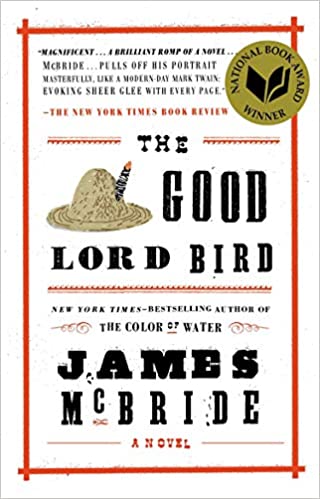
The series looks intriguing, but I confess to having passed on the book for a variety of reasons. The long one involves my three stacks method that has developed from having reading as a integral part of my job and as a hobby. Stack One includes all books for research. Actually, Stack One is more like a fort made out of books. Books for class or for prize committees make up Stack Two, which is more like a complex. Some overlap occurs between One and Two, but the majority of classes that I teach are world civilizations and therefore fall very far outside Stack One.
Then, Stack Three, fun books. Fiction, preferably with no relation to work. I won't even pretend to be literary or intellectual here. That's the rest of the day. I love me some historical fiction, but it absolutely CANNOT be about the antebellum U.S. unless aliens or time travelers appear or something occurs that places the story into the realm of magical realism or fantasy or science fiction. I get too picky. So, Underground Railroad by Colson Whitehead, yes. Invention of Wings by Sue Monk Kidd, no. Octavia Butler, yes. Jennifer Chiaverini, no. I just know too much about the era and become far too critical.
So, Good Lord Bird by James McBride would not have been on my list for that reason. Then, my husband read it out of curiosity. We have oddly different places where we forgive artistic license. He said, "absolutely not!" to Underground Railroad when he heard that it involved an actual railroad underground. I said, "this could be interesting," and was wholly rewarded. Good Lord Bird sounded interesting to him, but his tales of a fat, drunk, womanizing Douglass, not made any better by interviews with the author? Well, them's fightin' words! Also, life's too short and there are too many other books to waste time on something that will piss me off when I just want to escape.

Still, Daveed Diggs as Douglass, and the clips of him in this trailer. Also, Ethan Hawke not annoying me. Now, they have my interest. Dammit. I'm going to have to read the book. Of course, we don't have Showtime, so it will be next year or the year after before I see the series. Kind of like being the last historian in my field to see Hamilton.
Saving the best for last, young descendants of Frederick Douglass read his "What to the American Slave is Your Fourth of July," delivered in Rochester, at the invitation of the Rochester Ladies Antislavery Society, on the Fifth of July 1852.
Beautiful!

While research at the Beinecke won't be the same as sitting in the dining room of his beautiful Savannah townhome and talking of your research with him at the end of the day over a glass of wine, all while surrounded by the art of such luminaries as Jacob Lawrence and Edmonia Lewis, it will do. Certainly more people will have access, with less intrusion upon Dr. Evans and his wife. Much gratitude to him, David Blight, and everyone involved in this deal. My condolences to the other repositories that wanted the collection.

(Oh, and when you read the article, click on some of the links. That's the closest that me or my work will ever get to being in the New York Times, and I'll take it! Thank you to Dr. Evans, David, or the reporter, whoever took notice. Score for us Nobodies from Nowhere teaching at Places You Never Heard Of! My gratitude to Evans, Blight, and Stan Deaton of the Georgia Historical Society, who provided the introduction to Dr. Evans and access to the collection ten -- jeez! Has it been ten? -- years ago. All three were important parts of the final project.)
>
Second fall more under Six Degrees of Frederick Douglass. Thanks to my husband's daughter's Disney Plus account, we were finally able to see Hamilton. We actually had the opportunity when the tickets were expensive, but not prohibitively so, and before it hit big. (I thought I would just be another Bloody, Bloody Andrew Jackson -- who knew!) We chose instead to see a play downtown based on Marcus Rediker's Slave Ship. Four tickets for it cost as much as one for Hamilton, at the time. The paly was intense, and we sat practically on the stage in the front row; but good thing we don't invest in the stock market.
Anyway, Hamilton is a brilliant piece of musical theater. It's only flaws have to do with its source material and Lin Manuel Miranda's emphases that downplay the historical Hamilton's considerable warts (owned slaves, anti-immigrant despite his own background, elitism, monarchical tendencies, even the crack of dawn not save around him....). Still, I'd wholly recommend just for the genius of the lyrical and musical motifs alone, and the color blind casting never lets you forget that the men portrayed as fighting for freedom did not really mean freedom for the people who are right now playing them.
The Frederick Douglass part?
Can we all pause for a moment and praise the brilliant talent that is Leslie Odom Jr.? What a Triple Threat! He played Aaron Burr (sir). Where have you also seen him? Playing William Still in the film Harriet. You don't have to go too far to connect Still and Douglass, of course.

Even better: the actor playing the Lafayette/Jefferson role, Daveed Diggs, the one with the fabulous hair who rivets attention in every scene?:

>
You see him at the one minute mark. How many actors can say that they played both Thomas Jefferson and Frederick Douglass?
The series looks intriguing, but I confess to having passed on the book for a variety of reasons. The long one involves my three stacks method that has developed from having reading as a integral part of my job and as a hobby. Stack One includes all books for research. Actually, Stack One is more like a fort made out of books. Books for class or for prize committees make up Stack Two, which is more like a complex. Some overlap occurs between One and Two, but the majority of classes that I teach are world civilizations and therefore fall very far outside Stack One.
Then, Stack Three, fun books. Fiction, preferably with no relation to work. I won't even pretend to be literary or intellectual here. That's the rest of the day. I love me some historical fiction, but it absolutely CANNOT be about the antebellum U.S. unless aliens or time travelers appear or something occurs that places the story into the realm of magical realism or fantasy or science fiction. I get too picky. So, Underground Railroad by Colson Whitehead, yes. Invention of Wings by Sue Monk Kidd, no. Octavia Butler, yes. Jennifer Chiaverini, no. I just know too much about the era and become far too critical.
So, Good Lord Bird by James McBride would not have been on my list for that reason. Then, my husband read it out of curiosity. We have oddly different places where we forgive artistic license. He said, "absolutely not!" to Underground Railroad when he heard that it involved an actual railroad underground. I said, "this could be interesting," and was wholly rewarded. Good Lord Bird sounded interesting to him, but his tales of a fat, drunk, womanizing Douglass, not made any better by interviews with the author? Well, them's fightin' words! Also, life's too short and there are too many other books to waste time on something that will piss me off when I just want to escape.

Still, Daveed Diggs as Douglass, and the clips of him in this trailer. Also, Ethan Hawke not annoying me. Now, they have my interest. Dammit. I'm going to have to read the book. Of course, we don't have Showtime, so it will be next year or the year after before I see the series. Kind of like being the last historian in my field to see Hamilton.
Saving the best for last, young descendants of Frederick Douglass read his "What to the American Slave is Your Fourth of July," delivered in Rochester, at the invitation of the Rochester Ladies Antislavery Society, on the Fifth of July 1852.
Beautiful!
Friday, July 3, 2020
Madison Hemings: "Sucn is the story that comes down to me"
As I said last time, in my research I have developed an affection and respect for Madison Hemings. Yes, I know we are supposed to be objective and all, but we are all human and when another human speaks across time, we respond to that. His descendant, Shay Banks-Young explains better these reasons in her interview for Monticello's "Getting Word" project here:
Banks-Young says it. Madison was the man who made sure that his parentage and the story of Sally Hemings and Thomas Jefferson entered the record, and he was the only one of their four children who survived to adulthood to stay on the African American side of the color line. I use "African American" deliberately here.
So let's start at the beginning for this post. He told what he knew in an interview to the Pike County Republican (Ohio) in 1873. In Thomas Jefferson and Sally Hemings: An American Controversy, Annette Gordon-Reed traced the connection between the reporter who interviewed Madison (I don't mean to be disrespectful here, but a lot of Hemingses are going to enter the story, so using their first names will maintain clarity) and the census taker back in 1870 who noted "this man is the son of Thomas Jefferson."

Pretty cool, eh? 1870, understand, was long after the whole Callender controversy that sprung the Hemings-Jefferson story on the public had passed out of living memory, merely a footnote of a Federalist smear campaign in Jefferson biographies, and after it had been a tool of abolitionist propaganda in the antebellum era.
For your 6 Degrees of Frederick Douglass: The most significant example of the latter being William Wells Brown's Clotel; or, the President's Daughter. William Wells Brown knew Frederick Douglass, and once Rosetta was mistaken for Brown's wayward daughter.
Back to Madison Hemings. From the way he begins his account, the reporter seems to have asked him about the origin of his last name. The whole first paragraph then goes on to tell the audience "the story that comes down to me." Hemings -- no first name -- captained a ship that sailed between Virginia and England. He fathered Madison's grandmother, Elizabeth, with Madison's great-grandmother, "a full-blooded African, possibly a native of that country." The Captain was not the African's master, but he wanted to purchase his daughter from their master. The master would not sell. The Captain planned to kidnap her. Other enslaved people told the master, who moved mother and child into the house. The Captain then set off, disappearing from the colony and the known record -- although he may appear as a needle in some haystack of ship's logs or customs records somewhere in England. He is not, I can tell you, in the Transatlantic Slave Trade Database. The reason that the master would not sell Elizabeth, depsite the Captain offering what Madison described as "an extraordinarily high price"? He wanted to observe the ways a mixed race child would develop. Essentially, she was a science experiment to him.
So much in this one paragraph! Where to begin? First of all, the way people tell their family histories emphasizes the points that they consider important, and sheds the details that they consider less important. Sometimes, the vagaries of memory lose or change details, which itself can indicate emphases. Madison, in 1873, tells of events that his mother Sally remembered from what her mother Elizabeth remembered. Given that Elizabeth was an infant when these incidents happened, then she was told these events herself. The action of this part of the Hemingses' history took place just after 1735, the year Elizabeth was born. So, we have a 138 years gap. That's not to cast doubt on the story. That's to express amazement that the story lasted so long and to help explain the emphases and any details that don't bear out in the record.
For instance, Madison names the master as Wayles, who he says was Welsh, and he places much of the action in Williamsburg. In The Hemingses of Monticello, Annette Gordon-Reed, who was the first person (perhaps the only person) to deeply investigate the Hemings ancestry, found that Wayles did not claim Elizabeth Hemings until she was eleven and came to his estate as part of his wife Martha Eppes's dowry. Until then, Francis Eppes III owned her and, therefore, her African mother.
Gordon-Reed also surmised that Elizabeth's African mother may have been named -- by Eppes, of course, not her own mother back in Africa -- Parthenia or Sarah. No knowing for sure, she admitted, even less sure than most educated guesses, but still a better idea of what might be in that blank space in our knowing that the African woman occupies.
The Eppeses had a plantation at Bermuda Hundred. Maybe you've never heard of it, or it echoes as something you think you should have heard of somewhere. That was my feeling, anyway, so I looked it up. Bermuda Hundred was a town located far upriver from Jamestown, much closer to Richmond. Madison kept calling Williamsburg the port. Williamsburg itself had a port at the time, but it lay on the York River. In its earlier history, Bermuda Hundred served as the site of John Rolfe's experimentations in tobacco, his life with Pocahontas, and his death around the time that his uncle-in-law Opechancanough led a war against English settlement. Later, General U.S. Grant could see is location from his headquarters across the river in the war to end slavery. Today, few people know about it and think primarily of Jamestown or Williamsburg when thinking of colonial Virginia.
In the 1730s, however, Bermuda Hundred served as the main port on the Upper James River for the exchange of tobacco and slaves for the plantations in the Piedmont of Virginia. Plantations like Tuckahoe and Shadwell and the Forest and Guinea (later Hors du Monde) and Eppington and Monticello -- all associated with Thomas Jefferson and his extended family. That Transatlantic Slave Trade Database shows voyages directly from Africa beginning in the 1730s and escalating in the 1760s, some with a hundred or more captives on board (and more at the bottom of the ocean).
If Elizabeth's mother came directly from African, which Ira Berlin says a majority of enslaved people did in the Piedmont in the 1730, she could just as likely arrived at Bermuda Hundred as the Williamsburg port. More, perhaps, since the Eppeses' plantations lay next door and further away from Williamsburg. By the time, Madison or his mother would be telling the history, however, Bermuda Hundred would not sound right to them because the port had declined and disappeared.
I'm caught in trivialities, here. Madison's story raises some unanswerable questions. First of all, the African who became Elizabeth Hemings's mother, the importance of her appearance, and the cipher of her seeming dismissal. Second, the "amalgamation" experiment conducted by Wayles in this telling and the way it seems so, well, Jeffersonian. Also, the way that Wayles seems cold and calculating, with Madison expressing little connection to him as a grandfather other than as a matter of ancestry, less than to the Captain. So, I think I'll stop here and cover these in separate posts.
Banks-Young says it. Madison was the man who made sure that his parentage and the story of Sally Hemings and Thomas Jefferson entered the record, and he was the only one of their four children who survived to adulthood to stay on the African American side of the color line. I use "African American" deliberately here.
So let's start at the beginning for this post. He told what he knew in an interview to the Pike County Republican (Ohio) in 1873. In Thomas Jefferson and Sally Hemings: An American Controversy, Annette Gordon-Reed traced the connection between the reporter who interviewed Madison (I don't mean to be disrespectful here, but a lot of Hemingses are going to enter the story, so using their first names will maintain clarity) and the census taker back in 1870 who noted "this man is the son of Thomas Jefferson."

Pretty cool, eh? 1870, understand, was long after the whole Callender controversy that sprung the Hemings-Jefferson story on the public had passed out of living memory, merely a footnote of a Federalist smear campaign in Jefferson biographies, and after it had been a tool of abolitionist propaganda in the antebellum era.
For your 6 Degrees of Frederick Douglass: The most significant example of the latter being William Wells Brown's Clotel; or, the President's Daughter. William Wells Brown knew Frederick Douglass, and once Rosetta was mistaken for Brown's wayward daughter.
Back to Madison Hemings. From the way he begins his account, the reporter seems to have asked him about the origin of his last name. The whole first paragraph then goes on to tell the audience "the story that comes down to me." Hemings -- no first name -- captained a ship that sailed between Virginia and England. He fathered Madison's grandmother, Elizabeth, with Madison's great-grandmother, "a full-blooded African, possibly a native of that country." The Captain was not the African's master, but he wanted to purchase his daughter from their master. The master would not sell. The Captain planned to kidnap her. Other enslaved people told the master, who moved mother and child into the house. The Captain then set off, disappearing from the colony and the known record -- although he may appear as a needle in some haystack of ship's logs or customs records somewhere in England. He is not, I can tell you, in the Transatlantic Slave Trade Database. The reason that the master would not sell Elizabeth, depsite the Captain offering what Madison described as "an extraordinarily high price"? He wanted to observe the ways a mixed race child would develop. Essentially, she was a science experiment to him.
So much in this one paragraph! Where to begin? First of all, the way people tell their family histories emphasizes the points that they consider important, and sheds the details that they consider less important. Sometimes, the vagaries of memory lose or change details, which itself can indicate emphases. Madison, in 1873, tells of events that his mother Sally remembered from what her mother Elizabeth remembered. Given that Elizabeth was an infant when these incidents happened, then she was told these events herself. The action of this part of the Hemingses' history took place just after 1735, the year Elizabeth was born. So, we have a 138 years gap. That's not to cast doubt on the story. That's to express amazement that the story lasted so long and to help explain the emphases and any details that don't bear out in the record.
For instance, Madison names the master as Wayles, who he says was Welsh, and he places much of the action in Williamsburg. In The Hemingses of Monticello, Annette Gordon-Reed, who was the first person (perhaps the only person) to deeply investigate the Hemings ancestry, found that Wayles did not claim Elizabeth Hemings until she was eleven and came to his estate as part of his wife Martha Eppes's dowry. Until then, Francis Eppes III owned her and, therefore, her African mother.
Gordon-Reed also surmised that Elizabeth's African mother may have been named -- by Eppes, of course, not her own mother back in Africa -- Parthenia or Sarah. No knowing for sure, she admitted, even less sure than most educated guesses, but still a better idea of what might be in that blank space in our knowing that the African woman occupies.
The Eppeses had a plantation at Bermuda Hundred. Maybe you've never heard of it, or it echoes as something you think you should have heard of somewhere. That was my feeling, anyway, so I looked it up. Bermuda Hundred was a town located far upriver from Jamestown, much closer to Richmond. Madison kept calling Williamsburg the port. Williamsburg itself had a port at the time, but it lay on the York River. In its earlier history, Bermuda Hundred served as the site of John Rolfe's experimentations in tobacco, his life with Pocahontas, and his death around the time that his uncle-in-law Opechancanough led a war against English settlement. Later, General U.S. Grant could see is location from his headquarters across the river in the war to end slavery. Today, few people know about it and think primarily of Jamestown or Williamsburg when thinking of colonial Virginia.
 |
| Source: https://www.encyclopediavirginia.org/media_player?mets_filename=evr5090mets.xml |
In the 1730s, however, Bermuda Hundred served as the main port on the Upper James River for the exchange of tobacco and slaves for the plantations in the Piedmont of Virginia. Plantations like Tuckahoe and Shadwell and the Forest and Guinea (later Hors du Monde) and Eppington and Monticello -- all associated with Thomas Jefferson and his extended family. That Transatlantic Slave Trade Database shows voyages directly from Africa beginning in the 1730s and escalating in the 1760s, some with a hundred or more captives on board (and more at the bottom of the ocean).
If Elizabeth's mother came directly from African, which Ira Berlin says a majority of enslaved people did in the Piedmont in the 1730, she could just as likely arrived at Bermuda Hundred as the Williamsburg port. More, perhaps, since the Eppeses' plantations lay next door and further away from Williamsburg. By the time, Madison or his mother would be telling the history, however, Bermuda Hundred would not sound right to them because the port had declined and disappeared.
I'm caught in trivialities, here. Madison's story raises some unanswerable questions. First of all, the African who became Elizabeth Hemings's mother, the importance of her appearance, and the cipher of her seeming dismissal. Second, the "amalgamation" experiment conducted by Wayles in this telling and the way it seems so, well, Jeffersonian. Also, the way that Wayles seems cold and calculating, with Madison expressing little connection to him as a grandfather other than as a matter of ancestry, less than to the Captain. So, I think I'll stop here and cover these in separate posts.
Thursday, July 2, 2020
New Project
It's been a while, hasn't it? But, then, it usually is, once the serious writing for Women in the World of Frederick Douglass got underway, and then the book was published, and then the talks. I had two other ideas for books, one of which overwhelmed the other. Then, my dad died, which kind of blew a hole in my world and I lost interest in everything. That became a whole other story; and just as I was finding my balance, other things came up like teaching online, and pay cuts, and schools closing, and no retirement, and layoffs, and this ongoing disaster from which the world may not recover for decades, if ever.
Meanwhile, in the midst of that dark winter in which I felt nothing but loss, the marvelous Carol Berkin, who edits the series Lives of American Women found herself without an author for a book. Would I be interested? I had to think about it because, boy, it was tempting, but, boy, was I not sure that I could do it. Still, I told my mom about. The topic is one that interests her. Indeed, she was way ahead of the curve on the subject when I was not, back in the 1980s and early 1990s. (People can grow! Indeed, she showed me that, too.) My mom's response? "Do it!!!!!" Already, my mind had taken off in arranging the proposal, and her nudge -- the idea that I would do it for her -- pushed me into saying "yes."
The contract was offered to me on my birthday last year. Then the NEH awarded the project a research grant, which will be wonderful to use if the research facilities that I need to visit open again -- ever.
In addition to my mom, I have another audience in mind. The semester before Carol contacted me, I had spoken of the subject at some length to my U.S. History survey class, one in which half of the students were women, only two of whom were white. All of them wanted more. When I directed them to the key books, they took a look at the length and said, "is there anything shorter?" They only have so much time, they weren't sure if they wanted that much of a commitment. I get that. I thought, "someone needs to write a short introductory book on this woman." One that piques the readers' curiosity and directs them toward the longer, deeper work. Who knew it would be me?
So, this book will be for those women in my class and for my mom. They are my audience.
Who is the woman? Sally Hemings.
Yes! I am off of my rocker thinking I can do this! As one person, who is a Jefferson scholar, said, "why would you waste your time on a subject on which everything has been said?"
Well, I don't really have anything new to say at this point that will change the face of the scholarship. This is going to be synthetic and brief. This is for undergraduates and, again, people not sure if they are ready for the commitment of all of the other work on Hemings -- my particular favorite being The Hemingses of Monticello. (I cannot love that book hard enough! Annette Gordon-Reed shows her work. Every time I have a question -- boom!-- she answers it in the next paragraph or on the next page.)
I also want to introduce this beginner audience to the craft of historians, and I want to use her life as a way to address the big events and changes happening in her time, some which she witnessed and some which affected her indirectly. This book should be one that a teacher can assign to a survey just like the one almost every college student must take, and cover a period of time from a different perspective than the Great White Menz.
As I research this book this summer, thinking in particular about the thorny issues of Hemings' race and perceptions of what happened between herself and Jefferson, I watch Black Lives Matter overwhelm the news and force deep questions about the origins and depth of American racism into the streets in a way surpassing any other up to this point. Intersectional, interracial, intergender, inter-everything! Finally, Confederate statues that should have never been raised, topple! It is all exciting and frightening and necessary and a long long long time coming.
How does Hemings fit into this, not as a heroine, but as a woman with very limited power trying to get her family, her children, over to freedom and a better life? I know right where Jefferson fits. Yes, he was a slaveholder, but more than that. The better angels of his logic knew that slavery was unjust. At the same time, emancipation would cost him quite a bit, not the least of which was his lovely, luxurious life pursuing every curiosity. He is white people: "I'm for something just until it costs me something, and then I rationalize the reasons that 'too far' is the point where it costs me something." That is the question so many of we white people must ask.
Hemings's story is not a flip side of that precisely. Hers is more complicated because she sits on a line between slavery and freedom, black and white, exploitation and agency. She offered her children some interesting choices, too. In those choices, race become the dominant issue beyond freedom and slavery. The problem lies in that they had to make a choice and -- here's my 6 Degrees of Frederick Douglass -- one that Douglass addressed toward the end of his life with his interest in "amalgamation."
The guy I love most, I think, in this story, is Madison Hemings, the son who chose blackness while all of his siblings chose whiteness. He's the one who gave the world the "African" who was his great-grandmother, and the one sentence from the mouth of Elizabeth Hemings who was his grandmother, and witnessed the story of Sally Hemings his mother and Thomas Jefferson his father. I'm curious about Eston, and the way that his paternity and, more importantly, his maternity, passed through his descendants (Monticello has oral histories that I have yet to explore); but Madison, he seems to know who he was and perhaps he should be the next post.
Meanwhile, in the midst of that dark winter in which I felt nothing but loss, the marvelous Carol Berkin, who edits the series Lives of American Women found herself without an author for a book. Would I be interested? I had to think about it because, boy, it was tempting, but, boy, was I not sure that I could do it. Still, I told my mom about. The topic is one that interests her. Indeed, she was way ahead of the curve on the subject when I was not, back in the 1980s and early 1990s. (People can grow! Indeed, she showed me that, too.) My mom's response? "Do it!!!!!" Already, my mind had taken off in arranging the proposal, and her nudge -- the idea that I would do it for her -- pushed me into saying "yes."
The contract was offered to me on my birthday last year. Then the NEH awarded the project a research grant, which will be wonderful to use if the research facilities that I need to visit open again -- ever.
In addition to my mom, I have another audience in mind. The semester before Carol contacted me, I had spoken of the subject at some length to my U.S. History survey class, one in which half of the students were women, only two of whom were white. All of them wanted more. When I directed them to the key books, they took a look at the length and said, "is there anything shorter?" They only have so much time, they weren't sure if they wanted that much of a commitment. I get that. I thought, "someone needs to write a short introductory book on this woman." One that piques the readers' curiosity and directs them toward the longer, deeper work. Who knew it would be me?
So, this book will be for those women in my class and for my mom. They are my audience.
Who is the woman? Sally Hemings.
Yes! I am off of my rocker thinking I can do this! As one person, who is a Jefferson scholar, said, "why would you waste your time on a subject on which everything has been said?"
Well, I don't really have anything new to say at this point that will change the face of the scholarship. This is going to be synthetic and brief. This is for undergraduates and, again, people not sure if they are ready for the commitment of all of the other work on Hemings -- my particular favorite being The Hemingses of Monticello. (I cannot love that book hard enough! Annette Gordon-Reed shows her work. Every time I have a question -- boom!-- she answers it in the next paragraph or on the next page.)
I also want to introduce this beginner audience to the craft of historians, and I want to use her life as a way to address the big events and changes happening in her time, some which she witnessed and some which affected her indirectly. This book should be one that a teacher can assign to a survey just like the one almost every college student must take, and cover a period of time from a different perspective than the Great White Menz.
As I research this book this summer, thinking in particular about the thorny issues of Hemings' race and perceptions of what happened between herself and Jefferson, I watch Black Lives Matter overwhelm the news and force deep questions about the origins and depth of American racism into the streets in a way surpassing any other up to this point. Intersectional, interracial, intergender, inter-everything! Finally, Confederate statues that should have never been raised, topple! It is all exciting and frightening and necessary and a long long long time coming.
How does Hemings fit into this, not as a heroine, but as a woman with very limited power trying to get her family, her children, over to freedom and a better life? I know right where Jefferson fits. Yes, he was a slaveholder, but more than that. The better angels of his logic knew that slavery was unjust. At the same time, emancipation would cost him quite a bit, not the least of which was his lovely, luxurious life pursuing every curiosity. He is white people: "I'm for something just until it costs me something, and then I rationalize the reasons that 'too far' is the point where it costs me something." That is the question so many of we white people must ask.
Hemings's story is not a flip side of that precisely. Hers is more complicated because she sits on a line between slavery and freedom, black and white, exploitation and agency. She offered her children some interesting choices, too. In those choices, race become the dominant issue beyond freedom and slavery. The problem lies in that they had to make a choice and -- here's my 6 Degrees of Frederick Douglass -- one that Douglass addressed toward the end of his life with his interest in "amalgamation."
The guy I love most, I think, in this story, is Madison Hemings, the son who chose blackness while all of his siblings chose whiteness. He's the one who gave the world the "African" who was his great-grandmother, and the one sentence from the mouth of Elizabeth Hemings who was his grandmother, and witnessed the story of Sally Hemings his mother and Thomas Jefferson his father. I'm curious about Eston, and the way that his paternity and, more importantly, his maternity, passed through his descendants (Monticello has oral histories that I have yet to explore); but Madison, he seems to know who he was and perhaps he should be the next post.
Tuesday, July 30, 2019
Chittenango Landing Canal Boat Museum
After a lovely weekend in New York City talking to teachers about Douglass and women and the Civil War, and then a beautiful wedding of a former student in Washingtonville, I'm back home and preparing for this Thursday's talk.
If you are in Chittenango, birthplace of Wizard of Oz author of L Frank Baum who was also son-in-law of suffragist Matilda Joslyn Gage, who lived in my neighborhood, drop on by. My talk will be at the Chittenango Landing Canal Boat Museum on the old Erie Canal at 7:00 pm. A $5.00 donation is suggested for non-members of the museum. The subject will be "Frederick Douglass, Woman's Rights Man" and is part of their Woman Suffrage series. For more information on the talk and the museum, visit their website.
Oh, and contract for Sally Hemings: Given Her Time signed with a deadline of September 2021 (gulp!). Expect to be able to assign it to classes the following year. She may start encroaching on this blog, which would probably require renaming the whole thing. We'll see how that goes.
If you are in Chittenango, birthplace of Wizard of Oz author of L Frank Baum who was also son-in-law of suffragist Matilda Joslyn Gage, who lived in my neighborhood, drop on by. My talk will be at the Chittenango Landing Canal Boat Museum on the old Erie Canal at 7:00 pm. A $5.00 donation is suggested for non-members of the museum. The subject will be "Frederick Douglass, Woman's Rights Man" and is part of their Woman Suffrage series. For more information on the talk and the museum, visit their website.
 |
| For more information on "Frederick Douglass, Woman's Rights Man: Woman Suffrage Series" click here. |
Oh, and contract for Sally Hemings: Given Her Time signed with a deadline of September 2021 (gulp!). Expect to be able to assign it to classes the following year. She may start encroaching on this blog, which would probably require renaming the whole thing. We'll see how that goes.
Monday, July 22, 2019
Magic!
Y'all! Look what happened!
Henry McCartney of the Friends of Mt. Hope Cemetery and a fan of Douglass and the women in his life brought his book club to Syracuse so we could discuss Women in the World of Frederick Douglass last spring. We had such a wonderful evening chatting about Frederick and Anna and Helen and all of the others. Everyone thought the book would make a great movie or even a musical like Hamilton. So Henry decided to send a volume to Lin-Manuel Miranda. I mean, what the heck! That was one of the coolest things anyone has ever done for it.
Low and behold, Miranda wrote a thank you note back. Sure, he gets a million fan letters a minute, probably. Sure, an assistant probably composed it. Sure, my gender was switched. Still: Lin-Manuel Miranda has a copy of my book!
Not that him having it is any more important than when a teacher or someone at a talk or someone chatting with me learns about it and runs into the bookstore to buy it or someone contacts me because they came across a blog post in a bit of serendipity. Those are all equally fantastic in their own ways. They make the book something beyond me. I loved researching it, writing it, having it published, being recognized as having written it, being an expert on it, and all of that. Still, when someone comes to you and says that the book spoke to them and that they appreciated a particular point that it made or a depiction of a person (Anna has become quite beloved), then a circle has closed. Some final missing touch has brought the whole endeavor into a life of its own, like fairy dust. Magic!
There is another type of magic, too, like this weekend at the Society for Historians of the Early American Republic meeting (start putting together panel proposals for next year -- CFP up soon!). I was just chair of a panel of some fabulous young scholars on abolition, not presenting a paper, and I was on a committee to award the Mary Kelley Book Prize (the same one that I won last year), which went to Nora Doyle's incredible Maternal Bodies: Redefining Motherhood in Early America, her first book. Nancy Hewitt, by the way, won the biography prize for her much anticipated and worth-the-wait Radical Friend: Amy Kirby Post and Her Activist Worlds. I was also catching up with two old friends whom I hadn't seen in ages. Conferences can be like that. Being, now, at a point in my career where I'm helping to award prizes to scholars earlier in their careers and presiding over their panels, and seeing the thoughtful and creative directions their thinking has taken the study of this period makes me realize that there are many parts to this circle, and many circles.
I also had a couple of encounters with people whose work has influenced my own and they said that Women in the World of Frederick Douglass gave them a new and different insight into Douglass, that it changed the way they thought about him. Again, that's another circle closed in another arena. More, powerful magic!
Knowing that Lin-Manuel Miranda or Joyce Carol Oates or old school, Second Wave feminist Robin Morgan or some other celebrity has read -- or is at least aware of -- my book is rather fun and sparkly. Still, whoever put the book into their hands, like Henry, they are part of creating that magic, or making the book into a Real Live Person. You see, they aren't just doing something for me -- I'm happy, don't get me wrong there! -- but they see something in the book, in the ideas and the story about Douglass and especially about the women, and they want to pass it along to others.
They want their students to know about it, and they want someone who has access to a larger audience to know about it. That's the way knowledge spreads and the public becomes educated. That's really the whole point, isn't it? To create a virtuous, thinking citizenry fighting the forces of ignorance. That's the reason people write books or create art or teach in whatever sphere or engage in these regenerative act: to slake their curiosity and help others satisfy their and know more in the process about the world and the way it works.
The feedback lets you know that you aren't just sounding your barbaric yawp into the wilderness.
Back to Lin-Manuel Miranda. This missive to Henry and from Henry to me came at an auspicious moment: my birthday, which is tomorrow. Also for my birthday, an impending book contract for a classroom-use volume on the life and historiography of -- get this! -- Sally Hemings. I write this not as an expert on Hemings or Jefferson. That title I leave to the formidable Annette Gordon-Reed, to whom I bow down, and others such as John Kukla, Virgina Scharff, Cynthia Kierner, Catherine Kerrison, and Andew Burstein, among so many others. Instead, I write this as a teacher, introducing Hemings and the arguments surrounding her life and times to my students. It will be a short book of maybe two hundred pages text, and is exactly the type of book I wished that I had last fall when talking about this subject to my students who wanted to read about Hemings but took one look a the length of Hemingses of Monticello and said, "is there anything shorter?" (They would have LOVED Hemingses of Monticello, by the way; but still, you have to compete for their time.)
So, in closing, let's bring these two research projects together with this little musical jam that perhaps comes close to a hip-hop musical of Douglass: Epic Rap Battles of History, Thomas Jefferson vs Frederick Douglass.:
 |
Henry --
Thank you kindly for your sweet and
thoughtful gift. Your support of
"Hamilton" means the world. I look
forward to dive into Mr. Fought's
"Women in the World of Frederick
Douglass." Here's wishing you all
the best.
Siempre,
Lin-M----
|
Henry McCartney of the Friends of Mt. Hope Cemetery and a fan of Douglass and the women in his life brought his book club to Syracuse so we could discuss Women in the World of Frederick Douglass last spring. We had such a wonderful evening chatting about Frederick and Anna and Helen and all of the others. Everyone thought the book would make a great movie or even a musical like Hamilton. So Henry decided to send a volume to Lin-Manuel Miranda. I mean, what the heck! That was one of the coolest things anyone has ever done for it.
Low and behold, Miranda wrote a thank you note back. Sure, he gets a million fan letters a minute, probably. Sure, an assistant probably composed it. Sure, my gender was switched. Still: Lin-Manuel Miranda has a copy of my book!
Not that him having it is any more important than when a teacher or someone at a talk or someone chatting with me learns about it and runs into the bookstore to buy it or someone contacts me because they came across a blog post in a bit of serendipity. Those are all equally fantastic in their own ways. They make the book something beyond me. I loved researching it, writing it, having it published, being recognized as having written it, being an expert on it, and all of that. Still, when someone comes to you and says that the book spoke to them and that they appreciated a particular point that it made or a depiction of a person (Anna has become quite beloved), then a circle has closed. Some final missing touch has brought the whole endeavor into a life of its own, like fairy dust. Magic!
There is another type of magic, too, like this weekend at the Society for Historians of the Early American Republic meeting (start putting together panel proposals for next year -- CFP up soon!). I was just chair of a panel of some fabulous young scholars on abolition, not presenting a paper, and I was on a committee to award the Mary Kelley Book Prize (the same one that I won last year), which went to Nora Doyle's incredible Maternal Bodies: Redefining Motherhood in Early America, her first book. Nancy Hewitt, by the way, won the biography prize for her much anticipated and worth-the-wait Radical Friend: Amy Kirby Post and Her Activist Worlds. I was also catching up with two old friends whom I hadn't seen in ages. Conferences can be like that. Being, now, at a point in my career where I'm helping to award prizes to scholars earlier in their careers and presiding over their panels, and seeing the thoughtful and creative directions their thinking has taken the study of this period makes me realize that there are many parts to this circle, and many circles.
I also had a couple of encounters with people whose work has influenced my own and they said that Women in the World of Frederick Douglass gave them a new and different insight into Douglass, that it changed the way they thought about him. Again, that's another circle closed in another arena. More, powerful magic!
Knowing that Lin-Manuel Miranda or Joyce Carol Oates or old school, Second Wave feminist Robin Morgan or some other celebrity has read -- or is at least aware of -- my book is rather fun and sparkly. Still, whoever put the book into their hands, like Henry, they are part of creating that magic, or making the book into a Real Live Person. You see, they aren't just doing something for me -- I'm happy, don't get me wrong there! -- but they see something in the book, in the ideas and the story about Douglass and especially about the women, and they want to pass it along to others.
They want their students to know about it, and they want someone who has access to a larger audience to know about it. That's the way knowledge spreads and the public becomes educated. That's really the whole point, isn't it? To create a virtuous, thinking citizenry fighting the forces of ignorance. That's the reason people write books or create art or teach in whatever sphere or engage in these regenerative act: to slake their curiosity and help others satisfy their and know more in the process about the world and the way it works.
The feedback lets you know that you aren't just sounding your barbaric yawp into the wilderness.
Back to Lin-Manuel Miranda. This missive to Henry and from Henry to me came at an auspicious moment: my birthday, which is tomorrow. Also for my birthday, an impending book contract for a classroom-use volume on the life and historiography of -- get this! -- Sally Hemings. I write this not as an expert on Hemings or Jefferson. That title I leave to the formidable Annette Gordon-Reed, to whom I bow down, and others such as John Kukla, Virgina Scharff, Cynthia Kierner, Catherine Kerrison, and Andew Burstein, among so many others. Instead, I write this as a teacher, introducing Hemings and the arguments surrounding her life and times to my students. It will be a short book of maybe two hundred pages text, and is exactly the type of book I wished that I had last fall when talking about this subject to my students who wanted to read about Hemings but took one look a the length of Hemingses of Monticello and said, "is there anything shorter?" (They would have LOVED Hemingses of Monticello, by the way; but still, you have to compete for their time.)
So, in closing, let's bring these two research projects together with this little musical jam that perhaps comes close to a hip-hop musical of Douglass: Epic Rap Battles of History, Thomas Jefferson vs Frederick Douglass.:
Tuesday, July 16, 2019
WWFDD?
Douglass had been taken from his parents. His ancestors had been herded into cages, so was he. He and Anna Douglass broke the law to find a better life for themselves and their children. They defied the law to help people seek asylum in Canade. He searched for asylum himself. His family had been in the United States, then the British North American colony of Maryland, since the 1730s at least. Yet, in 1858, the Supreme Court ruled that he and his entire family were not Americans nor should they be. Whole organizations were devoted to deporting people like him to Africa. When the Constitution granted him citizenship and seemed to protect his right to vote -- it couldn't bar him from voting because of his color or his previous condition of servitude, to be specific -- the federal government did nothing to stop states from finding their ways around the intent of those amendments. He and Helen Douglass had become aware of convict lease by the end of his life. Ida B. Wells made sure they knew of the malpractice of the law-enforcement system against black men in the South.
His was a tune that many people would like to say sounds old-timey, nothing to do with today.
People have plenty of opinions about Douglass and today's politics, not all of them good and quite a number of them would not even qualify as "half-baked." (Reason number 5088 that I'm not on Twitter.) The problem with discussing Douglass and politics is that many people like to use him to advance their own agenda. Kind of like the Bible or the Constitution, depending on what passages you pull out, you can draft Douglass into any camp that you want.
Words and ideologies have contexts and a person's can change over the course of a lifetime. Not only that, but a person who is radical on one issue can be conservative on another. Douglass, for instance, was very much a radical anti-racist as an abolitionist while at the same time engaged in the politics of respectability, which you can't really classify as conservative or liberal according to our understanding of the terms today. Quite often he played with the contradictions.
Still, some things seem pretty clear. If you admire Frederick Douglass and what he did, but think that holding asylum-seekers in pens, separating them from their children, and telling naturalized or native-born women of color who, not incidentally, are representing their constituencies in Congress to leave the country is all fine, you might want to reexamine your reasons. Douglass isn't here to weigh in, but his life certainly gives us an idea.
His was a tune that many people would like to say sounds old-timey, nothing to do with today.
People have plenty of opinions about Douglass and today's politics, not all of them good and quite a number of them would not even qualify as "half-baked." (Reason number 5088 that I'm not on Twitter.) The problem with discussing Douglass and politics is that many people like to use him to advance their own agenda. Kind of like the Bible or the Constitution, depending on what passages you pull out, you can draft Douglass into any camp that you want.
Words and ideologies have contexts and a person's can change over the course of a lifetime. Not only that, but a person who is radical on one issue can be conservative on another. Douglass, for instance, was very much a radical anti-racist as an abolitionist while at the same time engaged in the politics of respectability, which you can't really classify as conservative or liberal according to our understanding of the terms today. Quite often he played with the contradictions.
Still, some things seem pretty clear. If you admire Frederick Douglass and what he did, but think that holding asylum-seekers in pens, separating them from their children, and telling naturalized or native-born women of color who, not incidentally, are representing their constituencies in Congress to leave the country is all fine, you might want to reexamine your reasons. Douglass isn't here to weigh in, but his life certainly gives us an idea.
Monday, 31 January [1887]: The National Archaelogical Museum of Naples
After an uneventful if mysteriously "strange sermon at the U.P. Church, on the greatness of man" on Sunday, the Douglasses met again with Eleanor Lewis and set off for the Museo Nazionale, now called the Museo Archeologico Nazionale or National Archaeological Museum. Then, as now, this is the museum to visit while in Naples, akin to the Uffizi in Florence; and the Baedeker of 1880 that the Douglasses carried with them referred to it as "The Museum" and gave a room-by-room description along with a map. Today, as then, Sundays are free. (Be aware of this that most museums in Italy are free on Sundays.)


While the museum has many exhibits, the main draw is and was the thing that Douglass mentioned: "A birds eye view of pictures, statuary and many objects of interest, taken from the ruins of Pompei and Herculanium."
The birds-eye view was actually a model, made in the 1850s, of the archeological digs as they stood at that time. The meticulous care with which the model-makers reproduced the mosaics and, more importantly, the frescoes on the walls, have served as some of the only records of those images because years -- centuries, now -- of exposure have caused them to deteriorate. Burial preserved the site, excavation restarted the processes of age.


Because of those processes, most of the artifacts and art were removed from the sites of the two cities and into this museum. (There's a longer history to that, but you can refer to Mary Beard's engaging work for more on the subject.) "The perfection of some of these in form and color and utility was remarkable considering their antiquity," Douglass commented in his diary. "In some respects they transcended modern art."
He was not wrong. I'm not sure what pieces he may have seen, but here are some samples.
There was one room that Douglass probably did not visit, and they did have it in those days because the Baedeker mentions it. You see, the Romans were earthy people, not as uptight about sexuality or nudity as later generations, and certainly not as constricted as those in the nineteenth century. The were, after all, people who considered enormous male genitalia to be good luck symbols. The founders of the museum in the eighteenth century already began to realize that certain people, especially ladies, did not have the sensibility for some of the artifacts. So, they took the most obvious ones and put them in a "Secret Room" or "Reserved Cabinet," "Raccolta Pornografica" in Italian, according to Baedeker, "to which men only are admitted." The Baedeker describes it as containing "mural and other paintings not adapted for public exhibition, and numerous bronzes, some of them of considerable artistic merit." (That sounds very much like the descriptions of Playboy that praise it for the articles.) They let women in these days and, let me tell you, the Romans were all about the dick. It was quite tedious.
Today, the room lies beyond the mosaics, near the one depicting Alexander and Darius. In the 1880s, according to the Baedeker, this room lay next to one in which gold and silver object, including jewelry, and cameos were on display. That is, things that ladies would have liked to have seen.
Douglass was there with ladies and he himself was no libertine, especially given his reaction to meeting Victoria Woodhull a couple of months later when they returned to Rome. He and they probably averted their eyes from this Racolta.
As for the rest of the collections, he concluded, "The musium is something to be seen not once but many times in order to comprehend its many attractions[.]" Certainly going to it before and after seeing the two sites would make the visit deeper and richer than a Sunday afternoon.
-------------------------------------


While the museum has many exhibits, the main draw is and was the thing that Douglass mentioned: "A birds eye view of pictures, statuary and many objects of interest, taken from the ruins of Pompei and Herculanium."
The birds-eye view was actually a model, made in the 1850s, of the archeological digs as they stood at that time. The meticulous care with which the model-makers reproduced the mosaics and, more importantly, the frescoes on the walls, have served as some of the only records of those images because years -- centuries, now -- of exposure have caused them to deteriorate. Burial preserved the site, excavation restarted the processes of age.


Because of those processes, most of the artifacts and art were removed from the sites of the two cities and into this museum. (There's a longer history to that, but you can refer to Mary Beard's engaging work for more on the subject.) "The perfection of some of these in form and color and utility was remarkable considering their antiquity," Douglass commented in his diary. "In some respects they transcended modern art."
He was not wrong. I'm not sure what pieces he may have seen, but here are some samples.
 |
| The expression on the donkey's face! |
 |
Evidence of writing.
Also, note the head scarf, continuing Douglass's observations from the train.
|
 |
| This is a famous picture, so seeing it is like seeing a celebrity. More than that, taken with the image above, you get a sense of the range of phenotypes, or skin color and hair textures -- the markers of what we call "race" today -- that existed in the Roman Empire. This piqued Douglass's curiosity as he travelled southward through Europe. |
 |
| Medusa. |
 |
| A miniature skeleton. |
 |
| A miniature Isis Fortuna |
 |
| A massive Hercules. The copy in the background is modern, as in the past decade. An artist did this big performance thing in which he made replicas of various artifacts from Pompeii and blew them up with various colored gunpowder at the Pompeii amphitheater. He had some blah-blah-blah-dialogue-with-the-past artist statement, but, really, I think he just wanted to blow shit up. |
 |
| A sample of a glass bottle still containing the remnants of oil. |
 |
| A sample of a glass bottle melted by Vesuvius's heat. |
 |
| Medusa. |
 |
| Another celebrity siting. This is in every World Civilizations textbook I've seen. It is a mosaic that covered a floor in a Pompeiian villa and supposedly depicts Alexander the Great defeating the Persian king Darius. |
 |
| Darius in mosaic.The detail and expression are amazing, rendered in tiny flecks of stone. |
 |
| Alexander the Great in mosaic. Even the horse has an expression. |
 |
| More reminders of mortality. |
 |
| Medusa. |
 |
| From the base of a mosaic column. Those are actual shells. |
 |
| Detail on a column. |
 |
| The room is now called the Secret Room, "Gabinetto Segretto." |
 |
| The equivalent of lawn ornaments. |
 |
| This was carved into the side of a building. |
Douglass was there with ladies and he himself was no libertine, especially given his reaction to meeting Victoria Woodhull a couple of months later when they returned to Rome. He and they probably averted their eyes from this Racolta.
As for the rest of the collections, he concluded, "The musium is something to be seen not once but many times in order to comprehend its many attractions[.]" Certainly going to it before and after seeing the two sites would make the visit deeper and richer than a Sunday afternoon.
-------------------------------------
Sources:
- Karl Baedeker Firm. Italy. Handbook for Travelers, Third Part: Southern Italy and Sicily (7th, ed.; London: Dulac and Co, 1880).
- Frederick Douglass, Travel Diary, Frederick Douglass Papers, Library of Congress.
Subscribe to:
Posts (Atom)