Back in December, I dashed off this post about a series of photos of Rosetta Douglass, Anna Douglass, and Amy Post, all of which included the same chair. The chair suggested that the photos all came from the same studio. Based on a letter from Amy Post to her husband, Isaac, and the presumed dates of all photos, I speculated that the photographer was John W. Hurn. I also, for some reason -- I think it was a misreading or confused reading of Picturing Frederick Douglass or simply and unquestioned assumption -- that Hurn was African American.
That post turned out to be rather popular, relatively speaking (as in, more than three people read it).
First, Judith Wellman, who does meticulous work into Seneca Falls, the Underground Railroad, and the multiple local and regional networks of activists in New York State; and two other Rochester historians, Charles Lenhart and Hal Shuler (who has sent me all sorts of wonderful tidbits and documents that he has discovered in his own research into Douglass in Rochester), all noted that John W. Hurn was not just a Philadelphia photographer, telegraph operator, and aid to Frederick Douglass in the aftermath of the Harpers Ferry raid. Hurn had formerly lived in Rochester, where he edited the Rochester Evening News and had married into the Anthony family. That would be the Anthony family of Susan B.
Then, Autumn Haag, Special Collections Librarian and Archivist for Research and Collections in the Rare Books, Special Collections, and Preservation Department at the University of Rochester (and with whom I had a wonderful conversation back in April when I visited there), received a research request about the pictures. Having access to the physical item of the Post image, she simply looked at the back and found that the photographer was not Hurn, but was "Powelson, Photographer, 58 State St., Rochester, NY." Then, she went on a search for other Powelson photographs and -- lo! and behold! -- found the chair as a featured prop.
My favorite is the one of Olive Oatman, who had been captured in Arizona by the Yavapai then later adopted by the Mohave and bore their distinctive tattoo on her chin.:
(I remember reading a YA novel about her back in seventh grade, and being thrilled, decades later, to discover that she was a real person.) How many times have I seen that picture in the past year alone and not made the connection? Alas, the perils of dashing off a blog post with minimal diligence!
This now makes me curious about Oatman in Rochester. There must be another story there.
Let this be a lesson for my students when they venture to cite such posts, or when they venture to cite a single source. You must always take the advice of Ben Bradlee (as played by Jason Robards in All the President's Men) and have two corroborating -- or contrasting -- sources, and blogs are not vetted scholarly works, even when written by scholars.
At the same time, let this also be a lesson that scholarship and knowledge comes about through collaboration. I had my pieces and observations. The Rochester group had theirs. The archives had theirs. Put together, we now have this bigger picture. This seems simple, just a chair and a photographer. Yet, this chair and photographer and the process here show the way that all knowledge, small with large, comes together and moves forward, rather than just restates the same stories with rearranged words.
Wednesday, June 5, 2019


Monday, June 3, 2019
At the Grafton Historical Society, Massachusetts
On April 30, 1842, Douglass spoke in Grafton, Massachusetts, outside of Worcester. This past weekend, I had the opportunity to follow in his footsteps. The short 2019 book tour (such as it is) continued by taking me there with a stop at the Grafton Community Barn to participate in “Rising Towards Unity … when not all voices were equal," a series of events presented by the Grafton Historical Society, Grafton Public Library, and the Unitarian Universalist Society of Grafton and Upton.
The venue had a bit of the air of a space in which Douglass or another nineteenth century speaker might have appeared, big, open, wooden floors, but bright and modern, too. I, alas, have not the lung or vocal capacity of those days, and the microphone was on the fritz, so there is a moment of adjustment to move me closer to the audience at the beginning of the video and then request from the back that I speak up from time to time. Everyone was so polite and engaged, despite my tendency to go off-script and over time, and they asked great questions, as well, and the president graciously waited to reopen the building when I left my phone charger behind.
Oh, and get this: Abby Kelley Foster sat in the front row! Not actually her, but Lynne McKenney Lydick, who portrays her, as well as Clara Barton, two local heroes of nearby Worcester. A young woman also showed up in the Bloomer costume that she uses for teaching children at the library. I usually try to dress in a way to evoke a historical period, so having the audience do the same makes me feel like my people have arrived.
The next event in their series will be "Reading Frederick Douglass Together: The Meaning of the Fourth of July for the Negro," to be held at the Grafton Common on July 5, 2019. If you are around, stop by.
By the way, note that my video editing skills have now improved with the inclusion of a title and conclusion cards and with a thumbnail different from the video. Everyday's a school day, right?
[The bracelet that I flash at the beginning reads "Claire Strong" in honor of my little niece and her struggle with leukemia. Our family likes to send pictures of it when we are at different places. Thus, it did not end up on the cutting room floor.]
The venue had a bit of the air of a space in which Douglass or another nineteenth century speaker might have appeared, big, open, wooden floors, but bright and modern, too. I, alas, have not the lung or vocal capacity of those days, and the microphone was on the fritz, so there is a moment of adjustment to move me closer to the audience at the beginning of the video and then request from the back that I speak up from time to time. Everyone was so polite and engaged, despite my tendency to go off-script and over time, and they asked great questions, as well, and the president graciously waited to reopen the building when I left my phone charger behind.
Oh, and get this: Abby Kelley Foster sat in the front row! Not actually her, but Lynne McKenney Lydick, who portrays her, as well as Clara Barton, two local heroes of nearby Worcester. A young woman also showed up in the Bloomer costume that she uses for teaching children at the library. I usually try to dress in a way to evoke a historical period, so having the audience do the same makes me feel like my people have arrived.
The next event in their series will be "Reading Frederick Douglass Together: The Meaning of the Fourth of July for the Negro," to be held at the Grafton Common on July 5, 2019. If you are around, stop by.
By the way, note that my video editing skills have now improved with the inclusion of a title and conclusion cards and with a thumbnail different from the video. Everyday's a school day, right?
[The bracelet that I flash at the beginning reads "Claire Strong" in honor of my little niece and her struggle with leukemia. Our family likes to send pictures of it when we are at different places. Thus, it did not end up on the cutting room floor.]
Sunday, April 21, 2019
Another Online Douglass Forum at Black Perspectives

This week, the African American Intellectual History Society (AAIHS) will run another forum, "The Futures of Frederick Douglass," on its online journal Black Perspectives. The last forum took place at the end of last November and included contributions from Christopher Bonner, David Blight, Manisha Sinha, Noelle Trent, and my own piece about Anna Douglass. That roundtable focused on the life and legacy of Douglass. This one will turn to the future of the study of Douglass.
The organizers are the same scholars who put together the conference in Paris last October, Helene Quanquin, Cecile Roudeau, and Michael Roy. (Helene will have a fantastic book coming out about men in the women's rights movement that will include Frederick Douglass next year, by the way.) Participants include Brigitte Fielder; P. Gabrielle Forman, whose Colored Conventions Project has been a great boon; Kay Wright Lewis; Robert Levine, whose Lives of Frederick Douglass is one of the most thoughtful books on Douglass's autobiographies and has a great piece on Douglass in Rome; Ezra Greenspan, who wrote a careful and insightful biography of William Wells Brown and is now looking at the wide network of Douglass's family; and Ronald Johnson, who focuses on the Atlantic World and Haiti. Oh, yes, and my lovely husband Douglas R. Egerton, who has written about slave rebels, African Americans in the American Revolution, the 1860 election, Black Reconstruction, and a Lincoln Prize-winning book about the Massachusetts 54th. Douglass popped up a lot in the last three, of course.
In other words, this should be a fascinating week of posts!
Friday, April 19, 2019
"Greater Reconstruction: American Democracy After the Civil War" Live Stream from UConn-Storrs

The program includes my lovely husband, Douglas R. Egerton, who will discuss part of his forthcoming book on the later generations of the Adams Family (yes, *snap, snap* -- no, not that Addams Family, the other one). Other luminaries include Kate Masur, Heather Cox Richardson, Jim Downs, Ana Lucia Araujo, and Tera Hunter. The mighty Eric Foner will deliver the keynote address tonight, and David Blight and Steven Hahn will participate in a panel tomorrow night.
"NOW you tell me?" you may ask in exasperation, unable to run up to Storrs to register. Fear not, I post now to let you know that you can watch parts of it from the comfort of your own home via live stream HERE.
(If that link doesn't work, go HERE, find the date, and click on the "Wilbur Cross" events.)
Pulitzer Prize-winning David Blight will, of course, represent for Douglass and Reconstruction, a subject he has studied and on which he has written since his dissertation. Many of the other papers will address the African American history that went on around Douglass and of which he was a part.
[NOTE: I would be there as a guest of my man, but the unfortunate events of last September still sap my energy and I really needed a quiet weekend to work in the yard, read, and work on my next two book proposals.]
Thursday, April 18, 2019
Friends of Mount Hope Cemetery Annual Meeting Talk

Frederick Douglass, Anna Douglass, Helen Douglass, little Annie Douglass, Rosetta Douglass Sprague, Nathan Sprague, Louisa Sprague, Alice Sprague, Annie Sprague, Amy and Isaac Post along with their family, the Porters, Susan B. Anthony, and so many more lie buried in Mount Hope Cemetery in Rochester, New York.
The Friends of Mount Hope care for the still-functioning cemetery and its records, as well as offer tours of the most significant elements of the site, including its geographic features, history as a burial place, and as the final resting place of so many important people in the history of the city and the nation. They, indeed, helped me with my research for the final chapter of my book; and when you visit the Douglass gravesite, remember that its condition results from their efforts. They literally care for Frederick Douglass.
Therefore, when Pat Corcoran invited me to speak at their annual meeting last week, I was more than honored. I made myself more anxious by choosing to speak about my research into the composition of the gravesite. After all, they probably know more about it than I do. Still, they proved to be a lovely audience (who bought many books), and I'm grateful for the work that they do. As I say in the introduction to my talk, everyone whose bones rest in that place were loved by someone, and they continue that care while providing a peaceful, green place of contemplation.
Tuesday, April 16, 2019
Seward Stories Talk: From Documentary Editing to Biography
Last Wednesday, at the suggestion of Pat Corcoran, Thomas Slaughter invited me to be the keynote speaker at the Seward Stories event at the University of Rochester. Slaughter edits and manages the Seward Family Digital Project, which lives in the Rush Rhees library there, and Seward Stories allows researchers working on the project to present interesting aspects of the project's findings and progress.
The whole endeavor is really exactly what an editing project like this should be. It makes archival material accessible to the public, annotates it for context that sometimes even scholars do not know nor understand, provides professional and scholarly experience for both undergraduate and graduate students, and facilitates collaboration within and across institutions and interest groups. This is the sort of thing of which I could only fantasize when I was at the Douglass Papers, before the technology was even available.
 I met with students who are working on impressive dissertations, with the history department chair, with the library dean, with the digital lab technicians, and with the archivists in special collections. Everyone was wonderful, but the last two left me with gifts.
The digital lab techs have created 3-D printing software for copies of the Douglass bust owned by the University of Rochester, and when I gushed about making plans to get to my local library to have them make one for me on the 3-D printer their, one of the techs said, "hey, here, have this one." So, swag!
Then, the special collections librarians did one better. They brought out the volume of sheet music that contains "Farewell Song to Frederick Douglass," composed by Julia Griffiths and her brother T. Powis, the one performed at the big Douglass gala in Rochester last December. They let me touch it! Without gloves! And had a great acquisitions story! And share my horror at auction houses that don't want to know provenance prior to their own purchase!
After the tours and lunch, we went to the auditorium in the library for presentations, which included reports on the work with seniors who collaborate with the students in transcribing letters, two charming discussions of unusual names in the project and the regular appearance of pets in the correspondence, and a rumination of the importance of this intimate view of the Seward family.
My own paper, conceived separately from these presentations, seemed to touch on some of the same issues. As you can see if you watch or listen to the video, I decided to explain the ways that my book evolved from my annotation of the Douglass correspondence. The paper fit right in methodologically and theoretically.
We all go so deeply into the details of our subjects' lives in annotation, but we are looking primarily at the alleged "private" side, finding that such distinctions are not accurate, even if they are the language of our subjects and thus the ways that they tried to explain the bargains and boundaries of their own lives.
The whole endeavor is really exactly what an editing project like this should be. It makes archival material accessible to the public, annotates it for context that sometimes even scholars do not know nor understand, provides professional and scholarly experience for both undergraduate and graduate students, and facilitates collaboration within and across institutions and interest groups. This is the sort of thing of which I could only fantasize when I was at the Douglass Papers, before the technology was even available.
 I met with students who are working on impressive dissertations, with the history department chair, with the library dean, with the digital lab technicians, and with the archivists in special collections. Everyone was wonderful, but the last two left me with gifts.
The digital lab techs have created 3-D printing software for copies of the Douglass bust owned by the University of Rochester, and when I gushed about making plans to get to my local library to have them make one for me on the 3-D printer their, one of the techs said, "hey, here, have this one." So, swag!
 |
"Claire Strong" is for my 5-year-old niece,
who is recovering from leukemia.
|
After the tours and lunch, we went to the auditorium in the library for presentations, which included reports on the work with seniors who collaborate with the students in transcribing letters, two charming discussions of unusual names in the project and the regular appearance of pets in the correspondence, and a rumination of the importance of this intimate view of the Seward family.
My own paper, conceived separately from these presentations, seemed to touch on some of the same issues. As you can see if you watch or listen to the video, I decided to explain the ways that my book evolved from my annotation of the Douglass correspondence. The paper fit right in methodologically and theoretically.
We all go so deeply into the details of our subjects' lives in annotation, but we are looking primarily at the alleged "private" side, finding that such distinctions are not accurate, even if they are the language of our subjects and thus the ways that they tried to explain the bargains and boundaries of their own lives.
Monday, April 15, 2019
A Day of Loss, and a Significant Win
My intention today was to post a video of one of my two talks that I gave last week in Rochester but, alas, the news cycle seems to have overtaken that.
First, I awaken to the news that David Brion Davis, the great historian of slavery, has died. He became an important voice in twentieth-century scholarship in situating U.S. racial slavery in the global history of slavery and then conceptualizing the challenge that its existence presented to a society that claimed to be based on equality. If you've read a book about slavery written in the past thirty years, it was influenced by him. One of my first college classes in history was with one of his former students, Steven Mintz.
 Then came the news that Notre Dame, which has suffered centuries of warfare, revolutions, Nazis, and city planning, has fallen to that bane of history: fire. This is relevant only in that I passed it every single day at the Douglass conference in Paris last October (where I let my gremlins be my muses) and that its loss seems emblematic of so many other losses to world culture, to history, to our ability to write history, and to its value.
Although he did not have a copy of The Hunchback of Notre Dame in his library, preferring instead Les Miserables for his Hugo, Douglass did actually see Notre Dame himself when he travelled to France in 1886-87. You can read a bit more about his journeys in Paris at the Frederick Douglass in the City of Lights: Walking Tour or in part one of his 1887 speech "My Foreign Travels." (That section of his and Helen's travel diaries are blank. They were neither in the habit of keeping journals.) He merely said, "...after exploring the aisle and crypts of Notre Dame and more old churches than I have time to mention and which speak to us of the dead past, I turn to the living present..." and described the French courts and government, all part of performing the American tourist comparing the decrepit Old World institutions to the vigorous New World's while also critiquing the hypocrisy of that vigorous New. Later, he described a boat trip -- similar to one that I took in 2012 -- that took passengers "down by solemn old Notre Dame, with her grim old walls and lofty towers, down by the Ille Saint Louis, the home of poet Theodore Tilton" whom he visited while in Paris.
The Baedeker guide that he and Helen brought with them described the Notre Dame that he saw. The cathedral that he saw had only been restored in 1845 after being left to decay during the Revolution. Although used as a military encampment by the communards a decade an a half before his visit, the fire they set on their retreat had caused minimal damage. All of this according to the guide, of course. Still, the Douglasses, too, could have gone up the two front towers for the view of the city while petting the grotesques that protected the cathedral. They, too, would have seen the statue of Charlemagne in the Place. Then, behind, they could have visited the Morgue, where the unidentified body of Ottilie Assing had been discovered on display after her suicide three years earlier. The memorial to the Jewish deportees during the Occupation now sits on that spot.
Finally, good news: David Blight's biography of Douglass, Prophet of Freedom, racked up another award and won the Pulitzer Prize. This could not happen to a more generous and deserving scholar. The committee consisted of some fine historians whose own research and prose make me turn into Wayne and Garth: Annette Gordon-Reed, Tiya Miles, and Marcus Rediker. (Marcus Rediker, incidentally, trained my husband in the trade.) That's two African American women and a Marxist, for those keeping score, one who has written about a Founding Father, one who has written about borderlands, and one who has written about the sea. Oddly enough, I think Douglass fits into all of those categories in one way or another. Their good opinion and judgement is well worth having. I'm very happy for David (and Douglass) and hope he is happy for himself!
So, we shall save the videos of last week's talks for another time.
First, I awaken to the news that David Brion Davis, the great historian of slavery, has died. He became an important voice in twentieth-century scholarship in situating U.S. racial slavery in the global history of slavery and then conceptualizing the challenge that its existence presented to a society that claimed to be based on equality. If you've read a book about slavery written in the past thirty years, it was influenced by him. One of my first college classes in history was with one of his former students, Steven Mintz.
 Then came the news that Notre Dame, which has suffered centuries of warfare, revolutions, Nazis, and city planning, has fallen to that bane of history: fire. This is relevant only in that I passed it every single day at the Douglass conference in Paris last October (where I let my gremlins be my muses) and that its loss seems emblematic of so many other losses to world culture, to history, to our ability to write history, and to its value.
Although he did not have a copy of The Hunchback of Notre Dame in his library, preferring instead Les Miserables for his Hugo, Douglass did actually see Notre Dame himself when he travelled to France in 1886-87. You can read a bit more about his journeys in Paris at the Frederick Douglass in the City of Lights: Walking Tour or in part one of his 1887 speech "My Foreign Travels." (That section of his and Helen's travel diaries are blank. They were neither in the habit of keeping journals.) He merely said, "...after exploring the aisle and crypts of Notre Dame and more old churches than I have time to mention and which speak to us of the dead past, I turn to the living present..." and described the French courts and government, all part of performing the American tourist comparing the decrepit Old World institutions to the vigorous New World's while also critiquing the hypocrisy of that vigorous New. Later, he described a boat trip -- similar to one that I took in 2012 -- that took passengers "down by solemn old Notre Dame, with her grim old walls and lofty towers, down by the Ille Saint Louis, the home of poet Theodore Tilton" whom he visited while in Paris.
The Baedeker guide that he and Helen brought with them described the Notre Dame that he saw. The cathedral that he saw had only been restored in 1845 after being left to decay during the Revolution. Although used as a military encampment by the communards a decade an a half before his visit, the fire they set on their retreat had caused minimal damage. All of this according to the guide, of course. Still, the Douglasses, too, could have gone up the two front towers for the view of the city while petting the grotesques that protected the cathedral. They, too, would have seen the statue of Charlemagne in the Place. Then, behind, they could have visited the Morgue, where the unidentified body of Ottilie Assing had been discovered on display after her suicide three years earlier. The memorial to the Jewish deportees during the Occupation now sits on that spot.
Finally, good news: David Blight's biography of Douglass, Prophet of Freedom, racked up another award and won the Pulitzer Prize. This could not happen to a more generous and deserving scholar. The committee consisted of some fine historians whose own research and prose make me turn into Wayne and Garth: Annette Gordon-Reed, Tiya Miles, and Marcus Rediker. (Marcus Rediker, incidentally, trained my husband in the trade.) That's two African American women and a Marxist, for those keeping score, one who has written about a Founding Father, one who has written about borderlands, and one who has written about the sea. Oddly enough, I think Douglass fits into all of those categories in one way or another. Their good opinion and judgement is well worth having. I'm very happy for David (and Douglass) and hope he is happy for himself!
So, we shall save the videos of last week's talks for another time.
Friday, February 22, 2019
Early Baltimore Digital Project at UMBC Imaging Center
The usual Douglassness has been going on. Our man turned 201, and the anniversary of his passing has passed. My book will be in paperback later this year.
I myself feel that I have contributed what I have to contribute to understanding Douglass and the world that he lived in, at least for now, and am working on two other projects. They actually do relate to him, but more on a macro level of race, gender, and narratives of U.S. history. Some of it requires watching a lot of 1970s t.v., a task for which I have trained my whole life. Then, there is the whole teaching thing that includes experimental methods with world civilizations this semester. (And, holy cow, but teaching a room full of 19-year-olds about an event that happened when you yourself were 19 and teaching about it as history is surreal!)
But, this is all beside the point of this post. This morning, on Facebook, someone shared this article, "It looks like a video game, but it's not. It's a 3D map of the buildings, roads and land in 1815 Baltimore, created by UMBC," from the Baltimore Sun. Oh, my god! What fun!
The article links to the digital history site Visualizing Early Baltimore, where they have used old maps, and current maps, and all sorts of digital wizardry to recreate 1815 Baltimore in 3-D -- a bit like in Assassins Creed (or what I know of it from watching my nephew play it), but not quite so far as to have an avatar in which to walk around in the city. Now there's a project!
Here is a view of the city from the project.:

You can zoom in and navigate, so of course I went in to Douglass sites, despite the fact that he would not get there for nearly a decade after this view of the city.
Here is Philpot Street, where he lived for a while as a teen and from where he described hearing Austin Woolfolk march slave coffles to the wharves at the foot of the street to be transported off to New Orleans.:
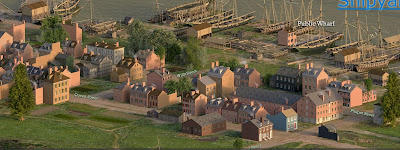


Obviously screencaps don't do it justice, so go to the site. Very cool!
You can get an idea of how very closely everyone lived and how that would impinge upon the lives of African Americans, who would be under close surveillance. At the same time, the black population was probably far more aware of the activities of the white population than the other way around. I wonder what might be revealed by putting together a project like this with a runaway slave ad project or like the work that Christopher Phillips did in mapping black residences in Baltimore.
Then, of course, I think of my nephew saying, "kids will only get into this if you make it into a game."
I myself feel that I have contributed what I have to contribute to understanding Douglass and the world that he lived in, at least for now, and am working on two other projects. They actually do relate to him, but more on a macro level of race, gender, and narratives of U.S. history. Some of it requires watching a lot of 1970s t.v., a task for which I have trained my whole life. Then, there is the whole teaching thing that includes experimental methods with world civilizations this semester. (And, holy cow, but teaching a room full of 19-year-olds about an event that happened when you yourself were 19 and teaching about it as history is surreal!)
But, this is all beside the point of this post. This morning, on Facebook, someone shared this article, "It looks like a video game, but it's not. It's a 3D map of the buildings, roads and land in 1815 Baltimore, created by UMBC," from the Baltimore Sun. Oh, my god! What fun!
The article links to the digital history site Visualizing Early Baltimore, where they have used old maps, and current maps, and all sorts of digital wizardry to recreate 1815 Baltimore in 3-D -- a bit like in Assassins Creed (or what I know of it from watching my nephew play it), but not quite so far as to have an avatar in which to walk around in the city. Now there's a project!
Here is a view of the city from the project.:

Here is Philpot Street, where he lived for a while as a teen and from where he described hearing Austin Woolfolk march slave coffles to the wharves at the foot of the street to be transported off to New Orleans.:

The Strawberry Alley AME Church, where he sometimes went, and where Anna Murray probably went, and where the men in the East Baltimore Mental Improvement Society went.:

Speaking of Anna Murray, she worked and lived along Caroline Street, which is the long street cutting diagonally through this image. Her employers were around the intersection of Gough, which is visible there about halfway up from the bottom.:

You can get an idea of how very closely everyone lived and how that would impinge upon the lives of African Americans, who would be under close surveillance. At the same time, the black population was probably far more aware of the activities of the white population than the other way around. I wonder what might be revealed by putting together a project like this with a runaway slave ad project or like the work that Christopher Phillips did in mapping black residences in Baltimore.
Then, of course, I think of my nephew saying, "kids will only get into this if you make it into a game."
Monday, December 31, 2018
Amy Post visits John W. Hurn
First of all, now that I have read the entire book, let me recommend Nancy Hewitt's fantastic biography of Amy Post, Radical Friend. The full review will be out whenever it gets published within the year; but just know that Post is lovely and this is a biography that she deserves.
Second, Hewitt threw in an interesting detail on page 241, mentioning that Post wrote a letter to her husband from John and Sarah Hurn's photography studio. Here is the letter from the Isaac and Amy Kirby Post Family Papers Project at the University of Rochester, written by Amy Post to her husband, Isaac, on 8 Dec 1863, from Philadelphia.:
 |
| …and now I am standing at John & Sarah Hurns shoe case surrounded by constant comers and goers, and bargain makers for pictures. |
John W. Hurn was an African-American photographer and the telegraph operator who helped Frederick Douglass flee Philadelphia when news of the Harpers Ferry raid broke. Hurn received the message and, instead of bringing the news straight to the authorities, he went to Thomas and Louisa Dorsey's home, where Douglass was staying, and told them, first. "You, no doubt, saved my life," Douglass later wrote to Hurn.
Hurn also took this quite famous photograph of Douglass in about 1862.:
 |
Head and Shoulders of Frederick Douglass
|
Incidentally, that picture is dated to January 1862 because that was when he was in Philadelphia giving a speech and would have had the opportunity to visit Hurn's studio. You know what else he was doing in Philadelphia then? Dropping Rosetta off with the Dorseys -- the same Thomas and Louisa Dorsey -- to stay while she searched for a teaching job. (She did not enjoy her time with the Dorseys, but that is Chapter 7.)
That got me thinking about these three pictures of Amy Post, Rosetta Douglass, and Anna Douglass.:


Note the chair, its carving, the upholstery, the finials. That's the same chair, right? These three photographs were clearly taken in the same studio. That's not a stretch to say so, don't you think? No photographer has been attached to these images, and the most reasonable guess would be a photographer in Rochester. A good flip through a Rochester City Directory wouldn't hurt, but I confess to having not gone that far just yet. (This is only a blog post.)
Still, if Douglass was at the Hurn studio in 1862, and Rosetta was with him, it is within the realm of possibility that she also had her picture made. Then, later Amy Post passed through and sat for her own portrait. As for Anna, she's a cipher, but if they were dropping off Rosetta for an indeterminate amount of time, could she perhaps have gone down with them and also been persuaded to sit?
Of course, all of the question marks put this well within the realm of speculation, one for further research. Nevertheless, wouldn't that be cool if the Hurns also photographed the two Douglass women and Post? It's certainly fun to think so.
Also, note how Post says that the studio belongs to both John and Sarah?
Friday, November 30, 2018
DAY 5: AAIHS Frederick Douglass Roundtable
 |
| Black Perspectives, AAIHS, Frederick Douglass Forum, 26-30 Nov 2018 |
The posts this week have all spoken to the past and present, describing Douglass's life, vision of the United States, and its connection to the state of our nation today. Morris, whose family is rooted in that past, tells of the ways that he sees his role in taking that legacy forward, into the future, through his work against human trafficking, today's trade in human bodies and lives, and educating children.
Morris is also a wonderful, generous man. He came to speak at Le Moyne a few years ago and our African American students lined up just to shake his hand and have him sign fliers, posters, anything they could find. One professor brought his son, who was about ten (maybe), who sat entranced. He feels the history, too, it is real for him, a live, electric wire from the past, through him, and into the future.
The craft of history is a collective endeavor, really, the study of different aspects of an individual's life, placing that individual within the context of others. It's like turning a kaleidoscope or circling around a statue or playing with the lenses on a camera. To be able to contribute a piece or perspective to that study, and to have others find that piece or perspective useful are two thrills of doing history. This has really been such an honor to be included among this group in this forum.
Indeed, it has been an honor, over this past year, to be part of so many events that bring people together who approach Douglass from so many different angles, disciplines, and ages. I've spoken in libraries, National Parks, elementary schools, Ivy League Universities, liberal arts colleges, community colleges, to children, adults, librarians, teachers, rangers, students of all sorts, people of all sorts. I've spoken in the west, the north, the south, the east, in England, in France. My book won two prizes and been nominated for a third (which I will not win and have no business winning, but it's still nice to have your work recognized). I feel that my fifteen minutes of fame are coming to an end, but the book is out there and will work its magic into the scholarship and interpretations over time. That's how historiography works.
I have had some significant pain and sadness in my life this past year, too, that overshadows the good more often than not. Still, I've been scrappy in spite of myself, to a certain degree charmed, and very very lucky. Definitely lucky.
From what I understand, Black Perspectives will continue with more Frederick Douglassness next week, publishing pieces from the conference that took place in Paris in early October. (I know this because eminent historian Douglas Egerton will have a post on Black Reconstruction from the concluding roundtable in which he and Manisha Sinha participated.)
Subscribe to:
Posts (Atom)