Showing posts with label On tour. Show all posts

Friday, June 28, 2019

Summer Touring Schedule (such as it is)

The book tour, such as it is, continues. Now is the season of summer schools and institutes, which are always fantastic no matter how you participate in them.

Last week, the lovely and brilliant Douglas Egerton and I drove down to Lawrenceville Academy in Princeton, New Jersey, to speak to historian Erik Chaput's summer school class on Frederick Douglass. The class is on Frederick Douglass, that is. Doug spoke about black abolition and I used Anna Murray to guide them through methods of research and ways to alert themselves to questions that they should be asking when they confront different types of information in documents. I had a great time, and I hope that they did, too. I forgot that they were high school seniors because they acted and thought like college seniors.

Only the book in the center is mine. 
The rest are only a fraction of Doug's output.
Erik took the picture.

Next up will be Graham Hodges' NEH Seminar for teachers on Abolition and the Underground Railroad at Colgate University, followed by Carol Berkin's on American Women at War in New York City, then on to Cambridge, Massachusetts, to chair a panel on abolition at the Society of Historians of the Early American Republic's annual meeting, followed by the Chittenango Boat Landing at the beginning of August. That last one is open to the public.

Fall will take this show overseas again, this time to Newcastle-upon-Tyne for Newcastle University's INSIGHTS series of lectures (this is last year's program). Newcastle was the home of the Richardsons, who began the campaign to purchase Douglass's freedom and provide the seed money for the North Star. Guess what my talk will be about?

Meanwhile, (among other things like two book proposals, one submitted) I'm writing an essay for an anthology, Frederick Douglass in Context, edited by Michael Roy, who was part of that conference in Paris last year. My essay is about Douglass and family, and I don't want to retread what I have already said nor do I want to tread on what I know of Ezra Greenspan's upcoming work (as if I could ever be as good!). Looking back on something that you've gone over a million times to see something new can be a challenge because you have to step away from your own patterns and ruts of thinking when you sometimes aren't even aware that you have them. I also have a problem figuring out when I'm saying something original because I'm too aware of where I picked up so many ideas and then I've lived with my own configuration of them for so long. Knowing what you have can sometimes be a different thing from stepping back and re-asking, "what do I have?"

Monday, June 3, 2019

At the Grafton Historical Society, Massachusetts

On April 30, 1842, Douglass spoke in Grafton, Massachusetts, outside of Worcester. This past weekend, I had the opportunity to follow in his footsteps. The short 2019 book tour (such as it is) continued by taking me there with a stop at the Grafton Community Barn to participate in “Rising Towards Unity … when not all voices were equal," a series of events presented by the Grafton Historical Society, Grafton Public Library, and the Unitarian Universalist Society of Grafton and Upton.

The venue had a bit of the air of a space in which Douglass or another nineteenth century speaker might have appeared, big, open, wooden floors, but bright and modern, too. I, alas, have not the lung or vocal capacity of those days, and the microphone was on the fritz, so there is a moment of adjustment to move me closer to the audience at the beginning of the video and then request from the back that I speak up from time to time. Everyone was so polite and engaged, despite my tendency to go off-script and over time, and they asked great questions, as well, and the president graciously waited to reopen the building when I left my phone charger behind.

Oh, and get this: Abby Kelley Foster sat in the front row! Not actually her, but Lynne McKenney Lydick, who portrays her, as well as Clara Barton, two local heroes of nearby Worcester. A young woman also showed up in the Bloomer costume that she uses for teaching children at the library.  I usually try to dress in a way to evoke a historical period, so having the audience do the same makes me feel like my people have arrived.

The next event in their series will be "Reading Frederick Douglass Together: The Meaning of the Fourth of July for the Negro," to be held at the Grafton Common on July 5, 2019. If you are around, stop by.


By the way, note that my video editing skills have now improved with the inclusion of a title and conclusion cards and with a thumbnail different from the video. Everyday's a school day, right?

[The bracelet that I flash at the beginning reads "Claire Strong" in honor of my little niece and her struggle with leukemia. Our family likes to send pictures of it when we are at different places. Thus, it did not end up on the cutting room floor.]

Thursday, April 18, 2019

Friends of Mount Hope Cemetery Annual Meeting Talk

Frederick Douglass, Anna Douglass, Helen Douglass, little Annie Douglass, Rosetta Douglass Sprague, Nathan Sprague, Louisa Sprague, Alice Sprague, Annie Sprague, Amy and Isaac Post along with their family, the Porters, Susan B. Anthony, and so many more lie buried in Mount Hope Cemetery in Rochester, New York. 

The Friends of Mount Hope care for the still-functioning cemetery and its records, as well as offer tours of the most significant elements of the site, including its geographic features, history as a burial place, and as the final resting place of so many important people in the history of the city and the nation. They, indeed, helped me with my research for the final chapter of my book; and when you visit the Douglass gravesite, remember that its condition results from their efforts. They literally care for Frederick Douglass.

Therefore, when Pat Corcoran invited me to speak at their annual meeting last week, I was more than honored. I made myself more anxious by choosing to speak about my research into the composition of the gravesite. After all, they probably know more about it than I do. Still, they proved to be a lovely audience (who bought many books), and I'm grateful for the work that they do. As I say in the introduction to my talk, everyone whose bones rest in that place were loved by someone, and they continue that care while providing a peaceful, green place of contemplation.

Tuesday, April 16, 2019

Seward Stories Talk: From Documentary Editing to Biography

Last Wednesday, at the suggestion of Pat Corcoran, Thomas Slaughter invited me to be the keynote speaker at the Seward Stories event at the University of Rochester. Slaughter edits and manages the Seward Family Digital Project, which lives in the Rush Rhees library there, and Seward Stories allows researchers working on the project to present interesting aspects of the project's findings and progress.

The whole endeavor is really exactly what an editing project like this should be. It makes archival material accessible to the public, annotates it for context that sometimes even scholars do not know nor understand, provides professional and scholarly experience for both undergraduate and graduate students, and facilitates collaboration within and across institutions and interest groups. This is the sort of thing of which I could only fantasize when I was at the Douglass Papers, before the technology was even available.

I met with students who are working on impressive dissertations, with the history department chair, with the library dean, with the digital lab technicians, and with the archivists in special collections. Everyone was wonderful, but the last two left me with gifts.

The digital lab techs have created 3-D printing software for copies of the Douglass bust owned by the University of Rochester, and when I gushed about making plans to get to my local library to have them make one for me on the 3-D printer their, one of the techs said, "hey, here, have this one." So, swag!

"Claire Strong" is for my 5-year-old niece, 
who is recovering from leukemia.
Then, the special collections librarians did one better. They brought out the volume of sheet music that contains "Farewell Song to Frederick Douglass," composed by Julia Griffiths and her brother T. Powis, the one performed at the big Douglass gala in Rochester last December. They let me touch it! Without gloves! And had a great acquisitions story! And share my horror at auction houses that don't want to know provenance prior to their own purchase!

After the tours and lunch, we went to the auditorium in the library for presentations, which included reports on the work with seniors who collaborate with the students in transcribing letters, two charming discussions of unusual names in the project and the regular appearance of pets in the correspondence, and a rumination of the importance of this intimate view of the Seward family.

My own paper, conceived separately from these presentations, seemed to touch on some of the same issues. As you can see if you watch or listen to the video, I decided to explain the ways that my book evolved from my annotation of the Douglass correspondence. The paper fit right in methodologically and theoretically.

We all go so deeply into the details of our subjects' lives in annotation, but we are looking primarily at the alleged "private" side, finding that such distinctions are not accurate, even if they are the language of our subjects and thus the ways that they tried to explain the bargains and boundaries of their own lives.


Friday, November 30, 2018

DAY 5: AAIHS Frederick Douglass Roundtable

Black PerspectivesAAIHSFrederick Douglass Forum, 26-30 Nov 2018
The AAIHS Frederick Douglass Roundtable in Black Perspectives concludes today with Christopher Shell's interview of Kenneth B. Morris, Jr. Morris heads the Frederick Douglass Family Initiatives and, as the title of the organization suggests, is a direct descendant of Frederick Douglass. His mother was Nettie Douglass, who was the daughter of Frederick Douglass III, who was the son of Joseph Douglass, who was the son of Charles Douglass, who was the son of Frederick Douglass. That's not all! His mother's mother, who married Frederick Douglass III, was Booker T. Washington's granddaughter.

The posts this week have all spoken to the past and present, describing Douglass's life, vision of the United States, and its connection to the state of our nation today. Morris, whose family is rooted in that past, tells of the ways that he sees his role in taking that legacy forward, into the future, through his work against human trafficking, today's trade in human bodies and lives, and educating children.

Morris is also a wonderful, generous man. He came to speak at Le Moyne a few years ago and our African American students lined up just to shake his hand and have him sign fliers, posters, anything they could find. One professor brought his son, who was about ten (maybe), who sat entranced. He feels the history, too, it is real for him, a live, electric wire from the past, through him, and into the future.

The craft of history is a collective endeavor, really, the study of different aspects of an individual's life, placing that individual within the context of others. It's like turning a kaleidoscope or circling around a statue or playing with the lenses on a camera. To be able to contribute a piece or perspective to that study, and to have others find that piece or perspective useful are two thrills of doing history. This has really been such an honor to be included among this group in this forum.

Indeed, it has been an honor, over this past year, to be part of so many events that bring people together who approach Douglass from so many different angles, disciplines, and ages. I've spoken in libraries, National Parks, elementary schools, Ivy League Universities, liberal arts colleges, community colleges, to children, adults, librarians, teachers, rangers, students of all sorts, people of all sorts. I've spoken in the west, the north, the south, the east, in England, in France. My book won two prizes and been nominated for a third (which I will not win and have no business winning, but it's still nice to have your work recognized). I feel that my fifteen minutes of fame are coming to an end, but the book is out there and will work its magic into the scholarship and interpretations over time. That's how historiography works.

I have had some significant pain and sadness in my life this past year, too, that overshadows the good more often than not. Still, I've been scrappy in spite of myself, to a certain degree charmed, and very very lucky. Definitely lucky.

From what I understand, Black Perspectives will continue with more Frederick Douglassness next week, publishing pieces from the conference that took place in Paris in early October. (I know this because eminent historian Douglas Egerton will have a post on Black Reconstruction from the concluding roundtable in which he and Manisha Sinha participated.)


Wednesday, November 28, 2018

DAY 3: AAIHS Frederick Douglass Roundtable

Black Perspectives, AAIHSFrederick Douglass Forum, 26-30 Nov 2018
Today's entry in the AAIHS Black Perspectives Frederick Douglass Forum comes from Noelle Trent, Director of Interpretation, Collections, and Education at the National Civil Rights Museum in Memphis, Tennessee. If you ever get the chance to visit that museum, bring Kleenex. The experience will astound you, taking you through the narrative of the Movement and the people who made it happen. No surprise, then, that someone who works there has also written a dissertation on Douglass and American exceptionalism, which I hope she publishes quite soon.

In "Frederick Douglass and the United States Constitution," Trent traces Douglass's interpretations and reinterpretations of the Constitution. She also pulls out a great quote from the Revolution that makes defending Susan B. Anthony and Elizabeth Cady Stanton very difficult during the late 1860s and early 1870s, a legacy that still haunts feminism to this day. More importantly, Trent reveals the ways that, even after the Reconstruction amendments passed, African Americans remained marginal in this idea of an American nation. The Liberty Party's vision of abolition may have passed, but the Garrisonian vision still had -- has -- a long way to go.

Tomorrow, I'm up, hoping to evoke sympathy for Anna Douglass as she was rather than as so many people then and now wanted and want her to be.

By the way, the mural there, as the caption on the AAIHS website note, is from Belfast. Here is the full mural from 2011, when I lived in Ireland for the year.

Tuesday, November 27, 2018

DAY 2: AAIHS Frederick Douglass Roundtable

Black Perspectives, AAIHSFrederick Douglass Forum, 26-30 Nov 2018


In "Frederick Douglass's Vision of America," which has previously appeared in Public Seminar as "This is Your America: Why Frederick Douglass Still Matters," Roberts addresses his fellow American citizens with the same stinging indictment of hypocrisy that Douglass did in his own time. He points out the yawning gap between the ideal of "America" and its reality. 

I may actually have my students read this piece in the next week because Roberts gets at an idea that I've been trying to impress upon them this semester in teaching the first half of the U.S. history survey. I'm teaching another course with a philosopher, and she has introduced me to some theory that has given me the tools to shape some of what I already know through history. The ideas of racial projects, hegemony, and counter-hegemony have helped to organize this story that I'm helping these students learn. 

Hegemony is that ideal, the story that some Americans like to believe about the country, the history that they learned in high school that bored the crap out of most of them. Counter-hegemony -- or counter-narrative, as I'm often calling it -- is the push-back, the Douglasses and Turners and Veseys and Truths and Tubmans and Tecumsehs and Fanny Wrights and so on and so forth. The ones forcing America to live up to this ideal. The whole thing, the whole mess and conflict becomes a racial project, or a series of competing racial projects that are, in the end, a national project. What is race? What does that mean? Who decides? What does it look like? What forms of power, institutionalize and otherwise, are involved? What forms of resistance? 

But, I digress, having just read Roberts piece after teaching that class and the Crisis of the 1850s. 

David Blight turns to "Frederick Douglass's Childhood of 'Extremes," looking at both the violence that characterized the young Frederick's youth and his process of remembering it. Blight has that ability to tell a story so simply that you don't realize just how complex and layered it is until you reflect. When I look at the young Frederick, I think of a child who was profoundly abused down to his very soul. That fueled his sense of justice and his rage and, I think, a need for love, just as a man and a human. Blight's piece highlights that in no uncertain terms.  

At the end of his piece, he imagines Douglass taking up his pen to delve into his pain and set down his autobiography, but I would like to add in two figures who could easily have helped him in the process. The first was his wife, Anna, who grew up to age sixteen in Caroline County and then lived in the same part of Baltimore as Frederick. The other was their friend and "adopted sister" (her term, historians would call this part of a fictive kin network, and Ezra Greenspan intends to include her in his study of the extended family), who went by the names Harriet Bailey, Ruth Cox, Harriet Adams, and Ruth Adams (Adams being her married last name). She hailed from Easton, where she lived into her twenties, in Talbot County. While Douglass' memory was prodigious, as I imagine people's memories were in those days moreso than now, there is certainly no reason that these two women did not help him along with some details of their own. Indeed, Douglass mentions a cousin of his wife who was beaten to death by Mrs. Giles Hicks, suggesting that Anna gave him some material herself. 

Tomorrow, Noelle Trent's piece will appear, followed by mine about Anna Douglass on Thursday. Friday, Christopher Shell will interview Kenneth B. Morris, Jr

Once again, the comments there (and here) are moderated in order to weed out verbally-abusive trolls desperate for attention. The AAIHS has had more than their share of problems in that department, as you can imagine.

Monday, November 26, 2018

DAY 1: AAIHS Frederick Douglass Roundtable

Black Perspectives, AAIHS, Frederick Douglass Forum, 26-30 Nov 2018

This week Black Perspectives, the online journal of the African American Intellectual History Society, will be running a round table on Frederick Douglass. This forum will feature a series of historians expounding on topics of their research and specialty as they relate to our favorite subject, Frederick Douglass. On the final day, Christopher Shell will interview Kenneth B. Morris, Jr., descendant of both Douglass and Booker T. Washington, and head of the Frederick Douglass Family Initiatives.

Today, Manisha Sinha traces the theme of fugitivity -- the state and experience of being a fugitive --- through Douglass's life, showing the ways it informed his criticism of the United States and his vision for its future. Sinha delivered this piece as part of a roundtable on Douglass at the Paris conference in October. The roundtable there asked each participant to choose a word to describe Douglass, thus the framing of her contribution here. As always, her thoughtful consideration of the theme illuminates and connects various points in Douglass's long life.

Christopher Bonner turns to that latter point, discussing the ways that Douglass helped Americans imagine, in specific terms, a racially-just nation. Naturally, all African Americans wanted, demanded, a nation that included them as free and equal citizens. Yet, distilling millions of peoples' hopes into a crystalline set of goals and actions requires a man of electric vision. Bonner sketches the means by which Douglass accomplished that task.

Contributions from David Blight and Neil Roberts appear tomorrow, Noelle Trent's will appear on Wednesday, a post about Anna Douglass by yours truly receives Thursday's spot, and the interview with Morris ties the whole week up on Friday.

You may, of course, engage with the authors in the comments section on their posts at the forum. Don't be alarmed if your comment doesn't appear immediately, however, because they are moderated (just as comments here on this blog are moderated). There are, after all, quite a number of rude, irrational, racist bullies out there who just want to use someone else's platform to call attention to themselves and feel powerful.

-------------------------------------------

Also, not the point of this post, the Prof. Bonner's post, or the painting, but I do love that the illustration of "Frederick Douglass's Radical Imagination" depicts him wearing a shawl. I am sure that there are about a thousand different textual interpretations to make of that, but my thoughts go in two directions. First, who did the artist envision as making him the shawl? Anna, perhaps, or Rosetta, or even a granddaughter? Second, as someone who knits and crochets, I want to make Douglass a shawl. 

Wednesday, November 14, 2018

David Blight Off the Deaton Path

Two of my favorite gentleman discuss yet a third of my favorite gentlemen.

Stan Deaton, Senior Historian and the Dr. Elaine B. Andrews Distinguished Historian at the Georgia Historical Society, interviews David Blight, author of Frederick Douglass: Prophet of Freedom, on his podcast "Off the Deaton Past."

Stan organized a fantastic NEH Seminar on African American history ages ago that took us throughout Savannah and onto the Sea Islands. (If you are a teacher at any level, I highly encourage you to look into these seminars and institutes.) He also introduced me to Walter O. Evans, who allowed me to research in the collection that David Blight describes here and portions of which have been published by Celeste Marie-Bernier and Andrew Taylor in If I Survive: Frederick Douglass and Family in the Walter O. Evans Collection. Stan does a great job as an interviewer, just prompting David and letting him tell his stories. You just sit there rapt, listening to his insights.

(Also, so he won't feel left out, my #1 favorite gentleman is Douglas Egerton.)

Link here: http://leighfought.blogspot.com/2018/11/david-blight-off-deaton-path.html

Monday, November 12, 2018

Upcoming AAIHS Online Forum

The African American Intellectual History Society will be hosting an online forum "Frederick Douglass @ 200" from Monday, 26 November, to Friday 30 November, 2018. That's the week after Thanksgiving. Vanderbilt professor of history, Brandon R. Byrd, whose specializes in Haiti, organized the roundtable, and invited this illustrious group of scholars to participate:

Oh, yes, and they invited me, too. My piece will be on Anna Douglass. I originally wanted to go in a different direction about Douglass and women's rights, but Carol Faulker did a much better job in her paper at the Paris conference, so I'm hoping that she publishes that. Then, after reading all of the reviews of David Blight's book, in which the reviewers still could not seem to understand Anna as more than a cliché of the long-suffering woman-behind-the-man (which is not how Blight portrays her, and certainly not how I wrote about her), I thought that I'd grant her some dignity by discussing some of the difficulties and the importance of understanding her as an historical actor.

I also confess that I am the reason that this roundtable was not published sooner. As mentioned at the beginning of my talk in Paris, my father died in September, which threw many things off the rails and required many an extension of deadlines, this being one. So, my apologies to the participants, organizers, and audience who anticipated this forum sooner. My gratitude also to Keisha N. Blain, the senior editor of Black Perspectives, as well as her staff, for being so patient with me.

This should be an exciting and interesting week of essays to read, given the different directions each scholar approaches our subject. Douglass is an endlessly fascinating man engaged in an endlessly fascinating era.

Saturday, February 16, 2013

"Frederick Douglass in Ireland" Conference (Feb. 22, 2013)


Next Friday, St. John Fisher's College in Rochester, New York, will be holding a day-long conference "Frederick Douglass and Ireland." The conference is open to the public and yours truly will be on between 1:25 and 2:20 pm. The schedule suggests that I will be talking about Douglass and women's suffrage; but, after talking with organizer Timothy Madigan, we concluded that something connecting Rochester, women, and Ireland (or at least the British Isles) might be more intriguing and pertinent. So, expect something on Julia Griffiths and a tiny bit on Isabel Jennings.

Here is the schedule:

Friday, February 15, 2013

"Exploring the Lives of Anna Douglass through History and Poetry"

Last fall I participated in the program "Exploring the Lives of Anna Douglass through History and Poetry" at Villanova University along with poet Nzadi Kieta. I presented my paper "Anna Murray: Mrs. Frederick Douglass," and Nzadi read from her cycle of poems in Anna's voice. This is the video of that lovely evening. I go first, giving Anna's story the historical bones, then Nzadi fleshes out and animates her life.


Many thanks to the Gender and Women's Studies and Africana Studies department who made this happen.

Monday, December 12, 2011

Shameless Bragging

Last Wednesday, I delivered a paper on "The Feminine World of Frederick Douglass" here at Queens College in Belfast, Northern Ireland.:


The Queens faculty who had invited me, Anthony Stanonis, Brian Kelly, and most especially, Catherine Clinton (who must be one of the most supportive historians for junior colleagues in the history of historians), all welcomed me and ensured that I had a packed room, coffee beforehand, and drinks and dinner afterward. They also made this cool poster to publicize the event.:


Great choice of picture! Also, note how they publicized my other two books there at the bottom?

Everyone was friendly and polite. Audiences on this side of the ocean either pay attention very well, or do an impressive, Tony Award winning performance of faking it. I tend to believe the former.

So, my gratitude to all!

Also, thank you to Angela Murphy for passing this along.:


Thank you also to Ann "Historiann" Little, who herself is an incredibly supportive historian. We have met at the Little Berks conference and she is an amazing, funny, smart person. With luck, her influence will drive this humble blog's readership up from an average of 15 readers per week (five of whom are me)!

Tuesday, July 5, 2011

Return to Mount Hope

I was wrong. It's definitely not the first time. Sadly, it will not be the last.

Today I went to the Rochester Museum and Science Center library to look in the Howard W. Coles collection. Coles was a resident fellow at the Museum before his death in 1996, so his extensive papers relating to his research into Rochester's African American history was donated to its library by his daughter and granddaughter in 1998. It's an interesting collection, and includes a few items related to Frederick Douglass.

That,  however, is not the point, nor what I was wrong about. You see, while I was waiting for the librarian to retrieve the papers, I started reviewing some of my notes and came across those that I took about the interments in Mount Hope Cemetery. Suddenly, some of the bits that I had transcribed without really thinking about them at the time, all came together and made sense.

Remember the Porter mausoleum? Wrong Porters. The Porters mouldering within the mausoleum were not the Porters in which I was interested and, most likely, did not keep the bones of little Annie Douglass company.

Here's a map:
I hope you can embiggen it. Down there at the bottom to the right you can find the Douglass graves. The Porter mausoleum stands out prominently in the section next to it. If you are looking for the Douglass graves, and you know that Annie Douglass had been buried with the Porters, then naturally, you assume that the Porter mausoleum is the place. The lack of names other than "Porter" does not disabuse you of that assumption.

That section, however,  is Section S. In the interment records, the Porters whose letters I had been reading and who figure most prominently in the Douglass story are actually buried in Section G -- or so I discovered upon my browse through my notes. Section G sits on a hill, high above a gunky green pond. So, I drove up there and started to wander about. Their graves are in spaces 65-70, not exactly helpful information when there are no clearly visible numbers on most of the plots. Nevertheless, I soldiered on because I simply had to see the right graves. As Digger told me, you can learn a lot from the graves, if you know how to read them. Not that I know, but even the wholly ignorant can pick up something from the stones and arrangement of the graves. Just wait until I get down to writing about the Douglass gravestones.

Fortunately, I didn't have to wander too far before I saw this:
The name "Farley" stood out on the tall monument.  The Porters and the Farleys were intermarried in one generation (not as oddly as the Posts, however, but that's another story), so I knew I was close. Sure enough, the graves on the far side of the monument are the Porters:
Samuel Porter was the oldest of this clan. He lived into his nineties, and the interment record says that he died of "old age." 
 His second (or was it his third?) wife was Isabella Porter. She and Samuel's daughter, Almira, ran a girls' school in Rochester:
 Samuel's son was Samuel D.  Porter, to whom Douglass gravitated as he became more invested in the use of party politics to end slavery.  Porter was also one of the people who has actual documentation recording his assistance to fugitive slaves. In 1851, when three men appeared at Douglass's doorstep fleeing the law after the Christiana Riot, Douglass turned to Porter for help in getting them safe passage to Canada on the actual railroad. Five years later, Samuel May and Jermain Loguen turned to Porter, asking him to provide a better stop than their own in Syracuse.

His wife, however, was one of the two women who will probably become prominent in the book. Susan Farley Porter was president of the Rochester Ladies' Anti-Slavery Society of which Julia Griffiths was the secretary. The RLASS asked Frederick Douglass to deliver his "Fourth of July" speech to one of their meetings. When I go to Michigan to see their papers, I will have a better idea of their activities (I hope!) and their relationship with Douglass.
Maria G. Porter, Samuel D. Porter's sister, was a governess and a boarding house keeper (as best as I can tell). She was also the treasurer of the Rochester Ladies' Anti-Slavery Society. She may have been the person who provided Julia Griffiths with a "respectable" place to live when Griffiths was accused of causing "trouble" in the Douglass household, although I'm not yet certain. I have to track down a primary source on that one. In any case, here lies Maria G. Porter:


From what I understand -- again, I need a primary source on this -- Annie Douglass was interred in the Porter family plot. A 2003 issue of the Mount Hope newsletter, the Epitaph, says she is buried with the Douglasses, but the cemetery researchers told me in answer to a reference e-mail request that she was buried with the Porters. Since Douglass and Samuel D. Porter were such close associates, since Susan and Maria were also closely allied with Douglass, and since the Porters in the mausoleum are not among the abolitionist Porters, then Annie was probably buried here.

So, what does this all tell me? I don't know. This is all a footnote of a footnote, which is what this blog is for.

Sunday, June 19, 2011

Honeoye, part 2

I ended up going back to Honeoye. Saturday morning, I went to the Rochester Public Library's Local History Room to see what they might have that will help me flesh out the context of Douglass family in Rochester. I'm particularly interested in the African-American community in that area since it works into some of my understanding of Anna and her own sense of community. Sadly, very little scholarly work has been done on African-Americans in Rochester. Happily (especially for her prospects as a historian), a graduate student at University of Rochester,  Monique Patenaude, is working on this subject.

As has been happening all week, I was digging a dry well. There are patterns to the dryness that I will write about later, so dry wells are not a loss. They are, in fact, quite valuable in guiding the way to a more accurate understanding of the subject; but, as I just said,more on that later. In the process of digging this well, I came across one of those WPA Writers' Project guides, this one concerning Rochester and its vicinity. These guides are fantastic in showing historic preservation and routes of travel in the 1930s; and this one included a "tour" that brought the traveller through Honeoye. The "tour" through Honeoye mentioned landmarks: a statue to Major General John Sullivan of Sullivan's Expedition (in)fame, a historical marker for the home of Gideon Pitts, and a historical marker for the home of Captain Peter Pitts. Peter Pitts was one of the earliest settlers of Honeoye and the father of Gideon Pitts; and Gideon Pitts was the father of Helen Pitts, the second Mrs. Douglass. (I may be missing a generation in there. My copy of the biography of Helen Pitts is, unfortunately, not on  hand.)
"Maybe they are still there," I thought. I also wondered, "How could I have missed a whole statue?" Of course, missing a statue may have had something to do with the fact that I had probably not seen the entire town since hunger,  exhaustion, and traffic from road construction made me  conclude that I had seen everything when, as it turned out, I was only about half to three-quarters of the way through the village. So,  after leaving the public library,  and after making a pass through Mount Hope Cemetery to see the Porter mausoleum (I thought it only respectful after having trawled through their family letters all week -- plus,  I'm a bit of a ghoul), I turned my green machine toward Honeoye.

Now alert and also more familiar with the route than I had been two days earlier, I did not miss this sign as I entered the village:

The marker to Peter Pitts's home.

I followed the same path through the village as I had before,  but did not let traffic deter me. Beyond the road work, the street went uphill and past this house:


What should be standing in front of this house? This marker!:

"Pitts Mansion. Built 1821 by Gideon Pitts, son of Capt. Peter Pitts, pioneer settler in 1789." Also, this was the birthplace and childhood home of Helen Pitts. Whether or not the house is the actual house,  I do not know and someone more versed in architectural history, especially the architectural history of western New York, or the local history of Honeoye could probably tell me more.

I did not find the statue of John Sullivan. I'm not sure if that is good or bad. On the one hand,  Sullivan's Expedition was a nasty, genocidal bit of American history, and a statue celebrating him is not the best idea. On the other hand, with the proper signage, perhaps that nasty, genocidal bit of American history and the reasons certain people  wanted to celebrate it might be addressed. Then, my sarcasm kicks in as I think about how well such attempts have gone in places like Mystic, Connecticut, and Deerfield, Massachusetts, when the older, celebratory statues and signs met with effort to update those sites to include more complicated and current knowledge of the violent historical events that occurred there. Perhaps that is what separates heritage from history: heritage is a celebration of a particular person's or group's past, while history is an attempt to understand the intricate interactions and points of view of the past, without too much identification with any one person or group.

In any case, I find something poetic, or ironic, in the fact that Peter Pitts participated in the oppression of one group of non-white people while his granddaughter challenged the oppression of another group of non-white people. He made war, and she quite literally made love.


Saturday, June 18, 2011

Home of Jermain Loguen

In Savannah, I read many letters from Lewis Douglass, Frederick's oldest son, to Amelia Loguen, the woman who became Lewis's wife. Early in their courtship, Amelia lived in the home of her father, Jermain, on Genesee street at the corner of Pine, in Syracuse, New York. Since I went to Syracuse after I left Savannah (with a short pause in Silver Spring in between), I decided to see where all of these letters had gone.

Jermain Loguen was not just anybody in Syracuse. He was a fugitive slave who had become a minister and a leader of the black community in the city. Unlike many (and I'd venture to say most) other alleged Underground Railroad sites, his home is actually quite well documented as a haven for people escaping slavery. In fact, just the other day I read a letter that noted it as such.

Since this is central New York, and since the Underground Railroad is huge heritage tourism business, the location of his home actually has a marker:


That is him, incidentally, in the upper left corner of the image.

He is also memorialized downtown in the monument to the Jerry Rescue:
You can't really see him in this image, but he is the figure on the far side of the fugitive slave, Jerry Henry, in the center.  You know Jerry Henry is the fugitive because he is shirtless and has ripped pants. That's the uniform.

Seriously, to make a long and involved story about race and ethnicity and politics and so forth short, Jerry was a fugitive who was being returned to slavery under the Fugitive Slave Act and Loguen pretty led a large group of people who busted him out of jail, where he awaited the slave catchers, and helped him to Canada. Loguen had to take a trip there, too, for his part in the bust.

The canal, incidentally, ran behind this statue.

Getting back to the home. Loguen's home sat on the corner of Genessee and Pine, the second dot from the right on the map below:

Do you know what is there now, at the corner of Pine and Genesee, beside this sign?

This:


Thursday, June 16, 2011

Honeoye, New York

It is late, and I have been in the archive all day, drilling a dry research well. Fortunately, there is a pattern to what I am not finding.

After a disappointing day, I decided to go out to see where Helen Pitts, the second Mrs. Frederick Douglass, grew up. The drive took me off of the interstate (imagine!) and down winding highways to Honeoye.

 This is essentially the whole town, which is a hamlet, actually, complete with a sheriff ensuring that you observe the speed limit. He's the white car on the right in the distance.
 I do know that the Pitts lived along this street somewhere, but little evidence is left of that period of time in this area. So many layers of time can erode small places sometimes.

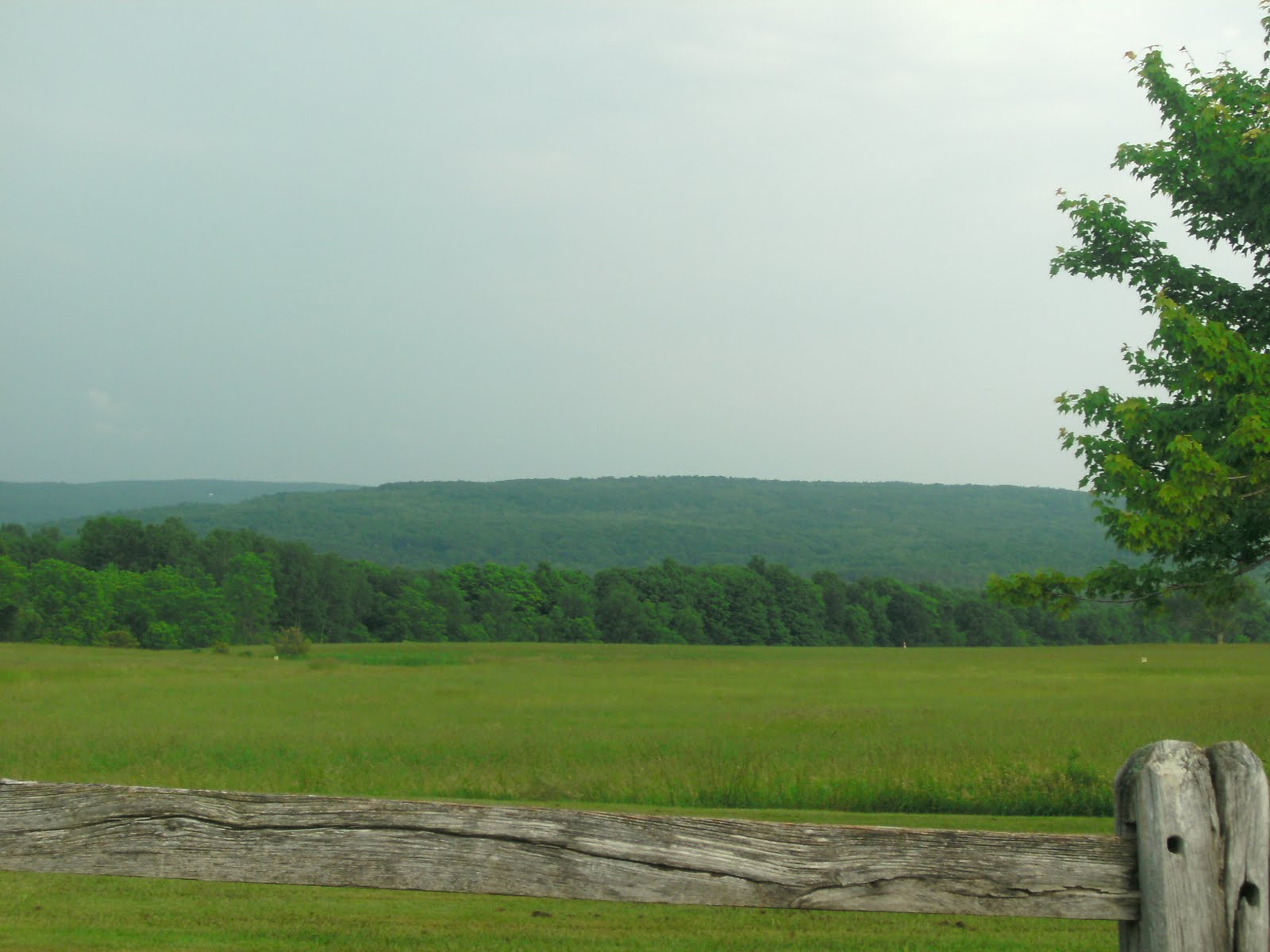
If you keep going straight down the street, you eventually go up a hill where you can find a scenic overlook. This is the view from there:

I imagine there were fewer trees then, as well.

This is a lovely, small, quiet place; but I imagine for a young woman in the nineteenth century, one with a burning to end slavery, to do good in the world, to do something at all in the world, it was much too small and much too quiet. She went to college at Mt. Holyoke, also a lovely, small quiet place.


Then, in the Civil War, she went south, into the Confederacy, to teach freedpeople in Norfolk, Virginia. After the war, she ended up in Washington, D.C. working on the women's journal The Alpha and in the Recorder of Deeds office where her boss was Frederick Douglass.  She now rests in Mt. Hope Cemetery, next to him and Anna Murray, the first Mrs. Frederick Douglass,  and not too very far from where I am researching.
 

Monday, April 4, 2011

Chapter 2 Has Left the Building!

The "shitty first draft" of my first completed chapter of Frederick Douglass's Women is now finished!

Yes, the title of this post says "Chapter 2," and it is the second chapter of the overall manuscript. No one says you have to write the thing in order, right?

When I wrote the public talk that I gave at Le Moyne and Montgomery Colleges, I had envisioned the first near half of it as being "Chapter 2: Anna Murray, Mrs. Frederick Douglass." Then I agreed to submit the paper for a workshop at SUNY-Binghamton. As I revised the colloquial language out and added more detail in, I found that the first chunk grew longer and longer and longer. "This is becoming a chapter as I write," I thought. So, I lopped off the last part, and committed to the chapter. 

Now, it's done and ready to enter the workshop ring this Friday!

Even better, parts of other chapters are written, as well.

Tuesday, February 15, 2011

"Anna Murray, Mrs. Frederick Douglass" at Montgomery College, Takoma Park, MD

For those who could not make the talk in Syracuse, I'll be giving an encore presentation at Montgomery College, Takoma Park, Maryland, on Tuesday, March 1st, at 1 pm in The Commons building, room 211.

In this talk, I do more than speculate on bandannas, hounds and spoons. Instead, I'm exploring ways to conceptualize Anna Douglass's world and her marriage to Frederick. He does not come off very well in this paper. There are reasons for that, and reasons for those reasons; but this is Anna's turn to be center stage -- whether she likes it or not -- and there are key points on which he behaves less than admirably from her point of view.

Thursday, February 10, 2011

Rockin' the House at LeMoyne College at 7 pm Tonight!

For those who might happen to be passing through Syracuse, New York, this evening:

I will be giving a talk at Le Moyne College, Syracuse, New York, at 7:00 pm in the college's Grewen Auditorium.

The talk will be "Anna Murray, Mrs. Frederick Douglass," in which I will outline Anna Murray Douglass's life, address the way historians have portrayed her, and discuss the limited evidence that we have in reconstructing her life. Then -- may my powers be up to the task at this point -- I will bring it all home and explain how this relationship is important in understanding Frederick Douglass and the lives of free black women such as Anna.

Aside from presenting what will be an awesome paper to an undergraduate audience, I am hammering out what will become essentially 1 1/2 - 2 chapters in the book.