Last fall I participated in the program "Exploring the Lives of Anna Douglass through History and Poetry" at Villanova University along with poet Nzadi Kieta. I presented my paper "Anna Murray: Mrs. Frederick Douglass," and Nzadi read from her cycle of poems in Anna's voice. This is the video of that lovely evening. I go first, giving Anna's story the historical bones, then Nzadi fleshes out and animates her life.
Many thanks to the Gender and Women's Studies and Africana Studies department who made this happen.
Showing posts with label Anna Murray Douglass. Show all posts
Showing posts with label Anna Murray Douglass. Show all posts
Friday, February 15, 2013


Sunday, December 4, 2011
Source Message Creep
Here is an object lesson on the reasons that you should avoid "as quoted in" in your own citations.
In Love Across the Color Lines, Maria Deidrich wrote of Ottilia Assing's interpretation of her relationship with Frederick Douglass and that Assing "believed that the Douglass marriage had been over long before she entered the scene, and in a way she was right." As evidence, Diedrich wrote, "Douglass hinted at marital problems in letters to friends, describing himself in 1848, for example, as a 'most unhappy man.'" [Diedrich, 175] The argument here, then, is that Ottilia Assing had a twentieth century understanding of a marriage being "over." This is based on Douglass saying one time, eight years before he even met Assing, that he was "most unhappy." The implication being that Douglass was unhappy in his marriage and, extrapolating from that unhappiness in 1848, his marriage was probably headed for divorce by 1856. I say "headed for divorce" because, it is clear through the rest of the book, Diedrich thinks Assing thinks this.
The source for this "unhappy" quote is this: "FD to Abigail and Lydia Mott, 21 February 1848, quoted in mcFeely, FD, p. 154." O.k. Let's take a look at McFeely, p. 154. McFeely wrote:
The source for McFeely was "Douglass to Abigail and Lydia Mott, Feb. 21, 1848." No repository because "Except where otherwise noted, citations of letters to or from Frederick Douglass are from the photostatic copies of his correspondence in the Yale University Frederick Douglass Papers." [McFeely, 387] Not to sound catty -- but to be totally catty -- would it have been too much trouble to find the actual source in the actual repository, not a photocopy in a project's office that might not exist ten or fifteen years down the road given the funding of such projects and the fate of some of the project papers? At least he was honest and did not try to claim that he did research at places where he did not.
So, alas, that is his source, and his source is no longer at Yale. His source is at the Frederick Douglass Papers project at IUPUI in Indianapolis. The actual source, the letter itself, is located in the Ida Husted Harper Papers at the Huntington Library, so I can forgive using the Douglass Papers project. It would have been rather a needle in a haystack in the pre-internet days.
Guess where I used to work? I even did some of the annotation for that letter. Those Mott ladies were a pain to track down, let me tell ya! You can find it in the first volume of the project's Correspondence Series on pages 296-7. Here is what the relevant part of the letter says (I'm leaving out the two post scripts that actually run about as long as the letter itself):
First of all, he was sorta flirting with them. He writes like this a lot to people like Amy Post, women whom he liked and whom he was friendly with on a personal basis. These two women are caring for his daughter, so he is of course going to be solicitous and flattering.
Second, he was poking a bit of fun at his own self-pity with all of the hyperbole. He even seems to be quoting something although, even now with Google, I can't seem to find the quote. While he may have been "kidding on the square" -- that is, stating a fact but phrasing it as if he were not serious about the statement -- and suffering from the pressures of finding that new home and starting that new business and having a sick wife and three small children, all while trying to, you know, fight the system of slavery...well, you can see that he might be referring to things other than his marriage.
That is to say, the context of the quote in this letter does not indicate that his marriage was on its way to being "over" or that he was in any way unhappy with the marriage. Yet, that is what it has become between the document itself and Diedrich's use of the "most unhappy man" quotation.
So, let that be a lesson: check the primary source before you use "as quoted in," especially if that quote is your sole piece of evidence for what will ultimately be a speculative claim about a long-dead couple's marriage. "As quoted in" may be obscuring the context of the quotation and then you get it all wrong.
In Love Across the Color Lines, Maria Deidrich wrote of Ottilia Assing's interpretation of her relationship with Frederick Douglass and that Assing "believed that the Douglass marriage had been over long before she entered the scene, and in a way she was right." As evidence, Diedrich wrote, "Douglass hinted at marital problems in letters to friends, describing himself in 1848, for example, as a 'most unhappy man.'" [Diedrich, 175] The argument here, then, is that Ottilia Assing had a twentieth century understanding of a marriage being "over." This is based on Douglass saying one time, eight years before he even met Assing, that he was "most unhappy." The implication being that Douglass was unhappy in his marriage and, extrapolating from that unhappiness in 1848, his marriage was probably headed for divorce by 1856. I say "headed for divorce" because, it is clear through the rest of the book, Diedrich thinks Assing thinks this.
The source for this "unhappy" quote is this: "FD to Abigail and Lydia Mott, 21 February 1848, quoted in mcFeely, FD, p. 154." O.k. Let's take a look at McFeely, p. 154. McFeely wrote:
Late in February, Douglass wrote the Mott sisters that he was a "most unhappy man." His "house hunting had not been successful and "Anna has not been well--or very good humored since we came here. She," he added, a bit less gloomily, "however looks better." In April, things looked up. [McFeely, 154]Has anyone ever been in Rochester in February? Imagine it without central heating. His mood improved, according to McFeely, because he had found a house in which to live. Now, perhaps you could infer that his unhappiness had to do with his wife's mood, but also he had to find a home in a new city while also trying to start up a new business. Nothing here says anything that might indicate that the marriage itself was unhappy or in anyway on the path to being "over."
The source for McFeely was "Douglass to Abigail and Lydia Mott, Feb. 21, 1848." No repository because "Except where otherwise noted, citations of letters to or from Frederick Douglass are from the photostatic copies of his correspondence in the Yale University Frederick Douglass Papers." [McFeely, 387] Not to sound catty -- but to be totally catty -- would it have been too much trouble to find the actual source in the actual repository, not a photocopy in a project's office that might not exist ten or fifteen years down the road given the funding of such projects and the fate of some of the project papers? At least he was honest and did not try to claim that he did research at places where he did not.
So, alas, that is his source, and his source is no longer at Yale. His source is at the Frederick Douglass Papers project at IUPUI in Indianapolis. The actual source, the letter itself, is located in the Ida Husted Harper Papers at the Huntington Library, so I can forgive using the Douglass Papers project. It would have been rather a needle in a haystack in the pre-internet days.
Guess where I used to work? I even did some of the annotation for that letter. Those Mott ladies were a pain to track down, let me tell ya! You can find it in the first volume of the project's Correspondence Series on pages 296-7. Here is what the relevant part of the letter says (I'm leaving out the two post scripts that actually run about as long as the letter itself):
The mail of this moment is a most welcome one. Friendship like every other good thing -- needs constant cultivation. Kind words which are so cheap and yet so useful -- and blissful. Why should we ever be sparing of them? -- I have been -- oh! What a weak confession a most unhappy man -- and simply because I have not been able to make all my arrangements for the last completely square with my wishes. What weak -- foolish and discontented creatures we are. I half think had you been near in my gloomy moments, and could have poured into my ear, those words and sentiments of love and sympathy with which your full hearts abound, my troubled spirit would have soon freed itself from its burden -- leaped up like a tired camel from its load. I have been house hunting ever since we arrived -- and have not yet secured a suitable location. Anne has not been well -- or very good humoured since we came here. She however looks better -- as I feel better to day. We are a weak set of mortals. I have many things I should like to say but hurry prevents.I emphasized the quote.
First of all, he was sorta flirting with them. He writes like this a lot to people like Amy Post, women whom he liked and whom he was friendly with on a personal basis. These two women are caring for his daughter, so he is of course going to be solicitous and flattering.
Second, he was poking a bit of fun at his own self-pity with all of the hyperbole. He even seems to be quoting something although, even now with Google, I can't seem to find the quote. While he may have been "kidding on the square" -- that is, stating a fact but phrasing it as if he were not serious about the statement -- and suffering from the pressures of finding that new home and starting that new business and having a sick wife and three small children, all while trying to, you know, fight the system of slavery...well, you can see that he might be referring to things other than his marriage.
That is to say, the context of the quote in this letter does not indicate that his marriage was on its way to being "over" or that he was in any way unhappy with the marriage. Yet, that is what it has become between the document itself and Diedrich's use of the "most unhappy man" quotation.
So, let that be a lesson: check the primary source before you use "as quoted in," especially if that quote is your sole piece of evidence for what will ultimately be a speculative claim about a long-dead couple's marriage. "As quoted in" may be obscuring the context of the quotation and then you get it all wrong.
Saturday, December 3, 2011
A Snag in Chapter One
I get trapped in my periodization sometimes. Originally, Chapter 1 broke down neatly into mothers and mistresses, with little overlap. Douglass's mother, the near non-entity he struggled to know as he wrote his autobiographies, is followed by his grandmother, whom he knew better and longer for the first few years of his memory. Then, he moved under the supervision of Lucretia Auld, then Sophia Auld, then Rowena Auld, then Sophia Auld again, then he ran away.
As I begin to get deeper into the story, this arrangement, which is a good skeleton, is far too simple. The mother and grandmother overlap; and, in the telling, the grandmother comes second, not first. At the Anthony house, where Lucretia moves to the front of the story, her counterpoint in the kitchen, Aunt Katy, begins to demand space (and she was quite the demanding woman in Douglass's version of events). Rowena Auld is little more than a guard dog of the pantry, and Douglass spent few months under her supervision for her to merit too much attention. During those months, however, it seems that his sister Eliza has some small role that he suggested but upon which he did not elaborate. His cousin Henny also pushes her way into the story. Yet, in this particular series of episodes in which he lived in Talbot County as a teenager, he carefully constructed and described a male-dominated world. Sophia he knew the longest and most intimately, and she appeared and re-appeared three times in his life. She will take up a good chunk of the chapter, and she will also reappear in a later chapter.
My initial divisions, too, have not taken into account the women scattered throughout his autobiographies who suffered brutal beatings and, he implied, rape. In fact, I’m pretty sure that, while he spoke in general terms of men being beaten, he described specific instances of beatings as happening to women (and one elderly man). I can buy that he saw few black women when he was hired out as a field hand in his teens in Talbot County, but in Baltimore, where he spent over half of his life until his escape, black women were in the majority. He only mentioned two, and they were beaten by a neighbor. As for free black women, he mentioned Sandy’s wife only. Otherwise, you would never know that black women could be free in Fells Point until you get to his marriage in New York to Baltimorean Anna Murray who, by the way, he mentioned in a footnote in the Narrative, was free.
As I organized this chapter, I had overlooked women who were not the primary caretakers of Douglass. Since this chapter has to do with his formative experiences with women and, by extension, his formative experiences with race, I cannot omit these women and the function that they served in creating the world in which he grew up. I also cannot omit the fact that he uses their stories in making his own point and that those stories only told what he saw and could use. He was not maliciously appropriating their lives, he seemed to be trying to speak for them when they could not, but he did not know or relate much more of their story than the beating, and they might have told the story in a different way. These often unnamed women haunt this chapter in a way that I have not yet fully incorporated and I have to do something with the absence of the free black women from his autobiographies.
As I begin to get deeper into the story, this arrangement, which is a good skeleton, is far too simple. The mother and grandmother overlap; and, in the telling, the grandmother comes second, not first. At the Anthony house, where Lucretia moves to the front of the story, her counterpoint in the kitchen, Aunt Katy, begins to demand space (and she was quite the demanding woman in Douglass's version of events). Rowena Auld is little more than a guard dog of the pantry, and Douglass spent few months under her supervision for her to merit too much attention. During those months, however, it seems that his sister Eliza has some small role that he suggested but upon which he did not elaborate. His cousin Henny also pushes her way into the story. Yet, in this particular series of episodes in which he lived in Talbot County as a teenager, he carefully constructed and described a male-dominated world. Sophia he knew the longest and most intimately, and she appeared and re-appeared three times in his life. She will take up a good chunk of the chapter, and she will also reappear in a later chapter.
My initial divisions, too, have not taken into account the women scattered throughout his autobiographies who suffered brutal beatings and, he implied, rape. In fact, I’m pretty sure that, while he spoke in general terms of men being beaten, he described specific instances of beatings as happening to women (and one elderly man). I can buy that he saw few black women when he was hired out as a field hand in his teens in Talbot County, but in Baltimore, where he spent over half of his life until his escape, black women were in the majority. He only mentioned two, and they were beaten by a neighbor. As for free black women, he mentioned Sandy’s wife only. Otherwise, you would never know that black women could be free in Fells Point until you get to his marriage in New York to Baltimorean Anna Murray who, by the way, he mentioned in a footnote in the Narrative, was free.
As I organized this chapter, I had overlooked women who were not the primary caretakers of Douglass. Since this chapter has to do with his formative experiences with women and, by extension, his formative experiences with race, I cannot omit these women and the function that they served in creating the world in which he grew up. I also cannot omit the fact that he uses their stories in making his own point and that those stories only told what he saw and could use. He was not maliciously appropriating their lives, he seemed to be trying to speak for them when they could not, but he did not know or relate much more of their story than the beating, and they might have told the story in a different way. These often unnamed women haunt this chapter in a way that I have not yet fully incorporated and I have to do something with the absence of the free black women from his autobiographies.
Thursday, May 5, 2011
Seems It Actually Was a Wig
I found an original print (but not the negative) of Anna Douglass's portrait:

The Frederick Douglass Collection at the Moorland-Spingarn Center of Howard University has a lovely series of photographs, including the carte de visite of this image. Looking closely at Anna's hairline in the image (which is much easier when the object is actually in your hand), you can see that the part of her hair rests just a fraction above her scalp and does not meet her forehead. Is her hair braided underneath, or cut close? Was she balding? In the actual photo, you can see that the material of her dress is overlaid with lace, and she seems to have a watch chain fixed near her lapel. So, how did this hairstyle fit into her presentation of herself?
Also, the image is not as early as I expected. She appears so young in this picture that I had assumed that it was taken in the 1840s. Of course, I was also assuming it was a daguerreotype. The carte de visite in the collection at Howard was dated 1874.
The collection also contains and amazing photo album filled with pictures of Douglass children, grandchildren and great-grandchildren, and I must have spent the entire afternoon absorbed in the images. One photo showed a very young Rosetta Douglass at maybe 10 years old, with two little ponytails. Another showed a very angry and equally terrified girl of about 1 who, as the images in the album advanced, grew into a lithe young woman and mother of a baby in a later photo. They were one of Rosetta's daughters and grandchild.
The archivists have identified another photo as Nathan Sprague, Rosetta's husband. I have not encountered any other photos of him with the possible exception of a photograph of the Douglass home on A Street in Washington, D.C., which shows two men standing in the yard, one presumably Douglass and the other supposedly Sprague. The features of both are unclear.
I first thought the portrait was of Jermain Loguen (who had a daughter, Amelia, who married Lewis Douglass, Frederick's son), who had a similarly square jaw, but the type of print and the age of the sitter suggested a younger man. Then, I saw the portraits of Rosetta's daughters. They look nothing like her and everything like this man. Also, when I got home and pulled up a picture of Loguen, I realized that they look very little alike except for a strong jawline.
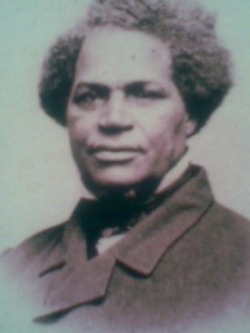
Another portrait included four of Rosetta's daughters and one of her granddaughters with what appeared to be an interracial couple identified only as Mr. and Mrs. Bruce. He was too young to have been Blanche K. Bruce. The picture looks like it was taken in the parlor at Cedar Hill.
Several unidentified women appeared in the album. I wondered if one of the portraits of a white lady in a hoop skirt was Julia Griffiths.
In any case, I shall turn to their collections for several of the images for the book.
Monday, April 4, 2011
Chapter 2 Has Left the Building!
The "shitty first draft" of my first completed chapter of Frederick Douglass's Women is now finished!
Yes, the title of this post says "Chapter 2," and it is the second chapter of the overall manuscript. No one says you have to write the thing in order, right?
When I wrote the public talk that I gave at Le Moyne and Montgomery Colleges, I had envisioned the first near half of it as being "Chapter 2: Anna Murray, Mrs. Frederick Douglass." Then I agreed to submit the paper for a workshop at SUNY-Binghamton. As I revised the colloquial language out and added more detail in, I found that the first chunk grew longer and longer and longer. "This is becoming a chapter as I write," I thought. So, I lopped off the last part, and committed to the chapter.
Now, it's done and ready to enter the workshop ring this Friday!
Even better, parts of other chapters are written, as well.
Yes, the title of this post says "Chapter 2," and it is the second chapter of the overall manuscript. No one says you have to write the thing in order, right?
When I wrote the public talk that I gave at Le Moyne and Montgomery Colleges, I had envisioned the first near half of it as being "Chapter 2: Anna Murray, Mrs. Frederick Douglass." Then I agreed to submit the paper for a workshop at SUNY-Binghamton. As I revised the colloquial language out and added more detail in, I found that the first chunk grew longer and longer and longer. "This is becoming a chapter as I write," I thought. So, I lopped off the last part, and committed to the chapter.
Now, it's done and ready to enter the workshop ring this Friday!
Even better, parts of other chapters are written, as well.
Tuesday, February 15, 2011
"Anna Murray, Mrs. Frederick Douglass" at Montgomery College, Takoma Park, MD
For those who could not make the talk in Syracuse, I'll be giving an encore presentation at Montgomery College, Takoma Park, Maryland, on Tuesday, March 1st, at 1 pm in The Commons building, room 211.

In this talk, I do more than speculate on bandannas, hounds and spoons. Instead, I'm exploring ways to conceptualize Anna Douglass's world and her marriage to Frederick. He does not come off very well in this paper. There are reasons for that, and reasons for those reasons; but this is Anna's turn to be center stage -- whether she likes it or not -- and there are key points on which he behaves less than admirably from her point of view.
Thursday, February 10, 2011
Rockin' the House at LeMoyne College at 7 pm Tonight!
For those who might happen to be passing through Syracuse, New York, this evening:
I will be giving a talk at Le Moyne College, Syracuse, New York, at 7:00 pm in the college's Grewen Auditorium.
The talk will be "Anna Murray, Mrs. Frederick Douglass," in which I will outline Anna Murray Douglass's life, address the way historians have portrayed her, and discuss the limited evidence that we have in reconstructing her life. Then -- may my powers be up to the task at this point -- I will bring it all home and explain how this relationship is important in understanding Frederick Douglass and the lives of free black women such as Anna.
Aside from presenting what will be an awesome paper to an undergraduate audience, I am hammering out what will become essentially 1 1/2 - 2 chapters in the book.
I will be giving a talk at Le Moyne College, Syracuse, New York, at 7:00 pm in the college's Grewen Auditorium.
The talk will be "Anna Murray, Mrs. Frederick Douglass," in which I will outline Anna Murray Douglass's life, address the way historians have portrayed her, and discuss the limited evidence that we have in reconstructing her life. Then -- may my powers be up to the task at this point -- I will bring it all home and explain how this relationship is important in understanding Frederick Douglass and the lives of free black women such as Anna.
Aside from presenting what will be an awesome paper to an undergraduate audience, I am hammering out what will become essentially 1 1/2 - 2 chapters in the book.
Wednesday, February 9, 2011
Spoons?
In "Recollections of My Mother," Rosetta Douglass Sprague described her parents early days of marriage in New Bedford:
The little that they possessed was the outcome of the industrial and economical habits that were characteristic of my mother. She had brought with her sufficient goods and chattels to fit up comfortably two rooms in her New Bedford home – a feather bed with pillows, bed linen, dishes, knives, forks and spoons, besides a well filled trunk of wearing apparel for herself.In 1872, just after the Douglass house in Rochester burned, Ottilia Assing wrote to her sister Ludmilla (in the same letter, as you will see, in which she clued me in to the possibility that Anna wore a wig):
Eleven thousand dollars in U.S. bonds burnt, probably because this stupid old hag totally lost her head, as it usually happens with uneducated people, for she had plenty of time to save them, and as they were deposited in a light tin box in her bedroom, and it had been forcefully drummed into her head what to safe first in case of an accident, no other explanation is possible. She probably thought more of her wig and some dozen silver spoons.Same spoons?
Friday, February 4, 2011
Another Bit about the Bandanna
In 1872, the Douglass house in Rochester burned down. In the aftermath, Ottilie Assing wrote to her sister Ludmilla excoriating Anna for the loss of an estimated $11,000 bond and securities. Her invective was vicious, classist, and racist; but, in them, she passed on an odd piece of information. After calling Anna a "hag," Assing wrote, "She probably thought more of her wig and some dozen silver spoons."
A wig? Let's take a look at a photograph of Anna (the last was a copy of a photograph, and I'd be interested in seeing the original.) This one, also in the Cedar Hill collections, was taken sometime just before the Civil War:

Is that perhaps a wig that she is wearing? Does Cedar Hill have evidence of Anna Douglass having worn a wig? She was a dark-skinned woman, so having hair that straight would be unusual, wouldn't it? Did black women straighten their hair in the 1850s? Or does a wig explain the texture? If so, then that might also explain the bandanna.
In fact, now that I'm thinking about it. There is a collection at the Nebraska Historical Society that includes clippings of the Douglass family's hair. I distinctly remember Frederick's because it was long like in his portraits, and Rosetta's, because it was so rich. I don't remember Anna's, and the woman who kept the clippings was good friends with Anna.
I need to check on these things. I have no idea what they will mean in the end, but with someone who left behind so little for a historian to work with, I have to take what I can get, where I can get it, and try to understand her life through it.
Saturday, January 29, 2011
Anna Douglass's Bandanna
Most accounts of Anna Douglass mention her dark skin. Ottilia Assing, before she had reason to be jealous, described her as, "completely black," in contrast to Frederick Douglass's lighter skin. Fredericka Bremer, also contrasting Anna's color with that of her husband, wrote: "It was his wife and little daughter I spoke of as being very black."
Frederick Douglass's biographers have also weighed in on her appearance. Benjamin Quarrels wrote, "Her straight black hair and her inexpressive features gave her face an Indian cast." Dickson Preston went so far as to add, "Anna was dark and quiet." William McFeely, who insists that Anna was not only quiet but inarticulate, had his own embellishments: "Anna was a full-lipped, ample woman. Her skin was deeper and richer in color than Frederick’s, and her eyes were softer and wittier than his, which seldom relaxed their watchful intensity." Arna Bontemps flat out said, "Anna Murray was not blessed with good looks."
Her inability to read also figures into these accounts, as do comparisons with Douglass's second, white wife, Helen Pitts, and efforts to portray her as the model Victorian housewife. Those are all issues to develop at another time.
Yes, Anna was dark. What of it? Seriously, what of it? What does her dark skin reveal about her? The contrasts with Douglass were explicit, and his contemporaries noted that his lighter skin tone indicated the miscegenation that he himself addressed in his autobiographies. The implication, then, would be that Anna's ancestry had less miscegenation than her husband's and that more of her predecessors came from Africa than from Europe. (I'm not quite sure of what to do with the constant genealogical references to possible Native American ancestry, all unsubstantiated, yet. That's another line of inquiry.) White people, even among Douglass's allies, found a closer tie to Africa either distasteful, as in the case of Bremer, or a political asset. "I wish he were full blood black for I fear your pro-slavery people will attribute his pre-eminent abilities to the white blood that is in his veins," Catherine Clarkson wrote to Maria Weston Chapman, in 1846. What of his wife, then, who was assumed to be "full blood black"? How did she react to this politicizing of her husband's and, by extension, her skin color? The color, in fact, seems to become less about the person than the color itself, a fetish.
I wonder about Anna's African ancestry and how that would fit into her experience. Her father was supposed to have been named Bambarra, according to Rosetta Douglass Sprague's memoir. Bambarra was the name of a group of people along the Senegambian River and a name the European traders gave to anyone captured and traded at the mouth of the river, regardless of their actual background. Given that she was born sometime around 1813 and was supposed to have been the 8th child of her parents, both of her mother and father -- like Douglass's mother and grandmother -- were born before the U.S. had withdrawn from the trans-Atlantic slave trade. This line of questioning will require a little more digging into the trade patterns on the Eastern Shore; but the hypothesis here is that her father or a grandparent came from either Africa or -- since a many Chesapeake slaves were imported from the Caribbean -- Barbados. This African lineage was linked to Anna's appearance. The color of her skin, being of such note to Frederick's associates, set her apart from them and could have affected her relationship with her husband both in his view of her and in her reticence in his world.
I seem to have digressed. I started this post with the intention of getting to this one detail that has intrigued me for the past few days. Benjamin Quarrels quotes a letter from Minnie Blackall Bishop to Charles H. Wiltsie, written in 1929, in which she wrote that Anna would wear a "'dark cotton dress and a red bandanna on her head'." This letter is in the Rochester Public Library, so it is on my list to find this summer, as is Jane Marsh Parker's and reminiscences.
The red bandanna caught my attention. White women did not tend to dress like that. They wore caps and bonnets and hats. Go south, however, to Savannah, to Charleston, to plantations, and black women wore scarves around their heads. Scarves protected their hair; and Stephanie Camp argues that, under those scarves, women braided and styled their hair in a creative expression of self, claiming their bodies as their own in defiance of the system of slavery. Scarves also hearkened back to the African practice of headwraps.
Was her bandanna a connection to her African ancestry, a persistence of African folkways on the Eastern Shore? I find this detail intriguing too because, just as Camp argues for enslaved women's use of fashion and appearance as an expression of self, this detail might also be an expression of Anna's self. Perhaps she had always worn a headwrap, a scarf, since her days in Baltimore and saw no reason to give it up in the North. Perhaps the scarf represented home, her past, part of where she came from, and nothing to be ashamed of or discard.
I have an idea about Anna that she had a strong sense of herself. Herself, however, was constantly in a world hostile to her race. Her husband brought her into a world that could be very patronizing toward her, and both he and his world -- largely white, predominantly middle class, lettered -- sent her many messages that she was somehow unfit or in need of improvement. I think she had a different definition of herself and had to hold herself in opposition to them to maintain her identity. The headwrap might be a small example of that identity.
Sunday, January 23, 2011
On Trusting Secondary Sources
How do you trust your secondary sources when you check their primary source and discover that the primary source does not say what the secondary source purports it to say? In fact, the primary source doesn't even touch on the subject.
I keep coming across this problem. An interesting "fact" crops up in a secondary source, one that seems less well-known or that I haven't heard of before. Interested in the primary source for that (and hoping that the primary source will be something new that will give me greater insight into my own inquiries), I check the notes. The notes cite another secondary source. So, I go to that secondary source. That secondary source often cites and another, which cites another, and I end up on a scavenger hunt to find this elusive primary source. Then, when I finally find a reference to a primary source, I look at the primary source and that alleged fact is nowhere in that primary source.
Thus far, I have found this sort of problem consistently with much having to do with Douglass's youth in Maryland, with much surrounding Anna Douglass, and with anything connected to the Underground Railroad (which is a whole other messy area in which what happened and what people wanted to happen get all mixed up and repeated as fact). Right now, I'm tangling with sources that describe bits about Frederick and Anna's meeting and her influence upon him during their early relationship for which I cannot find primary sources -- and I really really want those primary sources!
The first bit has to do with the free black East Baltimore Mental Improvement Society, which Douglass mentions in passing in his autobiographies. He is, in fact, the only primary source for that organization, and he will probably always be that only primary source. The little group of free black men and their one slave member may have passed into obscurity had it not been for that one slave member writing about their contributions to his development and then going on to be the most famous black man of the nineteenth century.
The second bit has to do with Douglass and the violin. Two secondary sources say that Anna encouraged Frederick to learn to play the violin and that they purchased sheet music together in Baltimore. Secondary source A cites secondary source B, and secondary source B cites My Bondage and My Freedom, which says nothing of the sort. Secondary source A, in fact, goes so far as to say that Anne herself played the violin. Secondary source A again cites secondary source B as well as another secondary source on the first mention of Anna's purported skill, then cites a 19th century secondary source on the second mention. I confess that I haven't seen the 19th century source as yet, and am grateful for the notation, so that bit of information may develop further. Nevertheless, I've now come across yet another 19th century source that says that Douglass took up the violin in England. I know from his own hand that he did know how to play at least one song by the time he was in England -- "Camels a'Comin'" -- in 1846. Was that actually something that he had just learned in the previous year while also making speech after speech in town after town? Was he so beloved that his hosts never mentioned the screetching of a beginning violinist?
In any case, what does this matter? Back at the Douglass Papers, these sorts of trivial-seeming research questions and tasks (all of which I loved because they were like detective work) all resulted in annotations. In fact, this sort of research led me to the questions that produced this book project. Annotations, however, are a very different creature than an oblique biography. An oblique biography demands that the details support some purpose.
In the case of the violin, I'm not entirely sure what a confirmation of that fact will tell, but it will go in the pile of evidence about Anna's life that will ultimately produce a more complicated picture of her or, at the very least, add to the set of questions about her life that seem to define the -- to use an artistic term -- negative space around the image of her and might go toward explaining more about the arc of the Douglass courtship and marriage. Certainly his ability to play the violin created a point of connection with his second wife, Helen. What role, if any, did it play in his life with Anna? What, in fact, did skill on the violin mean to them, other than a night's entertainment?
In any case, in portraying Anna, I'm finding that I am portraying a set of possibilities rather than a set of facts or even a testable theory. I want to be very clear about that in my text (or, depending upon the editor's choice, in my notes) because I want readers to be able to trust my assertions or at least test me by going to the primary source.
 Image: Frederick Douglass's violin, located at Cedar Hill, his home in Anacostia, D.C., now part of the National Parks Service.
I keep coming across this problem. An interesting "fact" crops up in a secondary source, one that seems less well-known or that I haven't heard of before. Interested in the primary source for that (and hoping that the primary source will be something new that will give me greater insight into my own inquiries), I check the notes. The notes cite another secondary source. So, I go to that secondary source. That secondary source often cites and another, which cites another, and I end up on a scavenger hunt to find this elusive primary source. Then, when I finally find a reference to a primary source, I look at the primary source and that alleged fact is nowhere in that primary source.
Thus far, I have found this sort of problem consistently with much having to do with Douglass's youth in Maryland, with much surrounding Anna Douglass, and with anything connected to the Underground Railroad (which is a whole other messy area in which what happened and what people wanted to happen get all mixed up and repeated as fact). Right now, I'm tangling with sources that describe bits about Frederick and Anna's meeting and her influence upon him during their early relationship for which I cannot find primary sources -- and I really really want those primary sources!
The first bit has to do with the free black East Baltimore Mental Improvement Society, which Douglass mentions in passing in his autobiographies. He is, in fact, the only primary source for that organization, and he will probably always be that only primary source. The little group of free black men and their one slave member may have passed into obscurity had it not been for that one slave member writing about their contributions to his development and then going on to be the most famous black man of the nineteenth century.
The second bit has to do with Douglass and the violin. Two secondary sources say that Anna encouraged Frederick to learn to play the violin and that they purchased sheet music together in Baltimore. Secondary source A cites secondary source B, and secondary source B cites My Bondage and My Freedom, which says nothing of the sort. Secondary source A, in fact, goes so far as to say that Anne herself played the violin. Secondary source A again cites secondary source B as well as another secondary source on the first mention of Anna's purported skill, then cites a 19th century secondary source on the second mention. I confess that I haven't seen the 19th century source as yet, and am grateful for the notation, so that bit of information may develop further. Nevertheless, I've now come across yet another 19th century source that says that Douglass took up the violin in England. I know from his own hand that he did know how to play at least one song by the time he was in England -- "Camels a'Comin'" -- in 1846. Was that actually something that he had just learned in the previous year while also making speech after speech in town after town? Was he so beloved that his hosts never mentioned the screetching of a beginning violinist?
In any case, what does this matter? Back at the Douglass Papers, these sorts of trivial-seeming research questions and tasks (all of which I loved because they were like detective work) all resulted in annotations. In fact, this sort of research led me to the questions that produced this book project. Annotations, however, are a very different creature than an oblique biography. An oblique biography demands that the details support some purpose.
In the case of the violin, I'm not entirely sure what a confirmation of that fact will tell, but it will go in the pile of evidence about Anna's life that will ultimately produce a more complicated picture of her or, at the very least, add to the set of questions about her life that seem to define the -- to use an artistic term -- negative space around the image of her and might go toward explaining more about the arc of the Douglass courtship and marriage. Certainly his ability to play the violin created a point of connection with his second wife, Helen. What role, if any, did it play in his life with Anna? What, in fact, did skill on the violin mean to them, other than a night's entertainment?
In any case, in portraying Anna, I'm finding that I am portraying a set of possibilities rather than a set of facts or even a testable theory. I want to be very clear about that in my text (or, depending upon the editor's choice, in my notes) because I want readers to be able to trust my assertions or at least test me by going to the primary source.
Thursday, January 20, 2011
The Perils of Being In Love With Your Subject
"Until our own time, history focussed on man the achiever; the higher the achiever the more likely it was that the woman who slept in his bed would be judged unworthy of his company. Her husband's fans recoiled from the notion that she might have made a significant contribution towards his achievement of greatness. The possibility that a wife might have been closer to their idol than they could ever be, understood him better than they ever could, could not be entertained." -- Germaine Greer, Shakespeare's Wife (London: Bloomsbury, 2007), 1.
Germaine Greer's assessment of Shakespeare's biographers reminded me also of Annette Gordon-Reed's assessment of Thomas Jefferson scholars who were not so much appalled that their favorite Founding Father had sex so much as that he had sex with an African American woman. These two scholars focused on women who, like Anna Murray Douglass, left behind no surviving documents in their own hand. The view of each woman comes from those around her, her actions, and how various people have chosen to remember and interpret her life. To discern the person through these layers of interpretation, the intent and meaning of her actions is a delicate task. In fact, sometimes it feels like a violation, an act of supreme hubris, and often aggression. We historians are nasty creatures sometimes, are we not?
I'm still rooting out what contemporaries have said, so my task for the week involves collecting historians' interpretations of Anna. Right now, I'm still in that state in which you just have a general impression of the consensus, but haven't really dissected your findings and engaged in an intelligent dialogue. One consistent element that I find is that her life lends itself to embellishment that perhaps overemphasizes, without evidence, her participation in such things as the aid of fugitives and the anti-slavery movement. I'm looking for the evidence, trust me! Nonetheless, this overemphasis seems more to portray her as the proper helpmeet for Douglass rather than to understand how she defined herself. I don't think Douglass's biographers have been as guilty of sexism or racism as Greer and Gordon-Reed charge the biographers of Shakespeare and Jefferson. I trust that they do want to give her her due. They just have not focused on Anna as subject, only as indirect object, and therefore have not fully considered her experience or range of options.
I could be wrong, of course. As I wrote, I have not yet deeply analyzed my findings; but I did want to write out my general impression. Also, I wanted a blog post for the day!
Germaine Greer's assessment of Shakespeare's biographers reminded me also of Annette Gordon-Reed's assessment of Thomas Jefferson scholars who were not so much appalled that their favorite Founding Father had sex so much as that he had sex with an African American woman. These two scholars focused on women who, like Anna Murray Douglass, left behind no surviving documents in their own hand. The view of each woman comes from those around her, her actions, and how various people have chosen to remember and interpret her life. To discern the person through these layers of interpretation, the intent and meaning of her actions is a delicate task. In fact, sometimes it feels like a violation, an act of supreme hubris, and often aggression. We historians are nasty creatures sometimes, are we not?
I'm still rooting out what contemporaries have said, so my task for the week involves collecting historians' interpretations of Anna. Right now, I'm still in that state in which you just have a general impression of the consensus, but haven't really dissected your findings and engaged in an intelligent dialogue. One consistent element that I find is that her life lends itself to embellishment that perhaps overemphasizes, without evidence, her participation in such things as the aid of fugitives and the anti-slavery movement. I'm looking for the evidence, trust me! Nonetheless, this overemphasis seems more to portray her as the proper helpmeet for Douglass rather than to understand how she defined herself. I don't think Douglass's biographers have been as guilty of sexism or racism as Greer and Gordon-Reed charge the biographers of Shakespeare and Jefferson. I trust that they do want to give her her due. They just have not focused on Anna as subject, only as indirect object, and therefore have not fully considered her experience or range of options.
I could be wrong, of course. As I wrote, I have not yet deeply analyzed my findings; but I did want to write out my general impression. Also, I wanted a blog post for the day!
Saturday, January 15, 2011
Compiling the Evidence: Frederick Douglass on Anna Murray Douglass
These are some of the things that Douglass wrote directly about his first wife, Anna Murray Douglass.
Narrative (1845):
“At this time, Anna* [*She was free], my intended wife, came on; for I wrote to her immediately after my arrival at New York, (notwithstanding my homeless, houseless, and helpless condition,)informing her of my successful flight, and wishing her to come on forthwith. In a few days after her arrival, Mr. Ruggles called in the Rev. J.W.C. Pennington, who, in the presence of Mr. Ruggles, Mrs. Michaels, and two or three others, performed the marriage ceremony, and gave us a certificate, of which the following is an exact copy: --
My Bondage and My Freedom (1855):
“I was hidden with Mr. Ruggles several days. In the meantime, my intended wife, Anna, came on from Baltimore – to whom I had written, informing her of my safe arrival at New York – and, in the presence of Mrs. Mitchell and Mr. Ruggles, we were married, by Rev. James W.C. Pennington.” Mentions “we” in relating his living conditions in New Bedford. Then, he wrote, “During the hardest of the winter, I hired out for nine dollars a month; and out of this rented two rooms for nine dollars per quarter, and supplied my wife – who was unable to work – with food and some necessary articles of furniture.”
Life and Times of Frederick Douglass (Gates version is the 1893 version – check the earlier and later versions):
“With Mr. Ruggles, on the corner of Lispenard and Church streets, i was hidden several days, during which time my intended wife came on from Baltimore at my call, to share the burdens of life with me. She was a free woman, and came at once on getting the good news of my safety. We were married by Rev. J.W.C. Pennington, then a well-known and respected Presbyterian minister. I had no money with which to pay the marriage fee, but he seemed well pleased with our thanks.” He uses the pronoun “we” through the rest of the paragraph
FD to Maria Weston Chapman, 10 September 1843, from Cambridge, Indiana, on page 13 of the first volume of Douglass’s correspondence by the Frederick Douglass Papers project:
“P.S. I have received a few lines from my wife asking for means to carry on household affair[.] I have not to send hir[.] Will you please see that she is provided with $25 or $30.”
FD to Harriet Bailey (aka Ruth Cox, Ruth Adams, and Harriet Adams), 16 May 1846, from England, on page 125 of the first volume of Douglass’s correspondence by the Frederick Douglass Papers project:
“Read the enclosed letter which I send to my Dear Anna over and over again till she can fully understand its contents[.]”
FD to Isabel Jennings, 22 September 1846, from Glasgow, Scotland, on page 166 of the first volume of Douglass’s correspondence by the Frederick Douglass Papers project:
“You may easily suppose the conclusion come to reluctantly when I tell you I had already written to my Anna telling her to expect me home on the 20th Nov. It will cost her some pain. Disappointment is the common lot of all – this may afford slight relief till I come.” (He had decided to stay in Britain for a bit longer after having been absent for a year.)
FD to Anna Richardson, 29 April 1847, from home in Lynn, Massachusetts, on page 208-209 of the first volume of Douglass’s correspondence by the Frederick Douglass Papers project:
“I am once more at home; once more with the wife of my bosom, and in the midst of the dear children of my love…My dear Anna is not well, but much better than I expected to find her, as she seldom enjoys good health. She feels exceedingly happy to have me once more at home. She had not allowed herself to expect me much, for fear of being disappointed; but she was none the less glad to see me on that account…Dear Anna and myself are intending to visit Albany in a few days: and we shall then see our only girl Rosetta.“
FD to Thomas Auld, 8 Sept. 1848, published in North Star, source here is the first volume of Douglass’s correspondence by the Frederick Douglass Papers project (312-313) and can also be found in their edition of My Bondage and My Freedom:
“I married soon after leaving you: in fact, I was engaged to be married before I left you, and instead of finding my companion a burden, she was truly a helpmeet. She went to live at service, and I to work on the wharf, and though we toiled hard the first winter, we never lived more happily….So far as my domestic affairs are concerned, I can boast of as comfortable a dwelling as your own. I have an industrious and neat companion….”
FD to Lydia Dennett, a Maine abolitionist, 17 April 1857, the original is in the Houghton at Harvard, this comes from Philip Foner’s edition, Frederick Douglass on Women’s Rights, page 21-22:
“Suppose I begin with my wife. I am sad to say that she is by no means well – and if I should write down all her complaints there could be no room even to put my name at the bottom, although the world will have it that I am actually at the bottom of it all. She has the face – I was going to use terms scarcely up to the standard of modern elegance – neuraligia. She has a great deal to do, but little time to do it in, and withal much to try her patience and all her other very many virtues. You have doubtless in your experience, met with many excellent wives and mothers, who have been in very much the same condition in which my wife is. She has suffered in every member except one. She still seems able to use with great ease and fluency her powers of speech, and by the time I am at home a week or two longer, I shall have pretty fully learned in how many points there is need of improvement in my temper and disposition as a husband and father, the head of a family! Amid all the vicissitudes, however, I am happy to say that my wife gives me an excellent loaf of bread and keeps a neat house, and has moments of marked amiability, of all which good things, I do not fail to take due advantage." (Well, Me-ow.)
FD to Doctress S. M. Loguen, 12 August 1882, after Anna Douglass’s death on August 4, just a week earlier; the original is at Howard (have to haul my rear-end over there), this is quoted in Philip Foner’s edition, Frederick Douglass and Women’s Rights, page 22:
“Mother was the post in the center of my house and held us together.”
I'm sure this isn't all he had to say about Anna. That is, not all he had to say about her in writing. I'm sure he had much to say in all manner of ways in life. They were, after all, married for a long time.
Now, to compile what others have said about her both in her time and since, especially historians, and figure out what it all means. I do know one thing: She's rather a blank slate, given that she left no writing from her own hand, so people liked to project on to her what they wanted or needed her to be.
Narrative (1845):
“At this time, Anna* [*She was free], my intended wife, came on; for I wrote to her immediately after my arrival at New York, (notwithstanding my homeless, houseless, and helpless condition,)informing her of my successful flight, and wishing her to come on forthwith. In a few days after her arrival, Mr. Ruggles called in the Rev. J.W.C. Pennington, who, in the presence of Mr. Ruggles, Mrs. Michaels, and two or three others, performed the marriage ceremony, and gave us a certificate, of which the following is an exact copy: --
‘THIS may certify, that I joined together in holy matrimony Frederick Johnson+ [+I had changed my name from Frederick Bailey to that of Johnson] and Anna Murray, as man and wife, in the presence of Mr. David Ruggles and Mrs. Michaels.Upon receiving this certificate, and a five-dollar bill from Mr. Ruggles, I shouldered on part of our baggage, and Anna took up the other, and we set out forthwith to take passage on board of the steamboat John W. Richmond for Newport, on our way to New Bedford.”
JAMES W.C. PENNIGTON.New York, Sept. 15, 1838’
My Bondage and My Freedom (1855):
“I was hidden with Mr. Ruggles several days. In the meantime, my intended wife, Anna, came on from Baltimore – to whom I had written, informing her of my safe arrival at New York – and, in the presence of Mrs. Mitchell and Mr. Ruggles, we were married, by Rev. James W.C. Pennington.” Mentions “we” in relating his living conditions in New Bedford. Then, he wrote, “During the hardest of the winter, I hired out for nine dollars a month; and out of this rented two rooms for nine dollars per quarter, and supplied my wife – who was unable to work – with food and some necessary articles of furniture.”
Life and Times of Frederick Douglass (Gates version is the 1893 version – check the earlier and later versions):
“With Mr. Ruggles, on the corner of Lispenard and Church streets, i was hidden several days, during which time my intended wife came on from Baltimore at my call, to share the burdens of life with me. She was a free woman, and came at once on getting the good news of my safety. We were married by Rev. J.W.C. Pennington, then a well-known and respected Presbyterian minister. I had no money with which to pay the marriage fee, but he seemed well pleased with our thanks.” He uses the pronoun “we” through the rest of the paragraph
FD to Maria Weston Chapman, 10 September 1843, from Cambridge, Indiana, on page 13 of the first volume of Douglass’s correspondence by the Frederick Douglass Papers project:
“P.S. I have received a few lines from my wife asking for means to carry on household affair[.] I have not to send hir[.] Will you please see that she is provided with $25 or $30.”
FD to Harriet Bailey (aka Ruth Cox, Ruth Adams, and Harriet Adams), 16 May 1846, from England, on page 125 of the first volume of Douglass’s correspondence by the Frederick Douglass Papers project:
“Read the enclosed letter which I send to my Dear Anna over and over again till she can fully understand its contents[.]”
FD to Isabel Jennings, 22 September 1846, from Glasgow, Scotland, on page 166 of the first volume of Douglass’s correspondence by the Frederick Douglass Papers project:
“You may easily suppose the conclusion come to reluctantly when I tell you I had already written to my Anna telling her to expect me home on the 20th Nov. It will cost her some pain. Disappointment is the common lot of all – this may afford slight relief till I come.” (He had decided to stay in Britain for a bit longer after having been absent for a year.)
FD to Anna Richardson, 29 April 1847, from home in Lynn, Massachusetts, on page 208-209 of the first volume of Douglass’s correspondence by the Frederick Douglass Papers project:
“I am once more at home; once more with the wife of my bosom, and in the midst of the dear children of my love…My dear Anna is not well, but much better than I expected to find her, as she seldom enjoys good health. She feels exceedingly happy to have me once more at home. She had not allowed herself to expect me much, for fear of being disappointed; but she was none the less glad to see me on that account…Dear Anna and myself are intending to visit Albany in a few days: and we shall then see our only girl Rosetta.“
FD to Thomas Auld, 8 Sept. 1848, published in North Star, source here is the first volume of Douglass’s correspondence by the Frederick Douglass Papers project (312-313) and can also be found in their edition of My Bondage and My Freedom:
“I married soon after leaving you: in fact, I was engaged to be married before I left you, and instead of finding my companion a burden, she was truly a helpmeet. She went to live at service, and I to work on the wharf, and though we toiled hard the first winter, we never lived more happily….So far as my domestic affairs are concerned, I can boast of as comfortable a dwelling as your own. I have an industrious and neat companion….”
FD to Lydia Dennett, a Maine abolitionist, 17 April 1857, the original is in the Houghton at Harvard, this comes from Philip Foner’s edition, Frederick Douglass on Women’s Rights, page 21-22:
“Suppose I begin with my wife. I am sad to say that she is by no means well – and if I should write down all her complaints there could be no room even to put my name at the bottom, although the world will have it that I am actually at the bottom of it all. She has the face – I was going to use terms scarcely up to the standard of modern elegance – neuraligia. She has a great deal to do, but little time to do it in, and withal much to try her patience and all her other very many virtues. You have doubtless in your experience, met with many excellent wives and mothers, who have been in very much the same condition in which my wife is. She has suffered in every member except one. She still seems able to use with great ease and fluency her powers of speech, and by the time I am at home a week or two longer, I shall have pretty fully learned in how many points there is need of improvement in my temper and disposition as a husband and father, the head of a family! Amid all the vicissitudes, however, I am happy to say that my wife gives me an excellent loaf of bread and keeps a neat house, and has moments of marked amiability, of all which good things, I do not fail to take due advantage." (Well, Me-ow.)
FD to Doctress S. M. Loguen, 12 August 1882, after Anna Douglass’s death on August 4, just a week earlier; the original is at Howard (have to haul my rear-end over there), this is quoted in Philip Foner’s edition, Frederick Douglass and Women’s Rights, page 22:
“Mother was the post in the center of my house and held us together.”
I'm sure this isn't all he had to say about Anna. That is, not all he had to say about her in writing. I'm sure he had much to say in all manner of ways in life. They were, after all, married for a long time.
Now, to compile what others have said about her both in her time and since, especially historians, and figure out what it all means. I do know one thing: She's rather a blank slate, given that she left no writing from her own hand, so people liked to project on to her what they wanted or needed her to be.
Tuesday, January 11, 2011
"Anna Murray, Mrs. Frederick Douglass," at Le Moyne College, Feb. 10th
I will be giving a talk at Le Moyne College, Syracuse, New York, on Thursday, February 10, 2011, at 7:00 pm in the college's Grewen Auditorium.
The talk will be "Anna Murray, Mrs. Frederick Douglass," in which I will outline Anna Murray Douglass's life, address the way historians have portrayed her, and discuss the limited evidence that we have in reconstructing her life. Then -- may my powers be up to the task at this point -- I will bring it all home and explain how this relationship is important in understanding Frederick Douglass and the lives of free black women such as Anna.
Aside from presenting what I hope will be an awesome paper to an undergraduate audience, I am hammering out what will become essentially 1 1/2 - 2 chapters in the book.
The talk will be "Anna Murray, Mrs. Frederick Douglass," in which I will outline Anna Murray Douglass's life, address the way historians have portrayed her, and discuss the limited evidence that we have in reconstructing her life. Then -- may my powers be up to the task at this point -- I will bring it all home and explain how this relationship is important in understanding Frederick Douglass and the lives of free black women such as Anna.
Aside from presenting what I hope will be an awesome paper to an undergraduate audience, I am hammering out what will become essentially 1 1/2 - 2 chapters in the book.
Sunday, January 9, 2011
Method to My Madness
The book itself is what I'm taking to calling a "sideways" or "oblique" biography. That is, I'm approaching Douglass through the women with whom he lived and associated, both public and private and at the intersection of both.
Other historians have used this method more frequently in recent years. The most famous would be, of course, Annette Gordon-Reed's acclaimed The Hemings of Monticello. Although she focuses on the Hemings family, I couldn't help but feel as if I were reading a biography of Jefferson, too. Not a full-blown, traditional biography, but a biography of him as a slaveholder, and the master of this particular family. Similarly, both John Kukla in Mr. Jefferson's Women (Random House, 2008) and Virginia Scharff in The Women Jefferson Loved (Harper Collins 2010) consider the ways that Jefferson interacted with women. Kukla focuses on Jefferson's romantic liaisons, while Scharff explores the connections of responsibility between Jefferson and the women closest to him. At the risk of drawing ire at those who dislike Thomas Jefferson: An Intimate Portrait, I'll venture that Fawn Brodie also observed Jefferson from the vantage point of women, as well. Then, beyond Jefferson scholarship, you can find Jane Glover's Mozart's Women: His Family, His Friends, His Music (Harper Collins, 2005) and Germaine Greer's (did you know that she was originally a Shakespeare scholar?) Shakespeare's Wife (Harper Collins, 2008). I'm sure other examples are out there. I could swear I saw a book about Elizabeth I and her women in the bookstore at the airport last month.*
From these oblique biographies emerges a pattern for this method of examining the Great Man (or, I suppose, Great Woman) from the point of view of a particular group of people in his life -- women, in most of these examples and in my own work. First, the author must reconstruct the lives of the women in question.The biography of the Great Man, then, also becomes a series of biographies about the women. In some cases, reconstructing a woman's life will be less difficult because she had the privilege that allowed her to leave the sorts of records that historians use for biography. In others, she become a hole in the narrative. The author must reconstruct everything around the woman in as much detail as possible in order to get some idea of who she could have been, always with the awareness that this portrayal is an educated guess.
Oddly enough, in my experience, I've had a more difficult time reconstructing Anna Murray's life as a free black woman than I have with Harriet or Betsy Bailey, Douglass's enslaved mother and grandmother. Enslaved women appear in a record because they had value to their masters as property. Free black women? They made their own way, hidden in other people's homes, their names changed in marriages that were often not recorded because their husbands were enslaved, and moving about frequently in order to find work. You might be able to reconstruct their lives as a group, but as individuals they prove quite elusive.
Getting back to the method, if the first order of business is to reconstruct the women's lives, the second is also to address the ways that other scholars have interpreted those lives -- if at all. Since the women in the lives of most Great Men, including their wives, appear as supporting characters, the women's historian who has begun reconstructing the women's lives often finds that historians have relied upon other historians who have relied upon yet other historians in order to form their own interpretation. The women's historian may also discover a new interpretation to the same stories simply by looking at the events from the women's point of view.
For instance, Scharff takes the romanticized tale of the Jefferson honeymoon and considers what the newlywed Martha Jefferson might have experienced riding up the mountain, soaked and shivering from the snowstorm, only to find a construction site, no fire and no food. In my case, I continually come across interpretations of the first Douglass marriage that describe him as disappointed. While that may be true, could she not have been disappointed herself? One you begin to tease out that thread, you begin to see the Great Man in a slightly different light.
Which leads to the third and most important part of the method: what do these relationships say about the Great Man himself? What new insight does the study offer into his life, his ideas, his work, and the events that he shapes? What, too, does that insight tell us about gender relationships at that period of time, and the lives of women?
This, then, is my method for the moment. I'm trying to reconstruct the lives of these various women by looking at what they wrote (if they wrote), what they did, what others wrote about them, and how other women in similar circumstances lived. I'm also looking at the ways that other historians have written about these women and their relationships to Douglass in order to see if I can synthesize and add to the conversation. Finally, I must figure out what it all means.
Then, of course, I must write it all out in an engaging and eloquent narrative for the audience's enjoyment!
---------------------
*I won't discuss the novel Douglass's Women here for a variety of reasons, but mostly because it is, in fact, a novel and not history.
Other historians have used this method more frequently in recent years. The most famous would be, of course, Annette Gordon-Reed's acclaimed The Hemings of Monticello. Although she focuses on the Hemings family, I couldn't help but feel as if I were reading a biography of Jefferson, too. Not a full-blown, traditional biography, but a biography of him as a slaveholder, and the master of this particular family. Similarly, both John Kukla in Mr. Jefferson's Women (Random House, 2008) and Virginia Scharff in The Women Jefferson Loved (Harper Collins 2010) consider the ways that Jefferson interacted with women. Kukla focuses on Jefferson's romantic liaisons, while Scharff explores the connections of responsibility between Jefferson and the women closest to him. At the risk of drawing ire at those who dislike Thomas Jefferson: An Intimate Portrait, I'll venture that Fawn Brodie also observed Jefferson from the vantage point of women, as well. Then, beyond Jefferson scholarship, you can find Jane Glover's Mozart's Women: His Family, His Friends, His Music (Harper Collins, 2005) and Germaine Greer's (did you know that she was originally a Shakespeare scholar?) Shakespeare's Wife (Harper Collins, 2008). I'm sure other examples are out there. I could swear I saw a book about Elizabeth I and her women in the bookstore at the airport last month.*
From these oblique biographies emerges a pattern for this method of examining the Great Man (or, I suppose, Great Woman) from the point of view of a particular group of people in his life -- women, in most of these examples and in my own work. First, the author must reconstruct the lives of the women in question.The biography of the Great Man, then, also becomes a series of biographies about the women. In some cases, reconstructing a woman's life will be less difficult because she had the privilege that allowed her to leave the sorts of records that historians use for biography. In others, she become a hole in the narrative. The author must reconstruct everything around the woman in as much detail as possible in order to get some idea of who she could have been, always with the awareness that this portrayal is an educated guess.
Oddly enough, in my experience, I've had a more difficult time reconstructing Anna Murray's life as a free black woman than I have with Harriet or Betsy Bailey, Douglass's enslaved mother and grandmother. Enslaved women appear in a record because they had value to their masters as property. Free black women? They made their own way, hidden in other people's homes, their names changed in marriages that were often not recorded because their husbands were enslaved, and moving about frequently in order to find work. You might be able to reconstruct their lives as a group, but as individuals they prove quite elusive.
Getting back to the method, if the first order of business is to reconstruct the women's lives, the second is also to address the ways that other scholars have interpreted those lives -- if at all. Since the women in the lives of most Great Men, including their wives, appear as supporting characters, the women's historian who has begun reconstructing the women's lives often finds that historians have relied upon other historians who have relied upon yet other historians in order to form their own interpretation. The women's historian may also discover a new interpretation to the same stories simply by looking at the events from the women's point of view.
For instance, Scharff takes the romanticized tale of the Jefferson honeymoon and considers what the newlywed Martha Jefferson might have experienced riding up the mountain, soaked and shivering from the snowstorm, only to find a construction site, no fire and no food. In my case, I continually come across interpretations of the first Douglass marriage that describe him as disappointed. While that may be true, could she not have been disappointed herself? One you begin to tease out that thread, you begin to see the Great Man in a slightly different light.
Which leads to the third and most important part of the method: what do these relationships say about the Great Man himself? What new insight does the study offer into his life, his ideas, his work, and the events that he shapes? What, too, does that insight tell us about gender relationships at that period of time, and the lives of women?
This, then, is my method for the moment. I'm trying to reconstruct the lives of these various women by looking at what they wrote (if they wrote), what they did, what others wrote about them, and how other women in similar circumstances lived. I'm also looking at the ways that other historians have written about these women and their relationships to Douglass in order to see if I can synthesize and add to the conversation. Finally, I must figure out what it all means.
Then, of course, I must write it all out in an engaging and eloquent narrative for the audience's enjoyment!
---------------------
*I won't discuss the novel Douglass's Women here for a variety of reasons, but mostly because it is, in fact, a novel and not history.
Subscribe to:
Posts (Atom)