Wednesday, June 10, 2015

More Love Advice

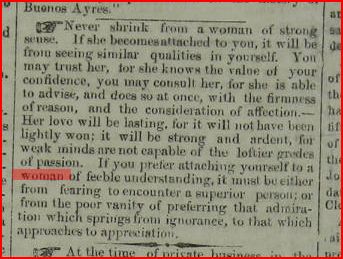
More advice on love from Frederick Douglass' Paper, 7 July 1857:

Never shrink from a woman of strong sense. If she becomes attached to you, it will be from seeing similar qualities in yourself. You may trust her, for she knows the value of your confidence, you may consult her, for she is able to advise, and does so at once, with the firmness of reason, and the consideration of affection. -- Her love will be lasting, for it will not have been lightly won; it will be strong and ardent, for weak minds are not capable of the loftier grades of passion. If you prefer attaching yourself to a woman of feeble understanding, it must be either from fearing to encounter a superior person; or from the poor vanity of preferring that admiration which springs from ignorance, to that which approaches to appreciation.


If this did not come from another paper, I suspect that the author was Julia Griffiths. Of course, Frederick Douglass would not have objected. He had a thing for women "of strong sense," both as wives and as friends.

Monday, June 8, 2015

Issues of Frederick Douglass' Paper

I've been meaning to post this for maybe two or three years. I'm a bit slow. I've also realized only last week that this blog's time zone was still set to Irish Summer Time, such as Ireland has a summer time.

Anyway, here is the point of the post:

No known full runs of the North Star or Frederick Douglass' Paper exist in any repository, microfilm edition, or database. Readex's America's Historical Newspapers  and African American Newspapers databases have some, but your library has to have a subscription. St. John Fisher College in Rochester has a few, which they have kindly digitized through New York Heritage Digital Collections, which is accessible to the public. You can find them here.They also include issues of Douglass' Monthly, full runs of which are available through academic libraries in print facsimiles, and the New National Era, full runs of which are available in microfilm through academic libraries.

Their collection also includes several other antislavery papers. One, The Radical Abolitionist, was edited by William Goodell, who was minister of the church in Honeoye (not that he was actually that was ordained) attended by Helen Pitts' family.

Sunday, June 7, 2015

Frederick Douglass in the News

"'Mount Misery': Frederick Douglass Confronts Donald Rumsfeld," from the Daily Beast, review of a play in which Douglass meets Rumsfeld. Rumsfeld, you know, owns the property where Edward Covey, the slave breaker in Douglass' Narrative, once lived.

"Famed Abolitionist Frederick Douglass 'Visits' Darlington During Annual Community Celebration," from the New Castle News (Pennsylvania).

"New York City's Juneteenth: Remembering Frederick Douglass's Eulogy to Abraham Lincoln at a Pivotal Moment in the City's Racial History," from the New York Daily News. (Yes, Texans, Juneteenth is celebrated everywhere.)

Friday, June 5, 2015

"Miss Rosa Douglass"

In the "Gleanings of News" column of Frederick Douglass' Paper, 13 January 1854:

    Miss Rosa Douglass has been holden in 
$500 at Norfolk, for assisting her mother, 
who has absconded, to teach negroes to read 
and write.
This is not Rosetta Douglass, Frederick daughter, however, but another woman with a similar name. Because Rosetta was working at the paper at that time, perhaps she saw this item in another paper and both she and her father thought it amusing and, perhaps, ironic. Her own mother, Anna, had "absconded" back in 1838 to marry Frederick Bailey (aka Johnson, aka Douglass), and Frederick had taught slaves, including himself, to read and write. Anna could not read, but perhaps Rosetta tried to help her learn at some point. Rosetta, after all, was the one who said her mother could read "a little," but she was also the one tied to both parents as her mother's amanuensis.

As for Norfolk, ten years after this notice, a future Douglass taught hundreds of former slaves to read and write. At the time, she was Helen Pitts, working for the American Missionary Association among the freedpeople at the epicenter of emancipation.

Thursday, June 4, 2015

Some Days I Have No Idea What He's Talking About

At the 1858 National Woman's Rights Convention in New York City, Douglass made this uncharacteristically short speech:
Loud calls were made for “Douglass,” when Fred. Douglass took the stand, and delivered a speech in behalf of woman’s rights. Having experienced slavery in his own person, it was impossible that he could be indifferent to any call for freedom. He based the rights of woman to freedom and to equality with man upon the same grounds on which he advocated the right of the slave to freedom and equality with the white race. The only difficulty that, in his opinion, existed anywhere in relation to this question was on that arose less out of the idea of rights than out of the idea of duties, or the idea of the possibilities of woman. What could woman do? Had been asked and answered generally, but he was inclined to think that woman herself was uneducated in a fuller notion of what she could do. He believed a woman could do anything a man could do, and by so doing could assimilate herself to man. If she handled the grubbing hoe instead of the needle her hands would become large and horny just as men’s hands do. There was no inherent principle of beauty in woman more than in man, for if they were to change places man would assume all that delicate texture of skin and beauty which woman has in her present position. He advocated the carrying out of the woman’s rights idea among the poorer classes, and instanced the fact of a man now building a house who was assisted by his wife in laying the bricks, splitting the wood, &c., and in such cases he saw the same hard features, hands, &c., both in man and woman.  On the plantation a woman was expected to hoe as many rows in a day as a man, and in consequence acquired physical strength and health; therefore a woman need not be afraid to go out West, for nature would furnish her with gloves of steel as well as the man. Let women go out there and do as in England, where the finest women, in his estimation, were working in the field.
The New York Times printed this variation:
Mr. Fred Douglass said he had never had the slightest difficulty with this question of woman's rights. On all the principles upon which he asserted the right of Slavery to freedom, he found that woman's rights could be based and would be based. The only difficulty in his opinion, existed anywhere in relation to this question was one that arose less out of the idea of rights than out of the idea of duties, or the idea of the possibilities of woman. What could woman do? had been asked and answered generally, but he was inclined to think that woman herself was uneducated in a fuller notion of what she could do. He believed that she could do anything that man could do, and by doing everything that man can do she would assimilate herself to man. if women could do as  men did they would look just about like what men did, and be able to do what men did. 
I suspect that he did not plan to make this speech or to speak at all at this convention. He had not appeared at a woman's rights convention since 1853, just before he and William Lloyd Garrison had a spectacular falling out (a longer story for another time -- or, as I call it, Chapters 4 and 5). Most of the women and men who attended the national and state conventions fell in line with Garrison, including Garrison himself. So, women's rights conventions were not something Douglass went out of his way to attend.

This one, however, took place for the first time during "Anniversary Week" in New York City, when and where Douglass was participating in two other meetings. My theory is that, as long as he was in town, he would slip into this one. Someone spotted him, hence "loud calls were made for Douglass," so he was obliged to say something.

But what on earth is he trying to say? This appears to be the outline of his speech:
1) I'm for women's rights.
2) The basis for women's rights and the emancipation of slaves is the same.
3) What can women do? That is the question.
4) Women can do anything a man can do, like physical labor, they just don't know it, yet.
5) In doing so, women assimilate to men. (Like the Borg? Is resistance futile?)

He seems to be intentionally uncontroversial here, but then he seldom said controversial things at women's rights conventions, as far as I can tell. At the American Equal Rights Association in the late 1860s, yes, but not at these antebellum conventions or at later woman suffrage conventions. His emphasis on physical labor is unusual, since he tended to focus on intellectual work. I'd like to think that this, as well as his mention of enslaved women, was his way of needling the largely white and middle class women's rights activists, who struggled to incorporate those groups into their national conventions.

I'd partly like to chalk this up to his being unprepared to speak, but he had always spoken extemporaneously.  Indeed, in later years, some of his old fans complained that they preferred his improvised speeches over his prepared ones. Of course, they may have been speaking more from nostalgia than from evidence. By 1858, he was making more prepared speeches, such as his "What to the American Slave is the Fourth of July?" So, he could have been rusty. Another possibility is that the transcription was rubbish.

The assimilation piece (joking aside) appears to be the key to fitting this speech in with his larger philosophy, once I figure it all out. Then, again, I'm not sure if he ever figured it all out. That actually makes me feel like he and I are puzzling through his ideas about women together. If only I could just turn to him and ask "really: what the heck do you mean here?"  Alas! A Ouija board is not a scholarly source, and he would never stop laughing disdainfully at the idea.

Wednesday, June 3, 2015

Elaboration on the Woman's Protective Union Advertised in the North Star

I found the "Woman's Protection Union" in the North Star when browsing for items about women, woman suffrage, or women's rights. The Union shows up only three more times, in notices for its meetings on October 3, 13, and 17, 1848, all three times called the "Woman's Protective Union."  They met at 3:00 in the Protection Hall, "corner of Main and St. Paul Streets," and "All interested in raising woman from her present state of degradation" and "friends of reform" were "respectfully invited to attend."

Not that I'm an expert on woman's rights organizations, but I had not come across this group before. They aren't in Rochester History, nor are they in Nancy Hewitt's Women's Activism and Social Change: Rochester, New York, 1822-1872, which is probably the best and most comprehensive book on the subject, or her published work on Amy Post. Obviously, this Union was short-lived and did not generate many records. 

According to Lisa Tetrault (among others), woman's rights activists resisted forming organization -- or at least national organizations -- in the antebellum era, working through temperance or antislavery societies. Also, in 1848, a woman's rights movement as such really did not exist. There was a sense of woman's rights, and women advocated for their own rights, but this took place within or in tandem with those other types of organizations. Even the Seneca Falls meeting was considered a blip rather than the beginning of something momentous. Although they knew of that convention, the woman's rights activists tended to date the beginning of the national movement to the 1850 Worcester Convention. 

So, this Woman's Protection Union is an anomaly. The members formed it on 18 Aug 1848, almost exactly a month after the Seneca Falls Woman's Rights Convention and two weeks after the more publicized (at the time) Rochester Woman's Rights Convention. Of its founders, Amy Post attended both conventions, signing the Seneca Falls "Declaration of Sentiments," and Sarah Owens and "Mrs. Roberts" spoke at the Rochester meeting. (I still have to do some investigation into "Mrs. Cavan") Both Owens and Roberts were concerned with discrimination against working women, which was clearly an important issue with the Woman's Protection Union given that they planned to continue their schedule of lower dues for women until "the time shall arrive that woman receive and equality of remuneration for the same labor performed as men." The meeting place, too, seems to have been a union hall, with the full name, "Hall of the Mechanics' Protection." 

This is also an attempt to form a reform society focused specifically on gender discrimination, placing it among the first -- if not the actual first -- explicitly woman's rights organizations in America. But, since I am not an expert on early organization, perhaps this last point can be debated.

Of course, Frederick Douglass was connected to it.

Sunday, May 31, 2015

A View Into the Office of Frederick Douglass' Paper, 1853

In a letter from "Communipaw" (James McCune Smith) to Frederick Douglass, printed in Frederick Douglass' Paper, 25 November 1853:
I certainly wish that our purse-proud brethren, who lazily sigh for the ease of England or Germany, or the oblivion of the steppes of Russia, in order to escape the duties which God has imposed on colored men in this land, could visit your home and your office for an hour, and witness the devotion of all your family to the success of your paper -- which is the success of the cause also -- one lad setting type, then folding, another feeding your new press, and Miss R.D. just budding into womanhood, laboring with pen in hand, by the side of our earnest and most efficient English benefactress - and the editor himself so selfishly proud and so superbly ambitious, in his shirt-sleeves, driving the press!

"Miss R.D." is, of course, Rosetta Douglass, Frederick's oldest daughter, who was fourteen at this point. He had a younger daughter, Annie, who was at home with her mother and Aunt Charlotte Murray, being only four.  The young men working the press were Lewis and Frederick, Jr., ages twelve and ten respectively. Charles, who was eight at this time, remembered that he joined them when he turned ten. The "most efficient English benefactress" was Julia Griffths, who was most important in ensuring that this paper continued production. 

This scenario fits with the reminiscences of all of the Douglass children, and one of the sons did mention that their father, at the urging of Anna, trained the boys in printing.  Frederick had begun his business with just such a goal in mind, not just for his own children but also to apprentice young black men who would have no other opportunities to learn the printing trade. In doing so, he would also help develop the black press. 

Little evidence exists about Rosetta during this period. I found entries concerning her aid to fugitive slaves in the Rochester Ladies' Antislavery Society account books in 1854 and 1857. Between 1855 and 1856, she attended Oberlin's Preparatory School, probably to gain enough education to become a teacher, which did not require a college degree at the time. She taught in Rochester in the 1858-1859 school year, a change that coincided with Frederick Douglass' Paper's conversion from a weekly to a monthly publication. In late 1858, too, she worked on a convention to protest the execution of Ira Stout, and she almost went to Haiti with her father in 1861. The war kept them both in the U.S. 

She asked her father to look out for an opportunity for a teaching position for her while he was on speaking tours, an ultimately went to Philadelphia in search of a job there in 1862, and found one in Salem, New Jersey later that year. When her brothers Lewis and Charles went off to war, she returned to Rochester. Then she married in 1864. 

There is much more to her story, but this excerpt from this letter as well as its context show that she did more than prepare delivery, as she said in her own memoir.

Thursday, May 28, 2015

Frederick Douglass's Relationship Advice

Frederick Douglass to Harriet Bailey (aka Ruth Cox), London, 18 Aug 1846, Addition II, Frederick Douglass Papers, Library of Congress. Written upon hearing of Harriet's engagement, when he was not aware that she had an intended.
I can not do any thing that looks like favoring a thing which I know nothing about especially a thing involving so grave a matter as that of marriage. It is a solemn matter. I wish I had time to write you such a letter as the solemn importance of the subject demands. Marriage is one act of our lives once performed it cannot be undone -- It is not a think which may be entered into to day and given up to morrow -- but must last so long as live continues -- I therefore counsel that you seriously consider before you take the step -- it may lead to a life of misery and wretchedness for which you alone must be responsible...I should rejoice to see you married tomorrow if I felt you were marrying some one worthy of you. It would in deed spread a dark cloud over my soul to see you marry some ignorant idle worthless person unable to take care of you or himself either -- I would rather follow you to your grave than to do that. You ought not to marry any ignorant and unlearned person -- you might as well tie yourself to a log of wood as to do so...

From the North Star, 20 October 1848:
A Word to the Ladies -- Is not much of the folly and dissipation of the times chargeable to the ladies? Do they not give their sweet smiles and pleasant voices to those who dress the best and are the most extravagant? Will a lady be so particular to stop in the street and talk with a mechanic as she will to a well dressed gentleman? -- pauper we were about to say.
                We can point to many a woman, who gave her heart and hand to a mealy-mouthed, delicate skinned, oily haired, fashionable young man, who has bitterly rued the day of her choice. A man who has but little business except to curl his hair, consult the tailor and talk insipidly, is not fit for a husband -- we care not how much money he may count.
                So long as young women are so unwise as to smile on such, there will be folly and dissipation among our young men. Ladies should be wise and consult their duty and future happiness. Young women, will you not reflect upon this subject?

Frederick Douglass to Rosetta Douglass Sprague, Port au Prince, Haiti, 23 Jan 1891, Addition 1, Frederick Douglass Papers, Library of Congress.  Charles Morris was a young journalist in Washington, D.C.. Annie was Rosetta Sprague's eldest daughter and Douglass's granddaughter.

...If Morris and Annie are going to make a match, I hope they will not delay the matter. These long delays only bring trouble. None of my business I know it but one will think. I have known a good deal and among other things I have known young me to keep company with a lady and then keep all others at a distance and when the lady was no longer young leave her – I do not say that any such fate awaits our Annie – I hope otherwise....

And two months later:  Frederick Douglass to Rosetta Douglass Sprague, Port au Prince, Haiti, 6 March 1891, Addition 1, Frederick Douglass Papers, Library of Congress. Nathan was Annie's father, Rosetta's husband, and was generally in and out of Douglass's favor.

...I meant all I implied in my reference to the case of Morris and our dear Annie. He should declare his purposes of keeping company with her or leave her course in clear in the world, and Nathan should tell him so – Annie is no longer a child to be trifled with, and I hope Morris is not trifling with her or trifling with himself. The life of a young woman is a solemn concern: One mistak step and her life is spoiled – If after keeping her company two or three years she is not married but all at once dropt – people draw conclusions unfavorable to her Now my dear Ros, Do not hurt the feelings of either Mr Morris or dear Annie, but I charge you as you value the future of your Daughter, to have a decision in the matter. Depend upon it I am right. Talk it over with Nathan. Tell him of the serious face I put upon it. He has strong good sense and I think he will see the matter in the same light as I see it in....

Wednesday, May 27, 2015

Document: "Woman's Protection Union," North Star, 15 Sept 1848

(Don't sign into your account for a few months and they go and change things up and you end up spending an hour just trying to muddle your way back in. Lesson learned.)

From the North Star,15 September 1848:

Woman's Protection Union
    At meeting held August 18th, 1848, a the Hall of the Mechanic’ Protection the following Preamble and Constitution were adopted, viz:
     Whereas, These truths are self-evident, that all women as well as men, are created equal -- that they are endowed alike with inherent and inalienable rights -- that the laws of nature and nature’s God, entitle them equally with men to the products of their labor or its equivalent; and Whereas, the usages and customs of society are such at the present day as to exert a prejudicial influence on woman as a class -- having a tendency to oppress and injure, rather than elevate and benefit -- to degrade and impoverish, rather than enrich and enlighten -- to encroach upon their rights and privileges -- to subvert their best interests, making them subservient to the will of man -- to obstruct, if not entirely to close all avenues leading to those stations of honor and respectability to which nature and right of equality so justly entitle them -- and whereas, individual effort is found insufficient to correct the existing evils of society in this respect:
     Therefore, We whose names are hereunto annexed, do agree to associate ourselves together for the purpose of our individual and collective benefit and protection -- and for the purpose of securing harmonious actions, we do adopt the following.
constitution
                 Article 1. The name of this Society shall be “Woman’s Protection Union,” of the city of Rochester, and shall be composed of such persons as will sign this Constitution.
                Article 2. The officers shall be a President, Vice-President, Secretary and Treasurer, who shall hold their offices for the term of six months.
                Article 3. Each woman on becoming a member, shall pay the sum of five cents; each man, the sum of twenty-five cents; but when the time shall arrive that woman receive an equality of remuneration for the same labor performed as men -- then this inequality of assessment shall cease.
                Article 4. The weekly dues shall be one cent for women and two cents for men.
                Article 5. The regular Meetings of the Society, shall be held on Friday, semi-monthly -- and ten members may form a quorum.
                The officers of the Society for the present term, are,
Mrs. ROBERTS, President
Mrs. Cavan, Vice-President.
Miss. S.C. Owens, Secretary.
Mrs. Amy Post, Treasurer.
The Regular Meeting will be held on Friday, September 15th, at half past 6 P.M., at the Hall of Mechanics’ Protection, where the friends of the movement are respectfully invited to attend and give such counsel, assistance and support, as may be in their power.
                SARAH C. OWENS, Secretary.


Saturday, November 15, 2014

Long Time, No See

One of my students inquired about my absence from this blog for the past year and a half. What can I say? Book or blog? Book wins. It is not yet done, but the end is within reach. What began as a project synthesizing research about Douglass and women, with some original research included, grew into a project that now relies almost wholly on original research with only passing mention of secondary sources. Much of that has to do with the weaknesses in the secondary work in regard to the women in his life.

In any case, I kept a list of good items for blog posts. These include many cool stories that just don't fit into the book. Now, I'm hoping to get back to this blog, especially as the book winds down -- or up -- and before the production begins (and the attendant slashing and burning of whole chunks of the book, since it has gone WAY over word count).

Hope springs eternal, but I do have cool odds and ends that will appear here eventually.