Showing posts with label Photos. Show all posts

Tuesday, June 11, 2019

Picture of "Mrs. Frederick Douglass, Jr."

Back in 2011, when I was researching in the Walter O. Evans Collection in Savannah (no, all you reviewers and interviewers, David Blight was not the first nor only biographer to use that collection, as he himself would point out), I found this piece of an extended Douglass family puzzle via Frederick Douglass, Jr.'s wife, Virginia L. Molyneaux Hewlett.

I have a bit of a file on Virginia Hewlett Douglass, but not much of her ended up in the book because her circle of action did not overlap enough with the ones that drove the narrative in my story. She may end up figuring into Ezra Greenspan's study of the wider Douglass family -- at least I hope she does.

In this file, however, I don't have a picture of her and, in fact, don't think I had seen a picture of her, although I found one of her father and her brother as well as those of her husband. Then, this weekend, a friend shared a story on Smithsonian.com about a photo album donated to the Boston Atheneum that had once belonged to Harriet Bell Hayden, wife of Lewis Hayden.

The Haydens, by the way, were some of the most interesting people of the nineteenth century. They should be up there with Harriet Tubman and Douglass himself. Their house on Beacon Hill has a landmark on it today, and is part of the National Parks walking tour. Here it is from a visit that I took with a Gilder Lehrman Teacher's Seminar, run by David Blight in 2017 (Yes, THAT David Blight -- he has been really cool, inviting me to speak to this seminar two years in a row and to go on this field trip. Alas, last summer the weather did not cooperate and I had a broken toe.):

"Home of Lewis Hayden, 1811-1889
Fugitive Slave -- Leading Abolitionist
Prince Hall Mason -- Rescuer of Shadrach
Member of the General Court
Messenger to the Secretary of State
----------
A Meeting Place of Abolitionists
and a Station on 
the Underground Railroad
The Heritage Guild, Inc."

Lewis Hayden House, Beacon Hill, Boston, 2017
Harriet Bell Hayden's album is supposed to contain many photos of the Boston black community, and Virginia Hewlett's is just one of many. The label on the image says "Mrs. Frederick Douglass," but the handwriting matches that on other pages, which suggest that it is not an autograph and was likely added later. The style of clothing suggests that this was Miss Hewlett rather than Mrs. Douglass, Jr., or, if Mrs. Douglass, Jr., very newly so. 

Here she is:

Virginia L. Molyneaux Hewlett Douglass

Note the detailing on her dress, the quality of the cloth, the boning in the bodice and gathering at the waist. So pretty! Then, her direct gaze at the camera. 

Frederick Douglass, Jr., remembered seeing her first in 1864 when she, at the age of fifteen, read a poem of her own composition to the Massachusetts 5th Cavalry of which his brother, Charles Douglass, was a part.  Frederick, Jr., seven years her senior, was himself a recruiter at the time. Years later, he transcribed her poem in a scrapbook now in the Walter O. Evans Collection (from which most of this information comes):

To the fifth Mass. Cavalry. Presented to the non commissioned officers at a Ball given by them March 29th 1864 at Dedham Mass. Miss Virginie L. Molyneaux Hewlett. 

Soldiers we have met together, 
But soon we’ll part perhaps forever. 
Though there may be sorrow in our hearts, 
Though tears may fall from our eyes, 
Still we feel, our loyal brothers 
You are struggling for your right, 
And you soon will win and keep it 
By your bravery and might. 
Brothers do ye feel afraid? 
Would ye now give up the glory?
 On, on, ye forever on, for God and victory 
He has heard his people’s cry, 
Has promised succor from on high. 
There have many gone before you, 
Many more are here to follow, 
Forward, then, and let this be your cry, 
‘Living we will be victorious, Or dying our deaths shall be glorious.'

[I confess that it continues from there, but I only transcribed enough to get the jist.]

Here he is about the time that he might have met Virginia.:

Frederick Douglass, Jr.
Handsome, no? I think this may have been taken at the same place where his brothers had their pictures taken in their uniforms; but that is a post for another time. For some reason, I love that all of the children have their mother's eyes, but you can see him setting his brow and expression like his father. 

Anyway, to get on with the story.

Frederick, Jr.,  must have kept in touch because he escorted Virginia to a dance in 1868 upon her graduation from Cambridge high school. If only letters survived! The two married on 4 August 1869 at the home of he father in Cambridge, Massachusetts. One newspaper mistakenly reported that she was white. 

By that time, with the war over, Frederick, Jr., had moved on from recruiting. After receiving a note threatening his life in D.C., he and his brother Lewis had journeyed out to Colorado and worked in silver mining, helped open a black school in Denver, and then Frederick, Jr., worked as Superintendent of Construction for the Union Pacific Railroad.  Anyone who has seen the t.v. series Hell on Wheels, set at that very same time, in that very same place, about the construction of that very same railroad, might think Frederick, Jr., would have been an interesting addition to the show. Alas, that wouldn't be the first filmic omission of the Douglass sons from historic events. But, I digress. When Frederick, Jr., brought Virginia from Cambridge to his home in Hillsdale, D.C., he had been running a grocery store but also begun printing the New National Era and serving as a representative to several different black organizations. He went on to hold a whole host of other positions, but that's a topic for another time.

Virginia taught and then became principal of schools in D.C., commended for her work. He also credited her with the authorship of the Frederick Douglass chapter in William J. Simmons's Men of Mark: Eminent, Progressive, and Rising, an encyclopedia of great black men in American history, published in 1887. That would put her among the earliest of Douglass biographers, but more importantly (at least to me), she placed Anna Douglass at his side as a partner, making her the earliest of Anna's biographers and an early player in the public effort to ensure that Anna was not forgotten after Frederick had remarried.

Much of Virginia's professional work in education seems to have taken place before 1874, from her husband's reminiscences in the Evans Collection (that requires more research required than for this blog post -- which seems to have grown with my cup of coffee since I only intended to say "hey, look at this picture!"). He also suggests that she was, like many African American women, involved in charitable or mutual associations. During all of her work, seven children arrived. 

The first two, Frederick Aaron and Virginia Anna, came in June 1870 and September 1871. Then a pause for three years until Lewis Emanuel arrived in December 1874. Then another pause until 1877 when Maud Ardelle arrived, followed the next year by Charles Paul. Another break until  Gertrude Pearl's birth in 1883 and then Robert Smalls' birth in 1886.  This Douglass family seems to have been attempting some type of birth control, erratic and semi-successful as it may seem. Still, they had a larger family than any of the other Douglasses, and it could have been larger. Consider Rosetta's pattern of having a child every two years between 1864 and 1877, or Charles and Mary Elizabeth's between 1867 and 1874, with a later child arriving in 1877.  Perhaps Virginia had miscarriages during the breaks.  

Or perhaps the illnesses and deaths that surrounded their household affected their family, too. Virginia Anna died before her first birthday in 1872. Lewis Emanuel followed in 1875, then Maud in 1877, at three months. Their eldest, Frederick Aaron, died in 1886. Gertrude Pearl went in the same wave of illness that took her two cousins with her within a week in November 1887. Her mother died at their home in 1878 and her brother, Emanuel, in 1888. He suffered from the typhoid that seemed to plague Hillsdale and which may have infected Virginia, as well (and raises questions about environmental racism in the area). The children were all buried in either Graceland or Harmonial (possibly the Columbian Harmony or the National Harmony -- that would require more research than this blog post) cemeteries in D.C.

Along the way, Virginia contracted that most Victorian of diseases, tuberculosis. In the early hours of 14 December 1889, she suffered a severe hemorrhage and died at home, only forty years old. Her husband noted in his scrapbook that "she was married 4 months and 10 days longer than she remained single." In what must have been words that he spoke at her funeral, he wrote "She was loving and loveable; she did her duty well. No man ever had a better wife and few have ever been honored by having one as good." He seemed never to have recovered from her loss, and their surviving children went to live with Rosetta. Then he followed his wife to his own death in July 1892. The couple were buried in Woodlawn Cemetery in Washington, D.C.

But, I think I wandered far away from my point -- or wandered into it. Whatever. In any case, what we have here is a woman, Harriet Bell Hayden, who saved a picture of another woman, Virginia Douglass, who wrote a biographical piece (for which she did not receive credit) in which she memorialized the role of another woman, Anna Douglass; and that first woman, Hayden, also saved visual documentation of a whole community and the people whom they considered important. Women -- black women -- do the work of history here.

------------------------------------
Sources:
  1. Donna Lorch, "These Photo Albums Offer a Rare Glimpse of Boston's 19th Century Black Community," Smithsonian.com, 29 May 2019. [Accessed 11 June 2019.]
  2. Scrapbooks in the Walter O. Evans Collection, Savannah, Georgia. (See also.)
  3. Correspondence, Addition I, Frederick Douglass Papers, Library of Congress..
  4. General Correspondence, Frederick Douglass Papers, Library of Congress.

Wednesday, June 5, 2019

The Chair in the Photographs

Back in December, I dashed off this post about a series of photos of Rosetta Douglass, Anna Douglass, and Amy Post, all of which included the same chair. The chair suggested that the photos all came from the same studio. Based on a letter from Amy Post to her husband, Isaac, and the presumed dates of all photos, I speculated that the photographer was John W. Hurn. I also, for some reason -- I think it was a misreading or confused reading of Picturing Frederick Douglass or simply and unquestioned assumption -- that Hurn was African American.

That post turned out to be rather popular, relatively speaking (as in, more than three people read it).

First, Judith Wellman, who does meticulous work into Seneca Falls, the Underground Railroad, and the multiple local and regional networks of activists in New York State; and two other Rochester historians, Charles Lenhart and Hal Shuler (who has sent me all sorts of wonderful tidbits and documents that he has discovered in his own research into Douglass in Rochester), all noted that John W. Hurn was not just a Philadelphia photographer, telegraph operator, and aid to Frederick Douglass in the aftermath of the Harpers Ferry raid. Hurn had formerly lived in Rochester, where he edited the Rochester Evening News and had married into the Anthony family. That would be the Anthony family of Susan B.

Then, Autumn Haag, Special Collections Librarian and Archivist for Research and Collections in the Rare Books, Special Collections, and Preservation Department at the University of Rochester (and with whom I had a wonderful conversation back in April when I visited there), received a research request about the pictures. Having access to the physical item of the Post image, she simply looked at the back and found that the photographer was not Hurn, but was "Powelson, Photographer, 58 State St., Rochester, NY." Then, she went on a search for other Powelson photographs and -- lo! and behold! -- found the chair as a featured prop.

My favorite is the one of Olive Oatman, who had been captured in Arizona by the Yavapai then later adopted by the Mohave and bore their distinctive tattoo on her chin.:


(I remember reading a YA novel about her back in seventh grade, and being thrilled, decades later, to discover that she was a real person.) How many times have I seen that picture in the past year alone and not made the connection? Alas, the perils of dashing off a blog post with minimal diligence!

This now makes me curious about Oatman in Rochester. There must be another story there.

Let this be a lesson for my students when they venture to cite such posts, or when they venture to cite a single source. You must always take the advice of Ben Bradlee (as played by Jason Robards in All the President's Men) and have two corroborating -- or contrasting -- sources, and blogs are not vetted scholarly works, even when written by scholars.

At the same time, let this also be a lesson that scholarship and knowledge comes about through collaboration. I had my pieces and observations. The Rochester group had theirs. The archives had theirs. Put together, we now have this bigger picture. This seems simple, just a chair and a photographer. Yet, this chair and photographer and the process here show the way that all knowledge, small with large, comes together and moves forward, rather than just restates the same stories with rearranged words.

Monday, December 31, 2018

Amy Post visits John W. Hurn

NOTE: This post has been updated in the June 5, 2019, post "The Chair in the Photographs."

First of all, now that I have read the entire book, let me recommend Nancy Hewitt's fantastic biography of Amy Post, Radical Friend. The full review will be out whenever it gets published within the year; but just know that Post is lovely and this is a biography that she deserves.

Second, Hewitt threw in an interesting detail on page 241, mentioning that Post wrote a letter to her husband from John and Sarah Hurn's photography studio. Here is the letter from the Isaac and Amy Kirby Post Family Papers Project at the University of Rochester, written by Amy Post to her husband, Isaac, on 8 Dec 1863, from Philadelphia.:

…and now I am standing at John & Sarah Hurns shoe case surrounded by constant comers and goers, and bargain makers for pictures.

John W. Hurn was an African-American photographer and the telegraph operator who helped Frederick Douglass flee Philadelphia when news of the Harpers Ferry raid broke. Hurn received the message and, instead of bringing the news straight to the authorities, he went to Thomas and Louisa Dorsey's home, where Douglass was staying, and told them, first. "You, no doubt, saved my life," Douglass later wrote to Hurn.

Hurn also took this quite famous photograph of Douglass in about 1862.:

Head and Shoulders of Frederick Douglass

Incidentally, that picture is dated to January 1862 because that was when he was in Philadelphia giving a speech and would have had the opportunity to visit Hurn's studio. You know what else he was doing in Philadelphia then? Dropping Rosetta off with the Dorseys -- the same Thomas and Louisa Dorsey -- to stay while she searched for a teaching job. (She did not enjoy her time with the Dorseys, but that is Chapter 7.)

That got me thinking about these three pictures of Amy Post, Rosetta Douglass, and Anna Douglass.:


Note the chair, its carving, the upholstery, the finials. That's the same chair, right? These three photographs were clearly taken in the same studio. That's not a stretch to say so, don't you think? No photographer has been attached to these images, and the most reasonable guess would be a photographer in Rochester. A good flip through a Rochester City Directory wouldn't hurt, but I confess to having not gone that far just yet. (This is only a blog post.) 

Still, if Douglass was at the Hurn studio in 1862, and Rosetta was with him, it is within the realm of possibility that she also had her picture made. Then, later Amy Post passed through and sat for her own portrait. As for Anna, she's a cipher, but if they were dropping off Rosetta for an indeterminate amount of time, could she perhaps have gone down with them and also been persuaded to sit? 

Of course, all of the question marks put this well within the realm of speculation, one for further research. Nevertheless, wouldn't that be cool if the Hurns also photographed the two Douglass women and Post? It's certainly fun to think so.

Also, note how Post says that the studio belongs to both John and Sarah?

Friday, August 5, 2011

Frederick Douglass Hall

In my research yesterday, I came across this letter, dated 4 May 1934:
My dear Friends:
It was pleasant to receive your telegram expressing appreciation of the University’s action in naming its new classroom building after your distinguished grandfather. We are sorry that the notice reached you too late for your attendance. I am happy to report to you that the dedication was well attended, that many eminent persons were present, including six members of the Douglass family. For your full information, I am sending you, herewith, a copy of the University’s news release of the occasion.
With cordial regards and best wishes, I am
Sincerely yours,
Mordecai W. Johnson
What building had been named after Frederick Douglass, might you ask? This one:


The Frederick Douglass Memorial building on Howard University campus, right across the quadrangle from the library in which I was sitting while reading that letter and in front of which I ate lunch (because the Moorland-Spingarn closes for lunch) all week.

Now, I find that I absolutely must locate (wherein "absolutely must" means "it would be cool, but not really necessary except for fun") "L'ouverture Terrace" in Takoma Park. Rosetta Douglass Sprague, Frederick Douglass's daughter, had a home there in the 1890s. Since I have worked in Takoma Park for the past 4 years, finding her home might be rather interesting. If the same house is standing, then I might be able to ascertain the style of living enjoyed by her family at that point in time. Her husband, after all, was supposed to have been a former slave and had to struggle for survival (and respect) in the aftermath of Emancipation and the rise of Jim Crow. That's a story that I'm still trying to tease out.

The "dear Friends" to whom this letter was addressed, Hattie B. Sprague, Fredericka Douglass Perry, and Rosabelle Sprague Jones, were three of Rosetta and Nathan's five children.

Thursday, May 5, 2011

Seems It Actually Was a Wig

I found an original print (but not the negative) of Anna Douglass's portrait:

The Frederick Douglass Collection at the Moorland-Spingarn Center of Howard University has a lovely series of photographs, including the carte de visite of this image. Looking closely at Anna's hairline in the image (which is much easier when the object is actually in your hand), you can see that the part of her hair rests just a fraction above her scalp and does not meet her forehead. Is her hair braided underneath, or cut close? Was she balding? In the actual photo, you can see that the material of her dress is overlaid with lace, and she seems to have a watch chain fixed near her lapel. So, how did this hairstyle fit into her presentation of herself?

Also, the image is not as early as I expected. She appears so young in this picture that I had assumed that it was taken in the 1840s. Of course, I was also assuming it was a daguerreotype. The carte de visite in the collection at Howard was dated 1874. 

The collection also contains and amazing photo album filled with pictures of Douglass children, grandchildren and great-grandchildren, and I must have spent the entire afternoon absorbed in the images. One photo showed a very young Rosetta Douglass at maybe 10 years old, with two little ponytails. Another showed a very angry and equally terrified girl of about 1 who, as the images in the album advanced, grew into a lithe young woman and mother of a baby in a later photo. They were one of Rosetta's daughters and grandchild.

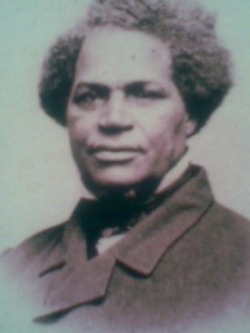
The archivists have identified another photo as Nathan Sprague, Rosetta's husband. I have not encountered any other photos of him with the possible exception of a photograph of the Douglass home on A Street in Washington, D.C., which shows two men standing in the yard, one presumably Douglass and the other supposedly Sprague. The features of both are unclear.

I first thought the portrait was of Jermain Loguen (who had a daughter, Amelia, who married Lewis Douglass, Frederick's son), who had a similarly square jaw, but the type of print and the age of the sitter suggested a younger man. Then, I saw the portraits of Rosetta's daughters. They look nothing like her and everything like this man. Also, when I got home and pulled up a picture of Loguen, I realized that they look very little alike except for a strong jawline.

Another portrait included four of Rosetta's daughters and one of her granddaughters with what appeared to be an interracial couple identified only as Mr. and Mrs. Bruce. He was too young to have been Blanche K. Bruce. The picture looks like it was taken in the parlor at Cedar Hill.

Several unidentified women appeared in the album. I wondered if one of the portraits of a white lady in a hoop skirt was Julia Griffiths.

In any case, I shall turn to their collections for several of the images for the book.