Showing posts with label Anna [Murray] Douglass. Show all posts

Monday, December 31, 2018

Amy Post visits John W. Hurn

NOTE: This post has been updated in the June 5, 2019, post "The Chair in the Photographs."

First of all, now that I have read the entire book, let me recommend Nancy Hewitt's fantastic biography of Amy Post, Radical Friend. The full review will be out whenever it gets published within the year; but just know that Post is lovely and this is a biography that she deserves.

Second, Hewitt threw in an interesting detail on page 241, mentioning that Post wrote a letter to her husband from John and Sarah Hurn's photography studio. Here is the letter from the Isaac and Amy Kirby Post Family Papers Project at the University of Rochester, written by Amy Post to her husband, Isaac, on 8 Dec 1863, from Philadelphia.:

…and now I am standing at John & Sarah Hurns shoe case surrounded by constant comers and goers, and bargain makers for pictures.

John W. Hurn was an African-American photographer and the telegraph operator who helped Frederick Douglass flee Philadelphia when news of the Harpers Ferry raid broke. Hurn received the message and, instead of bringing the news straight to the authorities, he went to Thomas and Louisa Dorsey's home, where Douglass was staying, and told them, first. "You, no doubt, saved my life," Douglass later wrote to Hurn.

Hurn also took this quite famous photograph of Douglass in about 1862.:

Head and Shoulders of Frederick Douglass

Incidentally, that picture is dated to January 1862 because that was when he was in Philadelphia giving a speech and would have had the opportunity to visit Hurn's studio. You know what else he was doing in Philadelphia then? Dropping Rosetta off with the Dorseys -- the same Thomas and Louisa Dorsey -- to stay while she searched for a teaching job. (She did not enjoy her time with the Dorseys, but that is Chapter 7.)

That got me thinking about these three pictures of Amy Post, Rosetta Douglass, and Anna Douglass.:


Note the chair, its carving, the upholstery, the finials. That's the same chair, right? These three photographs were clearly taken in the same studio. That's not a stretch to say so, don't you think? No photographer has been attached to these images, and the most reasonable guess would be a photographer in Rochester. A good flip through a Rochester City Directory wouldn't hurt, but I confess to having not gone that far just yet. (This is only a blog post.) 

Still, if Douglass was at the Hurn studio in 1862, and Rosetta was with him, it is within the realm of possibility that she also had her picture made. Then, later Amy Post passed through and sat for her own portrait. As for Anna, she's a cipher, but if they were dropping off Rosetta for an indeterminate amount of time, could she perhaps have gone down with them and also been persuaded to sit? 

Of course, all of the question marks put this well within the realm of speculation, one for further research. Nevertheless, wouldn't that be cool if the Hurns also photographed the two Douglass women and Post? It's certainly fun to think so.

Also, note how Post says that the studio belongs to both John and Sarah?

Thursday, November 29, 2018

DAY 4: AAIHS Frederick Douglass Forum (Anna Douglass Day!)

Black Perspectives, AAIHS, Frederick Douglass Forum, 26-30 Nov 2018
Anna Douglass, Frederick's first wife, takes center stage (probably to her chagrin) in today's Frederick Douglass Forum in AAIHS's Black Perspectives.

I'd summarize, but that might defeat the purpose of sending readers over to read the post there. Suffice to say that I wanted to place Anna Douglass at the center of the story, to explain the difficulties of knowing her, and to consider ways to understand her as her, not as a projection of what she should be.  As I said on the book of face, one of her key features is that she was not and is not anything anyone else wants her to be. She was and is herself, Anna. If she did not read, let her not read. If she got frustrated and angry with her husband, let her be frustrated and angry with her husband. He probably was a lot of work on a daily basis from her point of view. If she did not want to be known -- well, I'm not letting that one go, but I do realize that was her choice. 

She will, of course, be waiting on the Other Side -- if there is an Other Side -- to smack me. Although, I sense that a withering stare was more her style. 

In any case, thank you to Keisha N. Blain, Brandon R. Byrd, and their staff for putting together this fantastic roundtable and for inviting me to be included in such illustrious, smart company. May this piece do all involved (including Anna Douglass) justice!

Tomorrow, Christopher Shell will interview Kenneth B. Morris, Jr..

Tuesday, October 16, 2018

"Engendering Douglass: The Women Who Shaped a 'Self-Made Man'" by Our Earnest Struggle

Frederick Douglass is often described as a self-made man. Yet his life was profoundly shaped by the women around him--both those who helped and loved him, and those who used and opposed him. Our guests introduce us to some of them, and discuss the challenges of recovering their stories.

Professor Leigh Fought (LeMoyne College) is author of Women in the World of Frederick Douglass (2017). She paints an intimate portrait of Douglass’s wife, Anna; searches the record for his grandmother, Betsey; demystifies his relationship with “fr'enemy” Susan B. Anthony; and explains how Ida B. Wells rekindled his activist fire.
Annette Daniels Taylor, a Buffalo-based poet and performer with Young Audiences of Western New York, talks about the art of conjuring the past. She discusses her soundwalk through the Douglasses’ Rochester and brings Anna Douglass and neighbor Jenny Marsh Parker to life.

Image: "Anna Murray Douglass" mural by Shawn Dunwoody, School 12, Rochester, NY
This interview with poet Annette Daniels Taylor and me highlights Anna Douglass from two different directions and disciplines. Imagination plays a different but crucial role in both of our work, too, as we both try to reconstruct her world within our specific crafts and with our particular goals. Although our interviews were conducted separately, we seem to be in a conversation with one another, touching on similar ideas (partly through the skill of the interviewer).

Annette Daniels Taylor's work can be found here at the Frederick Douglass Experiment. It's a beautiful and fascinating combination of poetry, history, and tourism, revealing the veils that layer a place.


Sunday, September 2, 2018

Frederick Douglass Freedom Day: What Was Anna Doing?

Still trying to make Frederick Douglass Freedom Day a Thing. After all, in Life and Times of Frederick Douglass, at the very beginning of Second Part, Chapter 2, he said, "My free life began on the third of September 1838." (A year before the Amistad saga began, incidentally.)

Last year I wrote about Frederick Bailey donning a sailor suit and hopping a northbound train, ticket and borrowed protection papers in hand.  In his autobiographies, he told of his first few days, uncertain of whom to trust or where to turn, until directed to David Ruggles on Lispard Street. At some point during that time, he wrote to "Anna, my intended wife," who arrived from Baltimore, "to share the burdens of life with me." The Rev. J.W.C. Pennington, himself a former slave, now minister, married them in the presences of witnesses on September 15, "a few days after her arrival."

September 3, the day that Frederick left Baltimore, to September 15, the day that Frederick Bailey and Anna Murray were married. Considering the time for the letter to reach Murray and that she arrived a few days before the wedding, let's say ten days elapsed there between his departure and the news that he had arrived safely. Think back before then. He said that he had decided to take his own fate into his hands three weeks earlier. That makes a month in which Anna's life hung in the balance along with her future husband's. What did she do during this time?

The one source for her side of the story comes from their daughter, Rosetta Douglass Sprague, who wrote a memoir in the early twentieth century, My Mother As I Recall Her. The similarities between this story of her mother and those told by her brothers suggest that this was the family origin story and was, therefore, of great importance to all of the Douglasses. Rosetta's emphasis on her mother's role in the origin, along with the domestic details absent from the brothers' accounts, tells quite a bit about Anna's role in the family from the very beginning.

"The three weeks prior to the escape were very busy and anxious weeks," Sprague related, going on to point out that Anna Murray had saved her earnings and that "The little that they [her mother and father] possessed was the outcome of the industrial and economical habits that were characteristic of my mother." She detailed the "feather bed with pillows, bed linen, dishes, knives, forks and spoons, besides a well filled trunk of wearing apparel for herself," and, as most brides (and their little girl daughters) would remember, "a new plum colored silk dress was her wedding gown."

What would Anna's story of September 3, 1838 look like?

Had she saved her trousseau in hopes of some unknown but much desired future with a husband and family of her own, long before she had known of this young caulker with so much swagger? Had she begun to accumulate it when she met him probably earlier that year? (Had meeting her been his inspiration for the arrangement of pseudo-freedom that he had with Hugh Auld between May and August?) Had she purchased it in those three weeks when they made their plans to go north? Had she waited until she arrived in the city and then went on a shopping spree? Perhaps not the last, since Sprague does say "brought with her." Did she sew that plum silk dress herself, knowing that it would be her wedding dress?

What was the conversation between them when he told her that he had resolved to leave? "Miss Murray, I am going. Come with me and be my wife." "Miss Murray, we cannot stay here and have a life worth living. We must go north where I -- we -- can be free." "Mr. Bailey, let's go north." "Mr. Bailey, how much longer must you put up with this?" "Mr. Bailey, we shall not have a family where you can be taken away. We shall go north were you -- we -- can be free." "Are you thinking what I'm thinking? Then, let's go."

Think also of what she, too, risked as they planned the journey. She lived in the house of a white family. As satisfied with her work as they may have been, would they have kept her on if they discovered she had helped a slave run away? Those preparations that Sprague mentioned. She must have done them in private, quietly, not arousing suspicion that anything unusual was afoot. Her mask must remain firmly in place, not showing anxiety nor joy nor trepidation nor hope.

What of that letter that she received from Frederick, notifying her of his safe arrival in New York?How many days did she have to wait for it to arrive? To whom was it addressed? Certainly not her nor her employers. Did he wait until he found the safety of Ruggles' home to send it, or did he post right away? What subterfuge did they use?

How did she herself get away? She had the money to buy the ticket. Did she have to call upon friends to hold her trousseau until she could slip away, pretending to go to market or church or on some other errand, then meet her friends to collect her baggage before she caught her own train north? How did her employers react when she did not return? What friends did she leave behind who, as her husband said of his own, "I loved almost as I did my life, -- and the thought of being separated from them forever was painful beyond expression"?

Did the people she left behind include family? Remember that she had eleven brothers and sisters, perhaps some in Baltimore. Indeed, Frederick's outing of his own identity in his Narrative, while placing them all in danger of his return to slavery, allowed Anna the opportunity to reconnect with her own family, if she had not already done so. Her younger sister Charlotte began appearing in the records after this point, and moved in with the Douglasses in Rochester in the 1850s. Was she among those whom Anna left behind in Baltimore? How did they find one another again?

As she travelled, did she worry that she might encounter some visitor to her employer's home who might recognize her and ask questions? Did her heart break for the people she left behind? Or did she rejoice that she travelled toward a husband, maybe a baby in a year or so, a home to call her own? Did she feel that she was off on a great adventure? If she did, she had no idea how much of an adventure the next forty-four years would be.

What, too, would an older, Anna, further along on that adventure, advise that younger woman, sitting on that train, speeding toward the young, unemployed and penniless man with so much potential, waiting to marry her and "share the burdens of life"?


Saturday, June 30, 2018

The Anna Murray Douglass Academy

This just in from the Rochester Democrat and Chronicle:
"School 12, which stands on the former site of the Douglass household on South Avenue, is officially being renamed the Anna Murray Douglass Academy. The Rochester Board of Education approved the measure Thursday night.... The Anna Murray Douglass Academy becomes just the fifth city school or program to be named after a woman, joining School 2 (Clara Barton), School 45 (Mary McLeod Bethune), School 50 (Helen Montgomery) and the Florence S. Brown Pre-K Center." 
As I said in my book, she wasn't anti-intellectual just because she couldn't read. She clearly wanted her children educated, and listened and offered comment on others reading aloud. She might be embarrassed at this honor, private as she was, but I hope she and her husband would be quite proud. Her children absolutely would be.

That the school stands on the site of the Douglasses' South Avenue home seems fitting. Her name is on its deed and all of her actions and others' comments about her housekeeping indicate that she took great pride in being mistress of her own house. Now, her name marks the building on its site. She is remembered in the landscape.

Might I also float a proposal? There are murals going up in various sites, including Rochester and my own home of Syracuse, commemorating Douglass. One in Rochester includes both Frederick and Anna. The Douglass children opposed Helen Douglass's plans for a memorial to her husband in Washington, D.C., believing Rochester the more appropriate place since it had been the site of his most active, abolitionist years and their family life. I would love to see a mural of the Douglass family, including the little daughter Annie, who died in 1860 just shy of her eleventh birthday. A grouping of statues might even top that.


Is there an image of Annie, you ask? Oh, yes, there is. But perhaps that should be saved for another post.

Thursday, June 14, 2018

Anna Douglass in the Smithsonian Magazine, 5 March 2018

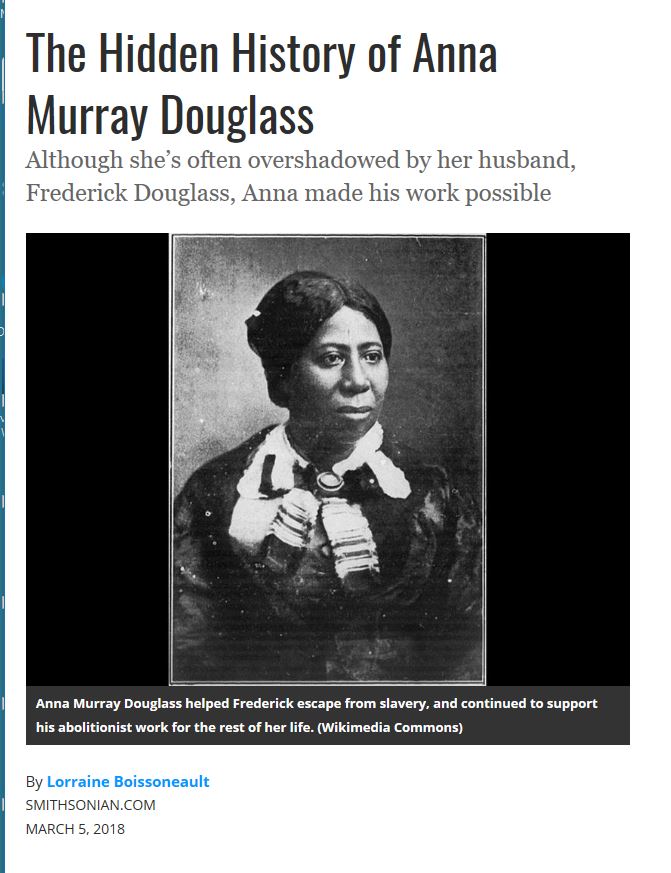
In early March, Smithsonian Magazine published an article about Anna Douglass, Frederick's first wife, "The Hidden History of Anna Murray Douglass." The writer, Lorraine Boissoneault, contacted me and Rochester local historian Rose O'Keefe (look for her talk at the Rochester Public Library this fall) to offer some insight.


Anna Douglass might have been embarrassed by all of this attention to her, but hers was a history that many women out there are so very happy to learn about. Her life mattered to many women.

Saturday, July 1, 2017

Poland Springs , 1883

Douglass spent the month of July 1883 in Poland Springs. He let his daughter, Rosetta, know that he was on his way there on 9 July:

My dear Rose: the journey in prospect gave me more trouble than in realization. It was extremely warm, but I suffered much less than I expected from smoke dust & heat. All turned out well as to making connections at New York, reached Providence promptly Sunday morning – went straight to Mrs. Greene’s & after breakfast to Miss Eddy, who without Sabbath day scruples went to work on my portrait which has been much improved since I left here five weeks ago. I shall probably leave here tomorrow for Poland Springs Please let the children at home know that I am in good care – I will write to them soon – You know when I am away from home, I am as much a part of my surroundings that I can do but very little in writing letters so you may consider as usual, no news, good news. But if anything should happen to me out of the common way it will be speedily make known through the newspapers. I shall however keep you pretty well informed as to how I am getting along. Don’t forget to tie up my daily letters & keep them securely –
                You may write to me if you please at Poland Springs.
                Love to the children all –
                Affectionately –
                Fredk. Douglass[1]

This was his destination as it would have appeared when he arrived:


Here is how it appeared in the early 20th century:


[1] Frederick Douglass to Rosetta Douglass Sprague, Providence, 9 July 1882, FDP, DHU-MS


Thursday, July 16, 2015

Who Are The People By the Bay Window?

Let's take a closer look at the picture of the bay window -- and the house attached to it.:


That appears to be Douglass there, just to the right of center, wearing the top hat. I'm guessing that is Anna there on the far right and Rosetta on the far left. I'm basing that guess on the shape of Rosetta's head as it appears here and in another picture of her from the 1860s, presuming that she still wore her hair in a similar fashion. Anna was a little more stout than her daughter, and that appears to be the case between these two women. Anna was supposed to have had darker skin, but you can never tell from photographs because of the light, exposure, deterioration of the object, and other factors that alter coloring. (I wish some of those sorts who do all of that textual reading of historic photographs could figure that out, but I digress.) 
The taller woman standing against the front door frame could be Louisa Sprague. The assorted little girls would probably be Annie, Harriet, and Estelle Sprague. If this picture was taken while Rosetta lived with her parents from 1876 to about 1878, Then Annie was between 11 and 13. Harriet was 10 to 12, and Estelle was 6 to 8. They had a sister, Alice, between Harriet and Estelle, but she had died in 1875. They also had a little sister, Fredericka, and a little brother, Herbert, ages 4 to 6 and 1 to 3 respectively. If this was taken in 1877, then the other man was the dishonored Nathan, fresh from jail in New York. 

This configuration of the household was not uncommon. There was a reason Douglass kept adding onto the house. In fact, take a look at the architecture. His granddaughter, Fredericka, later described the house as "really two connecting houses. Communicating doors were cut through the halls both up and down stairs, thus enabling the family to have desired ample space." According to her, subsequent owners blocked up the connecting doorways and the one house became two.When he moved to Cedar Hill, which was bigger than this house, he enlarged it, as well. 

The front parlor lay beyond the bay window. Fredericka said that Douglass, despite having another room dedicated to his study, sometimes annexed this room, as well. You can read Fredericka's full account of her grandfather in her reminiscences located in the Frederick Douglass Collection in the Moorland-Spingarn Center at Howard University. They are quite charming.

Wednesday, July 15, 2015

"The Bay Window is Now Finished"

I love finding little pieces in different documents that fit together like a puzzle, even if they are inconsequential.

In her memoir of her mother, Rosetta told a story about Anna Douglass's "grim humor":
On one occasion several young women called upon her and commenting on her spacious parlors and the approaching holiday season, thought it a favorable opportunity to suggest the keeping of an open house. Mother replied: “I have been keeping open house for several weeks. I have it closed now and I expect to keep it closed.” The young woman thinking mother’s understanding was at fault, endeavored to explain. They were assured, however, that they were fully understood. Father, who was present, laughingly pointed to the new bay window, which had been completed only a few days previous to their call.[i]

I had always assumed that took place in Rochester, perhaps because my research was stuck in Rochester or because Cedar Hill really doesn’t have a bay window that might fit the description, at least not on a floor where Anna might receive company.

Then I came across this letter from Louisa Sprague, who had temporarily taken the Douglass last name, writing to Frederick, who was passing through Rochester on his way back from a tour through the West. The “West” in those days meant St. Louis, Illinois, Iowa, Nebraska, and Michigan. She updated Frederick on the household:
My dear father, 
We are very sorry to here that sister Rose is so sick. Mother got a letter from Brother Nathan yesterday saying that she was very sick but he did not say what was the matter. Mother was very unease untell I got your letter to day. We were glad to here that you have left Omaha for Mother was very unease a bout you as well. the Bay Window is now finish. We have been visiting the Capitle and the house this week.  the weather has been very coal here. Mother and Miss pieran sends love to you. We had little Fred a one night with us. your daughter      
 Lou Douglass[ii] 

Charles Douglass, now living in Washington, D.C., too, looked in on the ladies and reported:
 On Sunday morning last I took mother, Miss Peirce, and Louisa to the Presbyterian Church in the large carriage. It was a beautiful day, and to day seems like spring. Ladies are out with parasols. The bay window has been completed, and is now ready for use.[iii]

Lou, incidentally, liked the carriage, especially when she could drive (but that's another story). 

The Douglasses lived neither in Rochester nor on Cedar Hill in 1873. They had just moved to A Street, NE, that June, after their house in Rochester had burned down. Louisa joined them in October (that is also another story).

This house was located just behind the U.S. Capitol, Supreme Court, and Library of Congress -- near the Folger Shakespeare Library, which would have pleased Frederick.  When Louisa says that they went to visit, they only had to walk a block or two. Frederick was in the thick of things there, and so was Anna. She had never courted the limelight or the type of upper class socializing that required holding an open house. She had things to do.

I like that Frederick was amused by her way of expression. He was a man who appreciated words and, with his love of Shakespeare, appreciated a good pun. They may have had divergent differences over the decades, but if she could make a play on words, there was something about her that he appreciated beyond her housekeeping skills.

Here is the house with the bay window back then:


Here is the house with the bay window in 2009:


[i] Rosetta Douglass Sprague, “My Mother As I Recall Her,” 1900, Family Papers, Frederick Douglass Papers, Library of Congress.
[ii] “LouDouglass” [Louisa Sprague] to FD, Washington, D.C., 31 Jan 1873, Frederick Douglass Paper, Library of Congress.
[iii] Charles Douglass to FrederickDouglass, Washington, D.C., 16 Jan 1873, Frederick Douglass Papers, Library of Congress.

Image credits: 
Historic photo of house: Frederick Douglass in Front of his A St NE Home, Frederick Douglass, Family and Groups, Photo Gallery, National Parks Service.
2009 photo of house: Me.