Saturday, June 18, 2011

Home of Jermain Loguen

In Savannah, I read many letters from Lewis Douglass, Frederick's oldest son, to Amelia Loguen, the woman who became Lewis's wife. Early in their courtship, Amelia lived in the home of her father, Jermain, on Genesee street at the corner of Pine, in Syracuse, New York. Since I went to Syracuse after I left Savannah (with a short pause in Silver Spring in between), I decided to see where all of these letters had gone.

Jermain Loguen was not just anybody in Syracuse. He was a fugitive slave who had become a minister and a leader of the black community in the city. Unlike many (and I'd venture to say most) other alleged Underground Railroad sites, his home is actually quite well documented as a haven for people escaping slavery. In fact, just the other day I read a letter that noted it as such.

Since this is central New York, and since the Underground Railroad is huge heritage tourism business, the location of his home actually has a marker:


That is him, incidentally, in the upper left corner of the image.

He is also memorialized downtown in the monument to the Jerry Rescue:
You can't really see him in this image, but he is the figure on the far side of the fugitive slave, Jerry Henry, in the center.  You know Jerry Henry is the fugitive because he is shirtless and has ripped pants. That's the uniform.

Seriously, to make a long and involved story about race and ethnicity and politics and so forth short, Jerry was a fugitive who was being returned to slavery under the Fugitive Slave Act and Loguen pretty led a large group of people who busted him out of jail, where he awaited the slave catchers, and helped him to Canada. Loguen had to take a trip there, too, for his part in the bust.

The canal, incidentally, ran behind this statue.

Getting back to the home. Loguen's home sat on the corner of Genessee and Pine, the second dot from the right on the map below:

Do you know what is there now, at the corner of Pine and Genesee, beside this sign?

This:


Thursday, June 16, 2011

Honeoye, New York

It is late, and I have been in the archive all day, drilling a dry research well. Fortunately, there is a pattern to what I am not finding.

After a disappointing day, I decided to go out to see where Helen Pitts, the second Mrs. Frederick Douglass, grew up. The drive took me off of the interstate (imagine!) and down winding highways to Honeoye.

 This is essentially the whole town, which is a hamlet, actually, complete with a sheriff ensuring that you observe the speed limit. He's the white car on the right in the distance.
 I do know that the Pitts lived along this street somewhere, but little evidence is left of that period of time in this area. So many layers of time can erode small places sometimes.

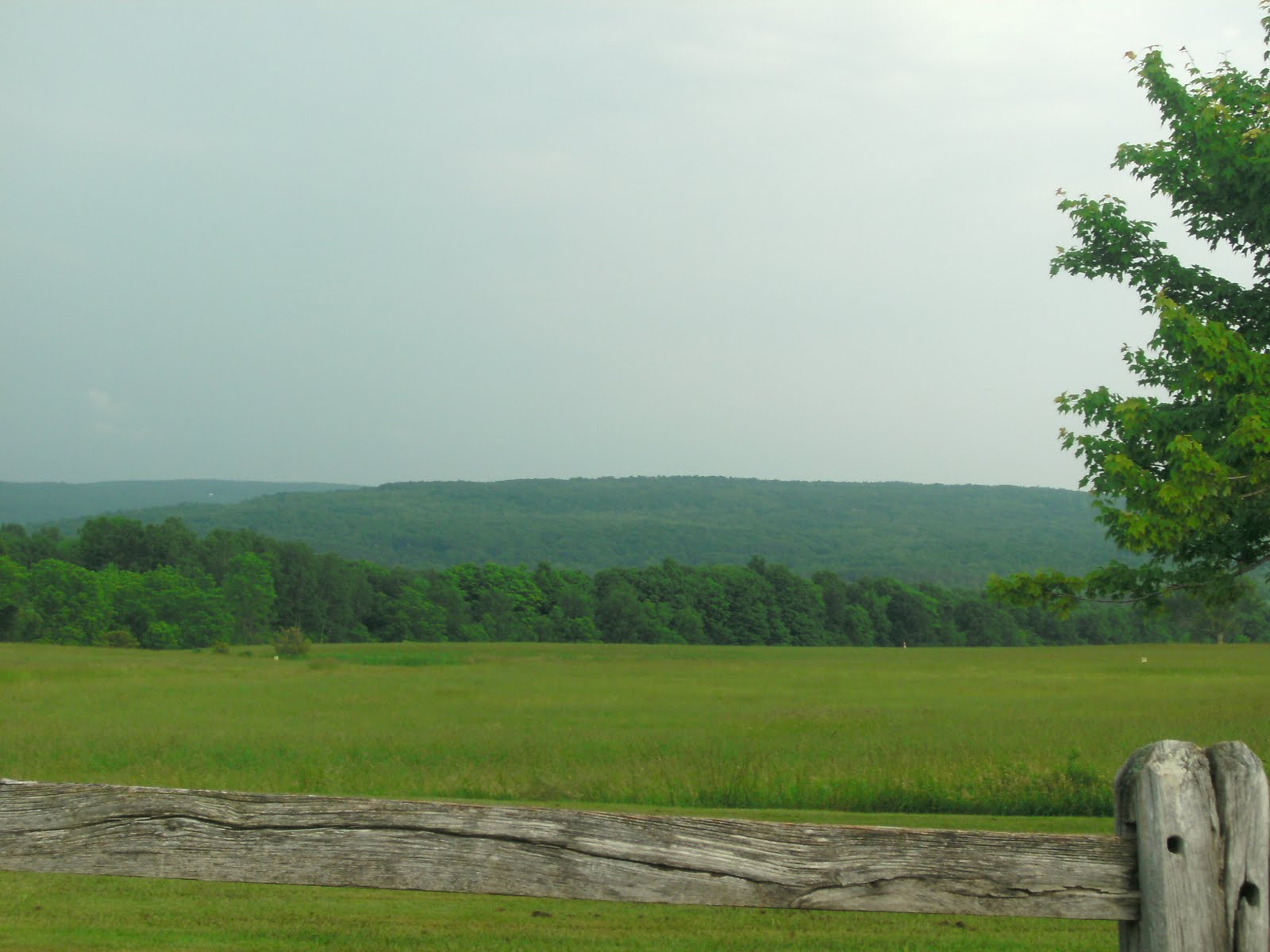
If you keep going straight down the street, you eventually go up a hill where you can find a scenic overlook. This is the view from there:

I imagine there were fewer trees then, as well.

This is a lovely, small, quiet place; but I imagine for a young woman in the nineteenth century, one with a burning to end slavery, to do good in the world, to do something at all in the world, it was much too small and much too quiet. She went to college at Mt. Holyoke, also a lovely, small quiet place.


Then, in the Civil War, she went south, into the Confederacy, to teach freedpeople in Norfolk, Virginia. After the war, she ended up in Washington, D.C. working on the women's journal The Alpha and in the Recorder of Deeds office where her boss was Frederick Douglass.  She now rests in Mt. Hope Cemetery, next to him and Anna Murray, the first Mrs. Frederick Douglass,  and not too very far from where I am researching.
 

Wednesday, June 15, 2011

Submitted for Your (Dis)Approval

Courtesy of Prof. Bob Buzzanco, University of Houston, (who would know about something like this!) via Facebook:


To be entirely pedantic, Frederick Douglass knew all about natural hair as he had a very impressive head of it.

Monday, June 13, 2011

Second Funniest Thing Found In the Garrison Family Papers

In the Garrison Family Papers at the Sophia Smith Collection at Smith College, I found a special issue of the British journal Anti-Caste.  This issue had been published in the spring of 1895 in memorial to Frederick Douglass, who had died in February. In this issue,  the editor, Catherine Impey, reprinted "Extracts from the Editor's Diary of a Visit to 'Cedar Hill,'" the visit in question having taken place in September 1892.

At one point in her week long visit, Impey described an excursion to the Art Gallery with Douglass; his wife, Helen Douglass; Helen's sister, Eva Pitts; Helen's friend, Miss Foy; and Douglass's granddaughters, Annie and Estella Sprague. "F.Douglass and six ladies," Impey parenthetically reported. Parenthetically, I am  surprised that she did not include an exclamation mark. Furthermore, on the way to the Art Gallery, they met with two other women, "a Mrs. Lee and her daughter, from Chicago (coloured)." Now, the party consisted of F. Douglass and eight ladies.

Understand that, in 1892, Douglass was 74 years old. Yet, he still had the physique to command this description from Impey as she, from her guest room window,  saw him strolling in the yard below. "What a grand majestic figure it is," she wrote. "Fine features, with a crown of white hair like the Egyptian monarchs of old." The magnetism of his youth was still present as he aged.

Yet, what struck me in this description, as in other indications of his life from the earliest accounts, including his own, was that he was surrounded by women and seemed most at ease among them. The only men who appear in this description of Impey's week at Cedar Hill were the carriage driver and Douglass's grandson, Joseph Douglass,who only appear to escort ladies off-stage. He is most jovial,  most relaxed, and most compliant around the ladies, and I am wondering why. Could this be his conservative or patriarchal streak? They are not a threat to him and generally in service (or thrall) to him; but is there something else there, something that carries me into the realm of "psychohistory"?

Wednesday, May 25, 2011

Day Four: May 25, 2011: The Coolest Thing I Found Today...

...in the Walter O. Evans' Frederick Douglass Collection, Savannah, Georgia. (Days 1-3 to follow, along with other explanations of this trip. What can I say? I've been busy in the evenings!)
The following notice became mislaid, but still hope it may be of interest to the friends of Mr. Hewlett. As announced in this column three weeks since, Mr. P. Molyneaux Hewlett made his debut, Monday evening, June 4th, as Othello, in the Union Hall, Boston, supported by excellent talent. A fair audience was in attendance, and was profuse with its applause. The role of Othello to the most experienced tragedians is one requiring their best endeavors, and is rarely played without room for criticism, and it would be a matter of surprise if a debutant should make an unqualified success at once. Mr. Hewlett’s text, gestures and movements were excellent, and in many parts the portrayal of agony exhibited a good control of his facial muscles, which is a great feature in this piece. With all kindness we would suggest a little closer attention to distinctness of tone, parts of passages being lost to the audience. The impersonation argues well for his future success, and we recommend an essay of the part in this city in the fall with the same excellent support. -- “Old Cambridge.” Old Cambridge Chronicle, 23 June 1877

A very enjoyable performance was given in Union Hall, Boylston street, last evening, the tragedy of ‘Othello’ being presented by an amateur association, assisted by several professional ladies and gentlemen. The title role was assumed by Mr. P. Molyneaux Hewlette, a colored tragedian, whose impersonation of the Moor was very favorably received by the audience. The support was, as a whole, very good, and the performance a decidedly entertaining one. -- “Othello,” Boston Herald, 5 June 1877

Mr. P. Molyneaux Hewlette, a colored gentleman, performed Othello on Monday evening, June 4th, at Union Hall, Boston. Mr. Thomas Downing [our Tom] son of Geo. T. Downing, Esq., of Newport, R.I., writes us that the performance was a decided success. The entire cast, except Mr. Hewlette consisted of white actors of recognized ability. The House was crowded, and Mr. H. was pronounced by the best critics of the ‘Athens of America’ an actor of decided ability.... Mr. Hewlette, we presume, is a son of Aaron Molyneaux Hewlette, professor and teacher of gymnastics, whom we knew well, years ago. The son, doubtless, inherits the qualities of his father, who was not only eminent in his profession, but a learned, refined gentleman; and entertaining conversationalist, of varied accomplishments and fond of music and the drama. Our knowledge of the father leads us to anticipate and desire the success of the son.-- “Colored Artists.” The Elevator, California, 7 July 1877
Yes, Paul Molyneaux Hewlett was the son of Aaron Molyneaux Hewlett, who ran the gymnasium and affiliated departments at Harvard University from 1859-1871. Paul Molyneax eventually dropped the Hewlett part of his name and became an actor in Europe. He was probably (I need to confirm this) the second black actor to portray Othello on the American stage. The first was Ira Aldridge, who also found that the prejudice of American audiences not only limited his roles but made even roles of black characters such as Othello impossible. In the 1880s, he was a member of the Fisk Jubilee Singers. He seems to be a bit of an early Paul Robeson, doesn’t he?

"What does this have to do with Frederick Douglass and women?” you may ask – I mean, aside from my belief that Frederick Douglass sounded like Paul Robeson (or James Earl Jones). Well, Paul Molineaux had a sister and Aaron Molineaux a daughter named Virginia. Virginia? She married Frederick Douglass, Jr. just after the Civil War. They had seven or eight children together. Douglass, the senior, loved Shakespeare and quoted Shakespeare about as much as he quoted the Bible. I wonder if he ever saw Paul Molineaux, his son’s brother-in-law, play Othello on stage?

“Wait a minute!” you may be saying. “Seven or eight children? How does that happen?” I submit this:
DOUGLASS – In Potomac City, D.C., on the 11th inst. Virginia Anna, daughter of Frederick, Jr., and Virginia L. Douglass, aged seven months and three weeks.

Funeral will take place at 3 P.M. to-day from the residence of the parents.--"Died”, [no source], [n.d.]

According to the family tree on Library of Congress Frederick Douglass Papers webpage, Frederick, jr., and Virginia had seven children: Frederick Aaron, Jean Hewlett, Lewis Henry, Maud Ardelle, Charles Paul, Gertrude, and Robert Small. No Virginia Anna. Perhaps she died in infancy? A quick look in Ancestry.com turns up nothing.

Poor Virginia Douglass herself died in 1890 after a long illness. Influenza had hit the Sprague family just before her death, but she had been sick before then. I don’t currently have any information that might indicate what this illness was. Puerperal fever? Cancer? Some deadly virus? Her husband wrote to Helen Douglass, his father’s second wife, “Virginia was my all.” Their son Charley, the third youngest, “tried” his father with what could have been his own coping mechanism for a dying mother, his “habit of running away."

Not too long after – not an uncommon nor shameful act -- Frederick, jr., married Laura Antoinette Haley. They had a son, Haley George Douglass, in 1891 (November, if I am not mistaken). Haley went to Harvard University and was eligible for the draft in World War I. He and his wife, Evelyn, seem to have had at least one son, Joseph J., who was born around 1920. (Obviously, the Douglass family began to have access to birth control in the generation of Douglass’s grandchildren.) Census records are not available after 1930, but he seems to have died in 1865. Lewis Douglass, who compiled much of the collection in which I am researching and who had no children of his own, left these papers to Haley. He had them as late as 1950, which I know because I found a document signed by him and dated 1950 in the scrapbook that contained these items.

That’s where the trail ends. For now. Perhaps his grandchildren or great-grandchildren, who would be my own age, are still in the D.C. area? Or, perhaps, the fact that this collection was for sale means that this family line ended sometime in the past 70 years.

Thursday, May 5, 2011

Seems It Actually Was a Wig

I found an original print (but not the negative) of Anna Douglass's portrait:

The Frederick Douglass Collection at the Moorland-Spingarn Center of Howard University has a lovely series of photographs, including the carte de visite of this image. Looking closely at Anna's hairline in the image (which is much easier when the object is actually in your hand), you can see that the part of her hair rests just a fraction above her scalp and does not meet her forehead. Is her hair braided underneath, or cut close? Was she balding? In the actual photo, you can see that the material of her dress is overlaid with lace, and she seems to have a watch chain fixed near her lapel. So, how did this hairstyle fit into her presentation of herself?

Also, the image is not as early as I expected. She appears so young in this picture that I had assumed that it was taken in the 1840s. Of course, I was also assuming it was a daguerreotype. The carte de visite in the collection at Howard was dated 1874. 

The collection also contains and amazing photo album filled with pictures of Douglass children, grandchildren and great-grandchildren, and I must have spent the entire afternoon absorbed in the images. One photo showed a very young Rosetta Douglass at maybe 10 years old, with two little ponytails. Another showed a very angry and equally terrified girl of about 1 who, as the images in the album advanced, grew into a lithe young woman and mother of a baby in a later photo. They were one of Rosetta's daughters and grandchild.

The archivists have identified another photo as Nathan Sprague, Rosetta's husband. I have not encountered any other photos of him with the possible exception of a photograph of the Douglass home on A Street in Washington, D.C., which shows two men standing in the yard, one presumably Douglass and the other supposedly Sprague. The features of both are unclear.

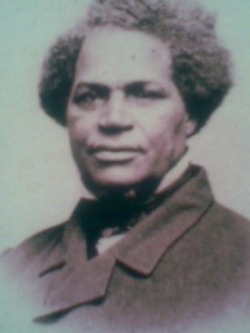
I first thought the portrait was of Jermain Loguen (who had a daughter, Amelia, who married Lewis Douglass, Frederick's son), who had a similarly square jaw, but the type of print and the age of the sitter suggested a younger man. Then, I saw the portraits of Rosetta's daughters. They look nothing like her and everything like this man. Also, when I got home and pulled up a picture of Loguen, I realized that they look very little alike except for a strong jawline.

Another portrait included four of Rosetta's daughters and one of her granddaughters with what appeared to be an interracial couple identified only as Mr. and Mrs. Bruce. He was too young to have been Blanche K. Bruce. The picture looks like it was taken in the parlor at Cedar Hill.

Several unidentified women appeared in the album. I wondered if one of the portraits of a white lady in a hoop skirt was Julia Griffiths.

In any case, I shall turn to their collections for several of the images for the book.

Wednesday, April 27, 2011

This Months' (and I do mean plural possessive) Acquisitions

Tracy Borman, Elizabeth's Women: Friends, Rivals and Foes Who Shaped the Virgin Queen (New York: Bantam Books, 2009).
Although I confess to a shameful vice for novels about the Tudor era, I actually know nothing about the study of the period and therefore cannot judge this as particularly good or bad scholarship. It's an easy read, almost like reading a novel, but then I am reading it without the rigor that I would apply to a book for serious research. This book sits half in and half out of the research category. The contents themselves won't help the Douglass book, but the way she crafts her narrative does.

Marla Miller, Betsy Ross and the Making of America (New York: Harold Holt, 2010).
How could I not? I still have my children's chapter book biography of Ross that I got back in grade school when my interest in women's history was obvious. Again, nothing to do with Douglass, but I am interested in the way she uses both biography and women's history to explain the American Revolution. I also like books that investigate mythical figures in order to find the historical person.

Ancestry.com membership.
Yes, it was expensive. Nonetheless, I now have online access to all sorts of public records used by genealogists, including those in the UK.

Permission to research in a private collection of Douglass documents.
Dr. Walter O. Evans of Savannah, Georgia, is allowing me to conduct research in his collection of Douglass documents next month. Stan Deaton of the Georgia Historical Society kindly vouched for my scholarship. Stan directed the amazing NEH Summer Workshop, African American History and Culture in the Georgia Lowcountry, that I attended last year. If you can, you should apply for it next year.

NEH Summer Stipend
The NEH will fund my research in western New York for two months this summer. Your tax dollars at work, so many thanks for filing.

Monday, April 4, 2011

Chapter 2 Has Left the Building!

The "shitty first draft" of my first completed chapter of Frederick Douglass's Women is now finished!

Yes, the title of this post says "Chapter 2," and it is the second chapter of the overall manuscript. No one says you have to write the thing in order, right?

When I wrote the public talk that I gave at Le Moyne and Montgomery Colleges, I had envisioned the first near half of it as being "Chapter 2: Anna Murray, Mrs. Frederick Douglass." Then I agreed to submit the paper for a workshop at SUNY-Binghamton. As I revised the colloquial language out and added more detail in, I found that the first chunk grew longer and longer and longer. "This is becoming a chapter as I write," I thought. So, I lopped off the last part, and committed to the chapter. 

Now, it's done and ready to enter the workshop ring this Friday!

Even better, parts of other chapters are written, as well.

Tuesday, March 22, 2011

Events at Montgomery College, Takoma Park, MD

In my capacity as Women's Studies coordinator at my campus, I am able to host various lectures. In the next week, we will be having two.

On March 24th, poet and author Marge Piercy will discuss her book Sex Wars: A Novel of the Turbulent Post Civil War Period. A reception and book signing will begin at 7:00 pm in the lobby of the Cafritz Arts building, and her lecture will begin at 7:30 pm in room 101. Her website is: http://www.margepiercy.com/.


Next Monday, March 28th, Montgomery College English and Women's Studies Professor Rita Kranidis will give her talk "Painting Beauty: Christina Rossetti and the Pre-Raphaelites," from 2-4 pm in the Commons Building, room 211.

 If you are in the area, these lectures are free and open to the public!