Monday, August 8, 2011

Bad Research Day

I started the day off by posting this on Facebook:
Off to the Archives of American Art. What I hope to find: salacious details of Ottilia Assing's forbidden love for Frederick Douglass. What I will probably find: leads on 19th century artists' addresses, the status of her dogs, and various travelogues, but not a dang thing pertinent to Douglass. All in German. Still, it is Ottilia, and she is usually a chatty correspondent.

I was so naive 12 hours ago.

The Archives of American Art is very easy to find, just a block down 9th Street from the National Portrait Gallery and Gallery Place/Chinatown Metro stop. The archivists -- all painfully young -- are friendly and helpful. The young woman working the manuscripts reading room had even processed the Sylvester Rosa Koehler Papers in which the Ottilia Assing letters were located. Plus, the whole design of the space looked like a modern art gallery. Very cool.

The box was big, not one of those grey Hollinger boxes, but a cube-ish file box with lots of folders. The Assing folders have several letters each, and each letter is 3-5 pages long and in superb condition. This was going to be awesome. Sure, I expected them all to be in German, and that I would be transcribing German all day to translate later. I have about three words of German -- at least one of which is obscene -- but a general knowledge of the grammar and syntax that, with a dictionary and a translation website, could help me get the gist of the contents. I've done it before with the Karl Varnhagan von Ense finding aid. Plus, from her letters in English, I know Assing's hand writing is quite legible. Here is an example from the Library of Congress:
http://memory.loc.gov/mss/mfd/04/04003/0017d.jpg

Not bad, right? Nicely shaped, no smudging, clearly delineated words. You can read it, which is not always the case. Gerrit Smith is a legendary case in point.

Her German handwriting is not quite as good. It's neat, that is certain, but the shapes of her letters made me wonder if I were not perhaps reading Russian. I spent thirty minutes deciphering the words "Hoboken" and "Rochester" -- and I'm still not certain that "Rochester" actually does say "Rochester." The jumble of letters that seems to say “Linber Hnow Rouflar!” may or may not actually say "Liebe Herr Koehler!" I read over another series of linked loops at least ten times before I realized that it said "Douglass." It looks like it says "Largfuff." Don't ask me how I managed to decipher the shape that spelled out "Washington."

In fact, I began to make a list of squiggles that I had deciphered:
  • What looks like Hobuknn is Hoboken
  • What looks like Rosfuflao is Rochester
  • Hs look like Wz
  • Small h looks like and f – loop above and below
  • T is never crossed
  • Capital S looks like cursive S, so does Capital A
  • Little e looks like tiny capital E or r
  • “ist” looks like Ift
  • Little p has a definite loop at the front like a p, but backbone goes above the loop
  • W looks like NB
  • Baltimore looks like “Lultimoon”
  • Greetings look like: “Linber Hnow Rouflar!” but might be “Lieber Herr Koehler!” Or “lieben Herr Koehler!” or “Liebe Herr Koehler”
  • Closings look like “Tpen Ottilie Assing”

In fact, Ottilie Assing actually looks like "Ollilir Affug."

Even with legible writing in English, you have to sometimes spend a little time over a word, comparing its loops to similar loops elsewhere in the document, discerning a few letters and playing with their sounds in your head and with the context of the rest of the sentence before the word suddenly appears to you, like one of those hidden pictures so popular in the early 1990s. That, however, requires agility with the language and familiarity with the shapes of the letters. In this case, the shapes of her German letters are not like the shapes of her English letters; and I, with my three years of high school and one semester of college German (which stuck with me longer than my six semesters of college French, but c'est la vie), all taken when leg warmers were still in style, cannot play with the shapes and sounds and make anything appear. Even the simple words that I do know, like "ein" and "ist" and "und," took me at least ten minutes to pick out.

"Ach, scheiss," I said, over and over and over. "I am totally effed." (Except I used another word, and I don't know the German for it.) How on earth am I going to get through this? I can't even transcribe them at this point. A shortcut occurred to me, that I could just use Maria Diedrich's Love Across Color Lines and cite these types of documents "as quoted in." Except I hate when historians do that. It's a graduate school trick, and casts doubt upon your argument because you never know if the person who quoted the passage originally quoted it in proper context. You have to see the quotation in context, and the context might give you so much more information.

That is, if you can actually read the context.

Also, in this case, while I'm not challenging Maria Deidrich's interpretation, I am questioning some of the finer points and I can't even really question in my own head, much less in print, if I can't read the letters she read and on which she based her arguments.

Now, if there were only some way I could trace out Assing's handwriting and puzzle over it on my own or with someone who has a better reading knowlege of German. If there were only some way that I could duplicate the image. If there were only some way in which I could blow that image up or shrink it down. If there were only some way that I could do this without paying a quarter per page.
Hmmmmm....

Friday, August 5, 2011

Frederick Douglass Hall

In my research yesterday, I came across this letter, dated 4 May 1934:
My dear Friends:
It was pleasant to receive your telegram expressing appreciation of the University’s action in naming its new classroom building after your distinguished grandfather. We are sorry that the notice reached you too late for your attendance. I am happy to report to you that the dedication was well attended, that many eminent persons were present, including six members of the Douglass family. For your full information, I am sending you, herewith, a copy of the University’s news release of the occasion.
With cordial regards and best wishes, I am
Sincerely yours,
Mordecai W. Johnson
What building had been named after Frederick Douglass, might you ask? This one:


The Frederick Douglass Memorial building on Howard University campus, right across the quadrangle from the library in which I was sitting while reading that letter and in front of which I ate lunch (because the Moorland-Spingarn closes for lunch) all week.

Now, I find that I absolutely must locate (wherein "absolutely must" means "it would be cool, but not really necessary except for fun") "L'ouverture Terrace" in Takoma Park. Rosetta Douglass Sprague, Frederick Douglass's daughter, had a home there in the 1890s. Since I have worked in Takoma Park for the past 4 years, finding her home might be rather interesting. If the same house is standing, then I might be able to ascertain the style of living enjoyed by her family at that point in time. Her husband, after all, was supposed to have been a former slave and had to struggle for survival (and respect) in the aftermath of Emancipation and the rise of Jim Crow. That's a story that I'm still trying to tease out.

The "dear Friends" to whom this letter was addressed, Hattie B. Sprague, Fredericka Douglass Perry, and Rosabelle Sprague Jones, were three of Rosetta and Nathan's five children.

Wednesday, August 3, 2011

Douglass and "Johnny Come Down to Hilo"

In one of the three versions of Fredericka Douglass Sprague Perry's reminiscences about her grandfather, Frederick Douglass, she wrote about one of the games that Douglass played with the grandchildren when they were young. He would lead them into the dining room at Cedar Hill to the music of his violin, then teach them "songs of the rollicking slave urchins he had learned as a slave boy." She transcribed two of them, and one of them seemed surprisingly familiar to me, hearkening back to my days at Mystic Seaport:
Oh John Low! Johnny went down the hi-lo!
Went down the hi-lo to get some gin,
Johnny went down the hi lo!
Drank so much he tumbled in,
Johnnie went down the hi-lo!
This actually sounds very much like an old sea shanty, work song, that has been transcribed this way:
Never seen the like since I been born
An Arkansas farmer with his sea boots on
Johnny come down to Hilo, poor old man
Wake her, shake her
Wake that gal with the blue dress on
Johnny come down to Hilo, poor old man

I got gal across the sea
She's a Badian beauty and she says to me…
Johnny come down to Hilo, poor old man
Wake her, shake her
Wake that gal with the blue dress on
Johnny come down to Hilo, poor old man

Sally's in the garden picking peas
The hair on her head hanging down to her knees
Johnny come down to Hilo, poor old man
Wake her, shake her
Wake that gal with the blue dress on
Johnny come down to Hilo, poor old man

My wife she died in Tennessee
And they sent her jawbone back to me
Johnny come down to Hilo, poor old man
Wake her, shake her
Wake that gal with the blue dress on
Johnny come down to Hilo, poor old man 
I put that jawbone on the fence
And I ain't heard nothing but the jawbone since
Johnny come down to Hilo, poor old man
Wake her, shake her
Wake that gal with the blue dress on
Johnny come down to Hilo, poor old man

So hand me down my riding cane
I'm off to see Ms. Sarah Jane
Johnny come down to Hilo, poor old man
Wake her, shake her
Wake that gal with the blue dress on
Johnny come down to Hilo, poor old man
Of course, you have to rearrange Perry's lyrics, remembered approximately fifty years later, to:
Went down the hi-lo to get some gin,
Drank so much he tumbled in,
Johnny went down the hi-lo!Oh John Low!
This was a work song that that could go on and on as long as the leader, who set the pace, could make up verses or as long as the task took. It has an upbeat rhythm and was good for fast moving jobs. So, the song wasn't so much a "slave urchin" song as it was a maritime working class song. The musicologist at Mystic Seaport said that it can be traced to the south, most specifically the Mississippi River, but such things did not stay in one place very long on the water, and white Marylanders did much nefarious slave trading down that way.

I imagine that Douglass learned this song on the docks and in the shipyards in Baltimore. His de facto master there owned and worked in shipyards; and before Douglass himself learned the caulking trade, he himself lived on and roamed the streets down by the wharves in Fells Point.

Douglass's daughter, Rosetta, mother of Fredericka, however, did not appreciate this song and looked on in "great disgust." For Douglass, this was one of the few things that he brought from slavery, and he actually seemed to have loved all music, regardless of its origins. For Rosetta, however, this song (even if the "shake her" part were omitted) was undignified, with shameful and low-class connections from which she seemed to have wanted to distance herself. For the grandchildren, it was a rollicking song taught to them by their grandfather and they, two generations removed from slavery, saw no degradation in it.

For your enjoyment, and to illustrate the song, here is a video of shantymen Fisherman's Friends singing:


I'd be curious to know if the other song that Perry transcribed sounds familiar to anyone:
Oh Suckey Susan lend me a string
Oh lend me a string to tie my shoe,
A cotton string – it will not do,
A cotton string is like miss Lou (an aunt of ours)
A cotton string will break in two
A cotton string – a cotton string –
Oh do, oh do, oh do Mr. Babcock do!


Source: Box 28-4, Folder 88: Sprague, Rosetta Douglass, Notebook 1886, Frederick Douglass Collection, Moorland-Spingarn Research Center, Founders' Library, Howard Univeristy, Washington, D.C.

Sunday, July 24, 2011

Clements Library

For the past week, I have been researching in the Clements Library at the University of Michigan in Ann Arbor. The collection that I'm visiting is the Rochester Ladies' Anti-Slavery Society Papers. I originally thought that this collection was in Rochester at the Rush Rhees Library, where I have been for the greater part of the past month. The reason I was under this mistaken impression? Well, a biographer listed it as being there in a bibliography. Fortunately, another bibliography in another book cleared that all up, and here I am.

Much of my research these days has not turned up much meat. Most of the letters to or from Douglass have been published. Many of the letters about Douglass are fairly well known. Most of the current work has more to do with finding more clues to more clues, but also filling out the stories of the women beyond their interaction with Douglass, placing them within a community and thereby opening up the context of Douglass's story. I'm trying to say more in this book than simply, "Douglass did this -- and these were the women there -- and Douglass did that -- and these were the women there." That's boring. That's note taking. I want to expand this story about the gender interactions within the abolitionist movement both in public and in private. Or something like that. It will sound more eloquent in the book.

Which reminds me: The scholarship around the public/private division of "separate spheres" has been slowly erasing that line, showing how that was not the way most women lived their lives. I think the divide was much more a male experience, if any one experienced it at all. In what I am studying, Anna Murray Douglass (the first Mrs. Douglass) was probably the most exemplary of a fully private life, with several caveats, of course. Douglass seemed to prefer as public a life as possible. Much of what he did, he did for an audience, and when he was at home, he tried to keep that locked up tightly. At least, that's what the documentation seems to say at this point. As usual, I have much more secondary work to do.

To get back to this collection, I wasn't entirely certain of what I expected it to contain,  but I didn't expect it to be this interesting. The majority of this past week, Box 1, full of correspondence, occupied my attention, and gave me an idea of the way that these women conceived of their antislavery work and some of the ways that the work extended into Reconstruction.

A fascinating series of letters came from Julia A. Wilbur, a woman -- I can't say "young" or not, but she identifies herself as a "spinster" -- who took on the task of going down to Washington, D.C., to aid the "Contraband," in 1863. Eventually, Harriet Jacobs joined her, and the two of them fought government bureaucrats, Union officers, a military governor, and ordained ministers to make sure that the "contraband" had decent living conditions, education and medical attention. The narrative of the letters is itself fascinating; but more interesting is the way that she starts out calling the freed people "contraband" and "poor creatures" and attempting to impose her ideas of "civilization" on them, to calling them "the people" and listening to their needs as articulated by "the people" themselves and both responding to and advocating for them.

Box 1 also includes some notes about aiding fugitives. I use the term "notes" because clearly someone at Douglass's office carried them to the sender. In once case, the writer, William Watkins, identified the messenger as Douglass's oldest son, Lewis. These letters show just how "upper ground" the Underground Railroad actually was in western New York. They all clearly identify the sender, the recipient, and that the fugitives with the sender need money. The sender is generally in the Frederick Douglass' Paper office, and the recipient is usually Maria G. Porter (who I mentioned in the posts on the Porter family graves), treasurer of the Rochester Ladies' Anti-Slavery Society.

I finished Box 1 on Thursday, and moved on to Box 2, thinking that there would not be much in it, and that I might be able to move this show on down to Oberlin to look up Rosetta Douglass in their archives. After all, how much can you find in an account book?

Clearly I forgot Watergate Deep Throat's dictum, "follow the money." One of the aspects of the antislavery movement that often gets lost in the ideology and action is the importance of money. There were only so many antislavery dollars out there to go around, and there seems to have been huge competition for them, which became tangled in the ideology and action. Much of what the women in the movement did, too, involved raising funds. Speakers needed salaries and expenses paid, lectures required advertisements, fugitives needed aid, rendition cases has court costs, Beecher's Bibles were not cheap, and every newspaper published struggled. Activism is not cheap!

All of this is to say that I found an amazing amount of data in this second box, which contains the Society's annual reports and account book. I'm in the account book, which, incidentally, required me to figure out how account books work (if you know me in the physical world, then you know that I am famed for my inability to understand numbers). The account book shows speakers' fees, the cost of renting a hall for the speakers, the amounts taken in at fairs both from foreign and from domestic goods (which will figure in with my analysis of Julia Griffiths, if I can round it all out with the same from the American Anti-Slavery Society), and the amounts given to fugitives or to bury fugitives who died.

Between the account book and the correspondence, however, you can see that these women saw their primary task as aiding not Frederick Douglass but enslaved -- or formerly enslaved - people themselves. They deployed the same networks and methods as emancipation advanced, sending an agent into the South, as they had when they provided railroad tickets, clothing and funerals to those running North. I have to dive back into the secondary literature -- fast becoming my greatest weakness -- in order to see how this fits into the larger pattern of women in the antislavery movement, and the ways that they differed or modeled themselves on other women.

What I am seeing is that there is a distinct difference in the way that they conceive of their activism and the way that Douglass sees his activism, and that, sometimes, the women believe that their work is, in fact, morally superior to his. Furthermore, the more that Douglass becomes famous and moves into party politics, the less feminine his world becomes. For Douglass -- and this is just a hypothesis at this moment -- the abolition movement was much more female or, at the very least, integrated by gender. The Civil War took him into a world in which men and masculine citizenship and political action dominated his work. He was a connection and a wedge for the women and their work, and, at the moment, the number of women working with him in reform seems to decrease or their activism and organizations seem separate from him in some way that made their relationship different than before the Civil War.

Here, too, I must sort out politics, activism, and reform.

After Michigan, I'm back to Syracuse, then off to D.C. to close shop there. Then, off to Ireland until May.

Tuesday, July 5, 2011

Return to Mount Hope

I was wrong. It's definitely not the first time. Sadly, it will not be the last.

Today I went to the Rochester Museum and Science Center library to look in the Howard W. Coles collection. Coles was a resident fellow at the Museum before his death in 1996, so his extensive papers relating to his research into Rochester's African American history was donated to its library by his daughter and granddaughter in 1998. It's an interesting collection, and includes a few items related to Frederick Douglass.

That,  however, is not the point, nor what I was wrong about. You see, while I was waiting for the librarian to retrieve the papers, I started reviewing some of my notes and came across those that I took about the interments in Mount Hope Cemetery. Suddenly, some of the bits that I had transcribed without really thinking about them at the time, all came together and made sense.

Remember the Porter mausoleum? Wrong Porters. The Porters mouldering within the mausoleum were not the Porters in which I was interested and, most likely, did not keep the bones of little Annie Douglass company.

Here's a map:
I hope you can embiggen it. Down there at the bottom to the right you can find the Douglass graves. The Porter mausoleum stands out prominently in the section next to it. If you are looking for the Douglass graves, and you know that Annie Douglass had been buried with the Porters, then naturally, you assume that the Porter mausoleum is the place. The lack of names other than "Porter" does not disabuse you of that assumption.

That section, however,  is Section S. In the interment records, the Porters whose letters I had been reading and who figure most prominently in the Douglass story are actually buried in Section G -- or so I discovered upon my browse through my notes. Section G sits on a hill, high above a gunky green pond. So, I drove up there and started to wander about. Their graves are in spaces 65-70, not exactly helpful information when there are no clearly visible numbers on most of the plots. Nevertheless, I soldiered on because I simply had to see the right graves. As Digger told me, you can learn a lot from the graves, if you know how to read them. Not that I know, but even the wholly ignorant can pick up something from the stones and arrangement of the graves. Just wait until I get down to writing about the Douglass gravestones.

Fortunately, I didn't have to wander too far before I saw this:
The name "Farley" stood out on the tall monument.  The Porters and the Farleys were intermarried in one generation (not as oddly as the Posts, however, but that's another story), so I knew I was close. Sure enough, the graves on the far side of the monument are the Porters:
Samuel Porter was the oldest of this clan. He lived into his nineties, and the interment record says that he died of "old age." 
 His second (or was it his third?) wife was Isabella Porter. She and Samuel's daughter, Almira, ran a girls' school in Rochester:
 Samuel's son was Samuel D.  Porter, to whom Douglass gravitated as he became more invested in the use of party politics to end slavery.  Porter was also one of the people who has actual documentation recording his assistance to fugitive slaves. In 1851, when three men appeared at Douglass's doorstep fleeing the law after the Christiana Riot, Douglass turned to Porter for help in getting them safe passage to Canada on the actual railroad. Five years later, Samuel May and Jermain Loguen turned to Porter, asking him to provide a better stop than their own in Syracuse.

His wife, however, was one of the two women who will probably become prominent in the book. Susan Farley Porter was president of the Rochester Ladies' Anti-Slavery Society of which Julia Griffiths was the secretary. The RLASS asked Frederick Douglass to deliver his "Fourth of July" speech to one of their meetings. When I go to Michigan to see their papers, I will have a better idea of their activities (I hope!) and their relationship with Douglass.
Maria G. Porter, Samuel D. Porter's sister, was a governess and a boarding house keeper (as best as I can tell). She was also the treasurer of the Rochester Ladies' Anti-Slavery Society. She may have been the person who provided Julia Griffiths with a "respectable" place to live when Griffiths was accused of causing "trouble" in the Douglass household, although I'm not yet certain. I have to track down a primary source on that one. In any case, here lies Maria G. Porter:


From what I understand -- again, I need a primary source on this -- Annie Douglass was interred in the Porter family plot. A 2003 issue of the Mount Hope newsletter, the Epitaph, says she is buried with the Douglasses, but the cemetery researchers told me in answer to a reference e-mail request that she was buried with the Porters. Since Douglass and Samuel D. Porter were such close associates, since Susan and Maria were also closely allied with Douglass, and since the Porters in the mausoleum are not among the abolitionist Porters, then Annie was probably buried here.

So, what does this all tell me? I don't know. This is all a footnote of a footnote, which is what this blog is for.

Monday, July 4, 2011

The Fourth of July

Douglass gave this speech to the Rochester Ladies' Anti-Slavery Society on July 5, 1852.


Partial text.

He was thirty-four years old at the time.

By the way, Julia Griffiths thought the speech was "great!"

Monday, June 20, 2011

The Porters

Last week I spent most of my time in the Porter Family Papers in the Special Collections of the Rush Rhees Library at the University of Rochester. Much like the Garrison Family Papers at the Sophia Smith Collection, when the title is "Family Papers" they do mean "family," as in "no matter what else the family was involved in, all you are going to get out of these papers is family news." They tell you when babies are born, when babies died, who got married, who visits who, who wants who to visit, what the travel plans for visiting are, who is sick and all of the specific symptoms (there is a particularly grisly description of an operation on Samuel D. Porter's arm in one letter), putting up preserves and pickles, and the details of how various people died. Great stuff for everything but my purposes. You would never guess that this was a family at the center of anti-slavery activity in Rochester or that two of the women were officers in the Rochester Ladies' Anti-slavery Society. That is, perhaps, telling unto itself.

After spending all of my week crawling through their private lives, I thought I should honor them by paying my respects to their bones in Mount Hope Cemetery. Saturday was a lovely day for traipsing about amongst dead people; and since my sojourn in the Rochester Public Library had reached a crossroads, and the crossroads indicated that I would have to delve into the type of research that would lead to a whole other project, and since the hour was late in the afternoon,  and since I was cold and hungry, I decided to take the research into the field (or graveyard). Often, you can find interesting information in the graveyard...or so I told myself in order to not feel quite so guilty for leaving the library before it closed.

The Porter mausoleum lies not too far from the Douglass family plot, where Frederick, Anna,  and Helen are all buried. I've got some interesting information on Anna's burial, but that will have to wait for another post since this one is on the Porters. Meanwhile, this is the Porter mausoleum:


It resembles the sort of mausoleum that you find in Louisiana along the lower Mississippi in places like New Orleans. I, in fact, have ancestors and relatives buried in such structures. This type here differs in a few respects. The Louisiana sort resembles a beehive with each body sliding into a discrete compartment. When you inter a person, you open only the space for that person's coffin and slide it in. The design of the structure acts like a giant oven, especially in the Louisiana heat, and speeds decomposition. After a period of time -- a year and a day, at one point in history -- you can reuse the space by opening it up, pushing the remains of the previous occupant to the back, and sliding in another body. Modern mortuary practices and coffin construction have interfered with this process, and have created a much messier process of reusing a space, especially in the decomposition of the bodies and disposal of the coffin.

The sort of crypt like the Porters' is an open room. When a person dies, you open the door, bring in the deceased, and lay the body on a shelf, a bit like in Romeo and Juliet, but nastier and probably smellier to our modern sensibilities. You continue to do that, moving older remains to make room for newer ones. At one point in history, bodies were not placed in coffins, by lain down in shrouds, unembalmed as if the person were asleep.

Douglass,  incidentally, would have been embalmed since his body travelled from D.C. to Rochester and was present at funerals in both places. What the Porters did I do not know.

I do know that you don't see this on many mausoleums in Louisiana:

Windows. Given that there is no visible evidence of hinges to suggest a hatch or door, I'm going to guess that this was a window, probably stained glass. Whatever was there, however, has since disappeared and left an opening that the groundskeepers have covered with plywood. Any kid who has build a clubhouse out of plywood in their back yard knows what happens to plywood when exposed to the elements of sun, rain, and, in some climates, snow. It buckles:


Yes, you see cracks about the edges of the wood. What you don't see are the big, fat, buzzing flies swarming about those cracks; and the combination of the cracks and flies made me curious as to what was inside. "I wonder if I could peep in around the cracks and see anything," I thought. Then, I thought, "Of course, I don't wonder enough to actually go try to peep around the cracks and see anything." The second I had that last thought, I actually did wonder enough to go try to peep around the cracks, but I stopped myself. I stopped myself not because the wood might pop off and I would be accused of desecrating a grave, nor because the groundskeeper was nearby, nor because of any health or legal or even ethical hazard. No, I stopped myself because, if I did see something, I could never ever un-see it. I wasn't prepared to not un-see something.

You may well wonder who the Porters were and whose remains lie within that crypt? The Porters, intermarried with the Farleys and along with the Posts, were at the center of abolitionism in Rochester and supported Douglass as he broke away from the abolitionist circle in Boston. Samuel D. Porter was a businessman, a Liberty Party man, and aided fugitive slaves (I'm investigating just how, since the Douglass biographies seem to attempt to marry myth with the actual evidence). His wife, Susan Farley Porter, was the president of the Rochester Ladies' Anti-Slavery Society; and his sister,  Maria G. Porter was the Rochester Ladies' Anti-Slavery Society treasurer. Their activities in the society included rasing funds that they used to help fugitives, as well. I have to go to the Clements Library in Michigan to read those papers (a certain historian mis-cited them as being in Rochester, thus I must alter my summer plans, which will also allow me to drop into Oberlin en route to see what I can learn about Rosetta Douglass's time there).
Little Annie Douglass,  who died at the age of ten while her father was in England, was also interred in the Porter mausoleum. When she died at her home only a few blocks from the cemetery, the Douglasses had not yet purchased their own burial plot, so she was placed here in the Porters'. As far as the research staff at Mount Hope knows, she was never moved, although the Douglass family monument includes her name and dates.

But, I did not begin this post in order to indulge my ghoulish tendencies. I intended to write about the dry well of my research and what that means. Since this is only a blog, and blog posts by nature should be short, I shall save that for another post. Suffice to say for the moment is that many historians and Douglass biographers have cited the Porter Family Papers, and a single digit number of letters in particular, as containing a wealth of information about their involvement in aiding fugitive slaves. I'm not saying that the Porters did not aid fugitives. That is clearly there in the evidence. I am saying that the generalizations extrapolated from that single digit number of letters do not necessarily reflect the actual evidence in those letters, or at least represent only a cursory reading of those letters.

I think those questionable -- not wrong, just questionable -- generalizations have something to do with the way that people attempt to make "common knowledge" and evidence fit together, or to use scraps of evidence to support that "common knowledge" without questioning the creation of that "common knowledge." I'm referring specifically to such things as aid to fugitives or the Underground Railroad myths, but it can extend to a whole host of information about social history, women's history, Native American history, and African American history. In fact,  I've discovered that the most important question I ask myself is, "how do we know what we think we know?" In research, that may be the only real question, or the one that guides all others.

Sunday, June 19, 2011

Honeoye, part 2

I ended up going back to Honeoye. Saturday morning, I went to the Rochester Public Library's Local History Room to see what they might have that will help me flesh out the context of Douglass family in Rochester. I'm particularly interested in the African-American community in that area since it works into some of my understanding of Anna and her own sense of community. Sadly, very little scholarly work has been done on African-Americans in Rochester. Happily (especially for her prospects as a historian), a graduate student at University of Rochester,  Monique Patenaude, is working on this subject.

As has been happening all week, I was digging a dry well. There are patterns to the dryness that I will write about later, so dry wells are not a loss. They are, in fact, quite valuable in guiding the way to a more accurate understanding of the subject; but, as I just said,more on that later. In the process of digging this well, I came across one of those WPA Writers' Project guides, this one concerning Rochester and its vicinity. These guides are fantastic in showing historic preservation and routes of travel in the 1930s; and this one included a "tour" that brought the traveller through Honeoye. The "tour" through Honeoye mentioned landmarks: a statue to Major General John Sullivan of Sullivan's Expedition (in)fame, a historical marker for the home of Gideon Pitts, and a historical marker for the home of Captain Peter Pitts. Peter Pitts was one of the earliest settlers of Honeoye and the father of Gideon Pitts; and Gideon Pitts was the father of Helen Pitts, the second Mrs. Douglass. (I may be missing a generation in there. My copy of the biography of Helen Pitts is, unfortunately, not on  hand.)
"Maybe they are still there," I thought. I also wondered, "How could I have missed a whole statue?" Of course, missing a statue may have had something to do with the fact that I had probably not seen the entire town since hunger,  exhaustion, and traffic from road construction made me  conclude that I had seen everything when, as it turned out, I was only about half to three-quarters of the way through the village. So,  after leaving the public library,  and after making a pass through Mount Hope Cemetery to see the Porter mausoleum (I thought it only respectful after having trawled through their family letters all week -- plus,  I'm a bit of a ghoul), I turned my green machine toward Honeoye.

Now alert and also more familiar with the route than I had been two days earlier, I did not miss this sign as I entered the village:

The marker to Peter Pitts's home.

I followed the same path through the village as I had before,  but did not let traffic deter me. Beyond the road work, the street went uphill and past this house:


What should be standing in front of this house? This marker!:

"Pitts Mansion. Built 1821 by Gideon Pitts, son of Capt. Peter Pitts, pioneer settler in 1789." Also, this was the birthplace and childhood home of Helen Pitts. Whether or not the house is the actual house,  I do not know and someone more versed in architectural history, especially the architectural history of western New York, or the local history of Honeoye could probably tell me more.

I did not find the statue of John Sullivan. I'm not sure if that is good or bad. On the one hand,  Sullivan's Expedition was a nasty, genocidal bit of American history, and a statue celebrating him is not the best idea. On the other hand, with the proper signage, perhaps that nasty, genocidal bit of American history and the reasons certain people  wanted to celebrate it might be addressed. Then, my sarcasm kicks in as I think about how well such attempts have gone in places like Mystic, Connecticut, and Deerfield, Massachusetts, when the older, celebratory statues and signs met with effort to update those sites to include more complicated and current knowledge of the violent historical events that occurred there. Perhaps that is what separates heritage from history: heritage is a celebration of a particular person's or group's past, while history is an attempt to understand the intricate interactions and points of view of the past, without too much identification with any one person or group.

In any case, I find something poetic, or ironic, in the fact that Peter Pitts participated in the oppression of one group of non-white people while his granddaughter challenged the oppression of another group of non-white people. He made war, and she quite literally made love.


Saturday, June 18, 2011

Home of Jermain Loguen

In Savannah, I read many letters from Lewis Douglass, Frederick's oldest son, to Amelia Loguen, the woman who became Lewis's wife. Early in their courtship, Amelia lived in the home of her father, Jermain, on Genesee street at the corner of Pine, in Syracuse, New York. Since I went to Syracuse after I left Savannah (with a short pause in Silver Spring in between), I decided to see where all of these letters had gone.

Jermain Loguen was not just anybody in Syracuse. He was a fugitive slave who had become a minister and a leader of the black community in the city. Unlike many (and I'd venture to say most) other alleged Underground Railroad sites, his home is actually quite well documented as a haven for people escaping slavery. In fact, just the other day I read a letter that noted it as such.

Since this is central New York, and since the Underground Railroad is huge heritage tourism business, the location of his home actually has a marker:


That is him, incidentally, in the upper left corner of the image.

He is also memorialized downtown in the monument to the Jerry Rescue:
You can't really see him in this image, but he is the figure on the far side of the fugitive slave, Jerry Henry, in the center.  You know Jerry Henry is the fugitive because he is shirtless and has ripped pants. That's the uniform.

Seriously, to make a long and involved story about race and ethnicity and politics and so forth short, Jerry was a fugitive who was being returned to slavery under the Fugitive Slave Act and Loguen pretty led a large group of people who busted him out of jail, where he awaited the slave catchers, and helped him to Canada. Loguen had to take a trip there, too, for his part in the bust.

The canal, incidentally, ran behind this statue.

Getting back to the home. Loguen's home sat on the corner of Genessee and Pine, the second dot from the right on the map below:

Do you know what is there now, at the corner of Pine and Genesee, beside this sign?

This:


Thursday, June 16, 2011

Honeoye, New York

It is late, and I have been in the archive all day, drilling a dry research well. Fortunately, there is a pattern to what I am not finding.

After a disappointing day, I decided to go out to see where Helen Pitts, the second Mrs. Frederick Douglass, grew up. The drive took me off of the interstate (imagine!) and down winding highways to Honeoye.

 This is essentially the whole town, which is a hamlet, actually, complete with a sheriff ensuring that you observe the speed limit. He's the white car on the right in the distance.
 I do know that the Pitts lived along this street somewhere, but little evidence is left of that period of time in this area. So many layers of time can erode small places sometimes.

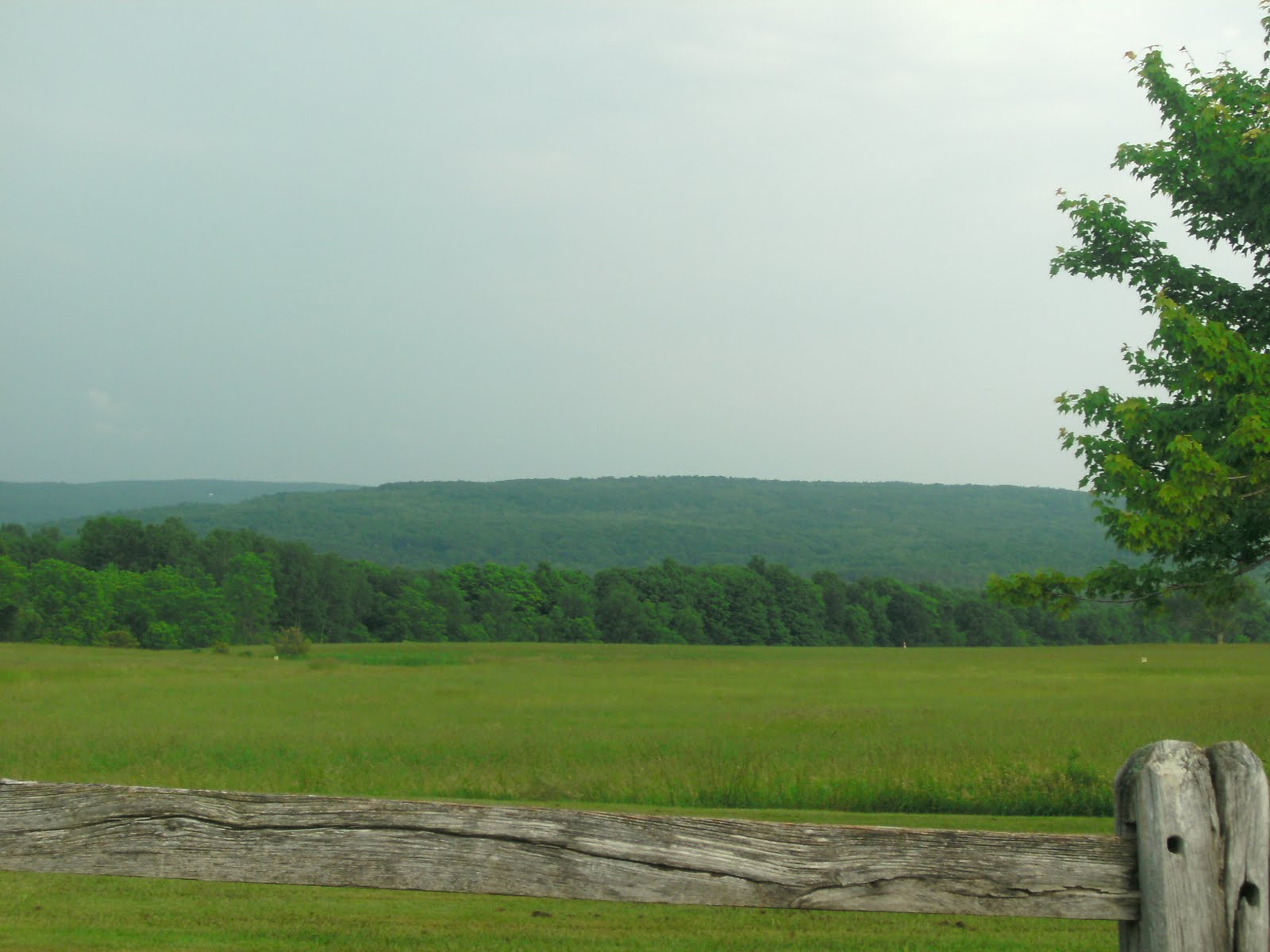
If you keep going straight down the street, you eventually go up a hill where you can find a scenic overlook. This is the view from there:

I imagine there were fewer trees then, as well.

This is a lovely, small, quiet place; but I imagine for a young woman in the nineteenth century, one with a burning to end slavery, to do good in the world, to do something at all in the world, it was much too small and much too quiet. She went to college at Mt. Holyoke, also a lovely, small quiet place.


Then, in the Civil War, she went south, into the Confederacy, to teach freedpeople in Norfolk, Virginia. After the war, she ended up in Washington, D.C. working on the women's journal The Alpha and in the Recorder of Deeds office where her boss was Frederick Douglass.  She now rests in Mt. Hope Cemetery, next to him and Anna Murray, the first Mrs. Frederick Douglass,  and not too very far from where I am researching.